AI in Accounting & Taxation: How Artificial Intelligence Is Transforming Finance for Indian Businesses
AI in Accounting & Taxation: How Artificial Intelligence Is Transforming Finance for Indian Businesses
Artificial Intelligence is no longer limited to technology companies, chatbots and automation.
It is rapidly becoming part of how businesses manage accounting, taxation, financial reporting, compliance and decision-making.
For decades, accounting has depended heavily on manual data entry, spreadsheets, reconciliations, document processing and repetitive compliance tasks.
AI is changing that model.
Today, businesses can use AI-powered tools to identify unusual transactions, extract information from invoices, automate reconciliation, analyze financial data, assist with tax research, generate reports and identify potential financial risks.
The transformation is significant enough that the Institute of Chartered Accountants of India (ICAI) held its AI Innovation Summit 2026 around the theme “Transforming Accounting, Audit, Tax, and Governance.” ICAI highlighted areas including AI, data analytics, cybersecurity, automation and the future of financial reporting and assurance.
At the same time, businesses need to understand an important principle:
AI can assist accounting and taxation, but it should not replace professional judgment, verification and accountability.
This article explains how AI is changing accounting and taxation, the benefits for Indian businesses, the risks involved and how companies can start adopting AI responsibly.
What Is AI in Accounting?
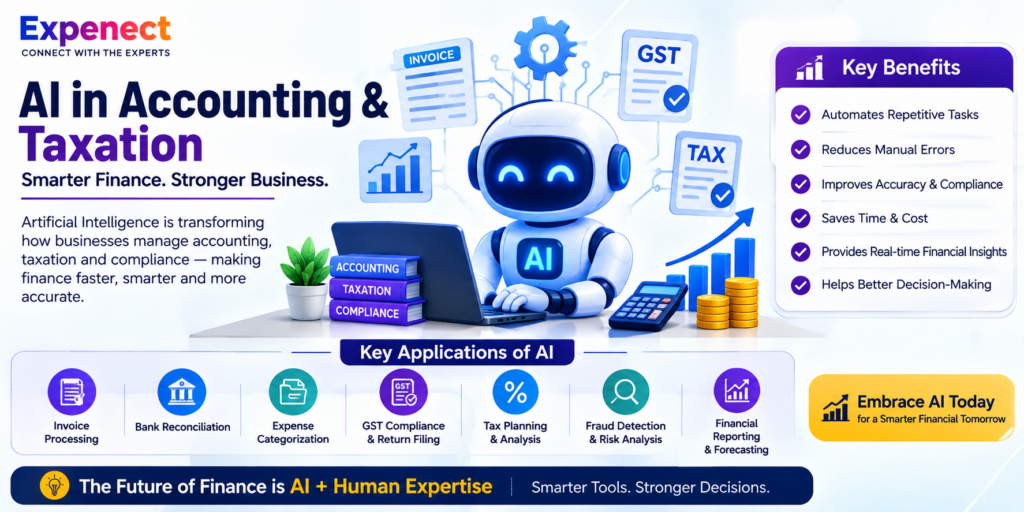
AI in accounting refers to using artificial intelligence and machine-learning technologies to automate, analyze or assist with financial processes.
Traditional accounting often involves:
Collect → Enter → Reconcile → Review → Report
AI can help transform this into:
Capture → Automate → Analyze → Flag → Review → Decide
Examples include:
- Automated invoice processing
- Expense categorization
- Bank reconciliation
- Transaction classification
- Fraud detection
- Cash-flow forecasting
- Financial analysis
- Tax-document extraction
- Anomaly detection
- Management reporting
Instead of spending hours processing repetitive information, finance professionals can spend more time analyzing the business and advising management.
Why AI Is Becoming Important for Accounting
The volume of financial information businesses generate continues to increase.
A typical business may have data coming from:
- Bank accounts
- UPI
- Credit cards
- Payment gateways
- GST systems
- E-commerce platforms
- Payroll
- Accounting software
- Invoices
- Expense-management systems
- CRM platforms
- Inventory systems
Manually processing all this information can be time-consuming.
AI can help finance teams process large amounts of structured and unstructured data more efficiently.
This is one reason AI is becoming increasingly relevant to accountants and finance professionals.
1. Automated Bookkeeping
One of the most obvious applications of AI is bookkeeping automation.
AI-enabled accounting systems can assist with:
- Transaction categorization
- Expense classification
- Invoice recording
- Payment matching
- Recurring transaction recognition
- Data extraction
For example, when an invoice is uploaded, an AI-powered system may extract:
- Vendor name
- Invoice number
- Date
- Tax details
- Amount
- Line items
This reduces manual data entry.
However, automated entries should still be reviewed according to the business’s accounting controls.
2. AI-Powered Invoice Processing
Businesses receive hundreds or thousands of invoices.
Traditionally, employees may manually enter invoice information into accounting software.
AI and OCR-based systems can extract information automatically.
Traditional Process
Invoice → Employee reads → Data entry → Verification → Accounting system
AI-Assisted Process
Invoice → AI extracts data → System validates → Exception flagged → Human review
This can significantly reduce repetitive work.
3. Bank Reconciliation
Bank reconciliation is another area where automation can provide significant benefits.
AI-powered systems can compare:
Bank transactions ↔ Accounting records
and identify potential matches.
For example:
Bank transaction:
₹25,000 — ABC Technologies
Accounting record:
ABC Technologies — ₹25,000
The system can suggest a match.
Transactions that don’t match can be flagged for human review.
4. Expense Categorization
Businesses make hundreds of payments every month.
AI can learn from historical accounting classifications and help categorize transactions into areas such as:
- Travel
- Advertising
- Software
- Office expenses
- Professional fees
- Utilities
- Rent
- Employee expenses
This can save finance teams significant amounts of repetitive work.
However, businesses should establish clear accounting rules because similar transactions may sometimes require different treatment.
5. Detecting Financial Anomalies
AI can analyze transaction patterns and identify unusual activity.
For example, suppose a company normally spends:
₹2–3 lakh per month on a particular category.
Suddenly, spending increases to:
₹10 lakh.
An AI system can flag the transaction pattern for review.
Other examples include:
- Duplicate invoices
- Unusual payments
- Unexpected vendor changes
- Abnormal expense patterns
- Unusual transaction timing
- Sudden changes in customer payments
AI doesn’t automatically prove fraud.
It helps identify transactions that deserve investigation.
6. Fraud Detection
Financial fraud can be difficult to identify using simple rules alone.
AI can analyze large numbers of transactions and look for patterns that humans may miss.
Potential applications include:
- Duplicate payment detection
- Suspicious vendor activity
- Unusual reimbursement claims
- Unusual employee transactions
- Fake invoice patterns
- Unusual payment behaviour
This is particularly useful for businesses with high transaction volumes.
7. AI in GST Compliance
GST compliance generates significant amounts of financial data.
AI and data analytics can assist with:
- Invoice matching
- Transaction classification
- Exception detection
- Reconciliation
- HSN/SAC analysis
- Identifying unusual GST patterns
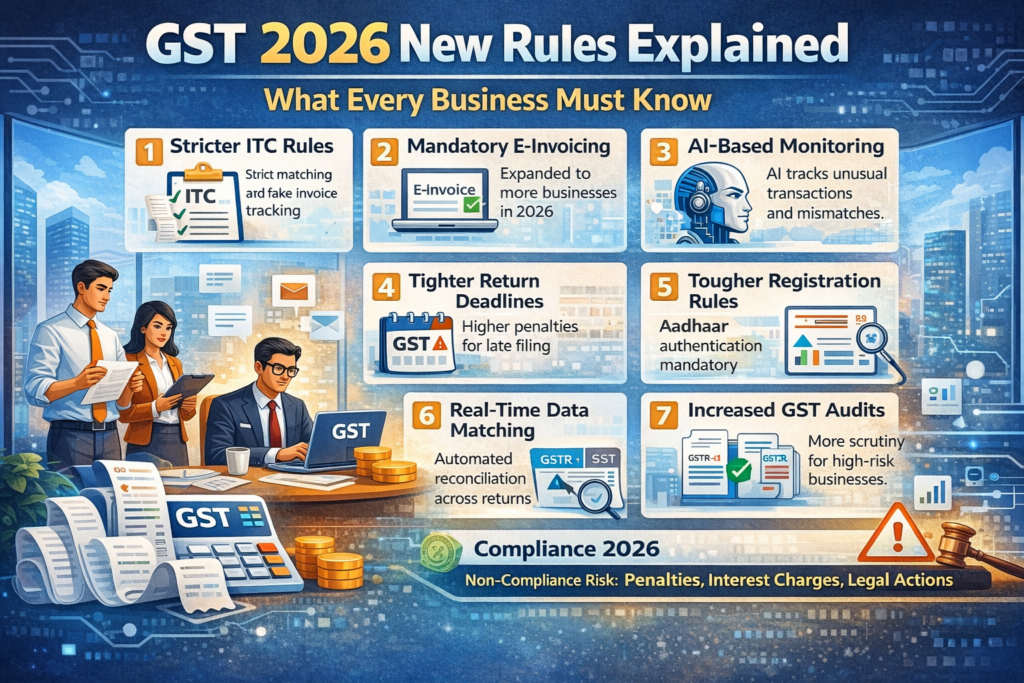
Interestingly, GSTN itself uses AI/ML in its revamped HSN search facility. The GST portal says its HSN search algorithm is linked to the e-invoice declaration database and uses taxpayer-declared information to assist users in finding relevant HSN/description matches. The portal also explicitly states that this facility is not legally binding advice.
This illustrates an important point:
AI can assist tax-related processes, but the final legal and tax determination still requires appropriate verification.
8. AI for Tax Data Preparation
Tax compliance involves collecting and organizing significant amounts of information.
AI can help businesses prepare information for professional review by:
- Extracting data from invoices
- Categorizing transactions
- Identifying missing information
- Comparing accounting records
- Organizing supporting documents
- Highlighting potential inconsistencies
This can reduce the time accountants spend on repetitive preparation.
9. AI-Assisted Tax Research
Generative AI can help finance professionals quickly:
- Summarize tax provisions
- Compare rules
- Identify relevant concepts
- Draft research notes
- Prepare questions for further investigation
- Organize large amounts of information
But this is an area where businesses need to be particularly careful.
AI-generated tax answers can be incomplete, outdated or incorrect.
The answer generated by an AI system should not automatically be treated as tax advice.
Tax professionals should verify important conclusions against authoritative legislation, rules, notifications, circulars and official guidance.
10. AI and the Changing Indian Tax Environment
AI becomes even more relevant as India’s tax and compliance ecosystem becomes increasingly digital.
India’s direct-tax framework has also undergone a major transition.
The Income-tax Act, 2025 came into force from 1 April 2026, and ICAI has published updated resources relating to the Income-tax Act, 2025 and Income-tax Rules, 2026.
For businesses, this reinforces the importance of keeping accounting and tax systems updated.
AI can help organize and process information, but businesses should ensure their software, accounting rules and tax workflows reflect the currently applicable law.
11. AI-Powered Financial Forecasting
AI can analyze historical financial data to assist with forecasting.
For example, it can analyze:
- Historical sales
- Seasonal trends
- Customer behaviour
- Expenses
- Collections
- Inventory
- Cash flow
and help generate forecasts.
A business might use these models to estimate:
Expected revenue → Expected expenses → Expected cash position
This can help management identify potential cash shortages earlier.
12. Cash-Flow Management
Cash flow is one of the biggest challenges for growing businesses.
AI can assist with:
- Predicting collections
- Identifying overdue customers
- Forecasting expenses
- Modeling different scenarios
- Monitoring cash balances
For example:
Scenario A: Revenue grows 20%
Scenario B: Revenue remains flat
Scenario C: A major customer delays payment by 45 days
AI-assisted forecasting can help management understand how these scenarios may affect cash.
13. AI for Financial Reporting
Instead of manually preparing every management report, businesses can use AI-assisted systems to generate summaries such as:
- Monthly revenue report
- Expense analysis
- Profitability report
- Cash-flow summary
- Budget variance
- Receivables ageing
- Business KPI dashboard
For example:
“Revenue increased 18% compared with the previous month, while gross margin decreased by 4 percentage points due primarily to higher direct costs.”
A management report like this can be generated from structured financial data and then reviewed by a finance professional.
14. AI Can Help CEOs Understand Financial Data
One of the most exciting applications is making financial information easier for non-finance executives to understand.
Instead of opening a complex spreadsheet, a CEO could ask:
“Why did profit fall this month?”
An AI-assisted reporting system could analyze the underlying data and identify possible contributors such as:
- Revenue decline
- Increased salaries
- Higher marketing costs
- Lower gross margins
- Increased finance costs
The CEO can then investigate the underlying figures.
This makes financial information more accessible to business owners.
15. AI for Accounts Receivable Management
Late payments can create serious cash-flow problems.
AI can help businesses analyze customer payment behaviour.
For example:
| Customer | Average Payment Time |
|---|---|
| Customer A | 18 days |
| Customer B | 32 days |
| Customer C | 67 days |
| Customer D | 85 days |
AI can identify customers whose payment patterns are deteriorating.
Businesses can then prioritize collection efforts.
16. AI for Accounts Payable
AI can also assist with supplier payments.
Possible applications include:
- Invoice matching
- Duplicate invoice detection
- Payment scheduling
- Vendor analysis
- Identifying unusual payment requests
- Cash-flow prioritization
The objective isn’t simply to delay payments.
It’s to manage supplier obligations efficiently while maintaining healthy working capital.
17. AI for Budgeting
Traditional budgeting often relies heavily on historical spreadsheets.
AI can assist businesses by analyzing historical patterns and creating scenario-based budgets.
For example:
Conservative Scenario
Revenue growth: 10%
Base Scenario
Revenue growth: 20%
Aggressive Scenario
Revenue growth: 35%
Management can then estimate how each scenario affects:
- Hiring
- Marketing
- Profit
- Cash flow
- Working capital
- Funding requirements
18. AI Can Help Identify Cost-Saving Opportunities
AI can analyze expense data and identify recurring costs.
For example:
A business may discover that it is paying for:
- 35 software subscriptions
- 12 unused licenses
- Multiple overlapping tools
- Expensive vendor contracts
AI can highlight patterns for management to investigate.
Even small savings across many recurring expenses can improve margins.
19. AI in Audit and Assurance
AI is also changing audit processes.
Auditors can use technology to analyze large datasets rather than relying only on small samples.
Potential applications include:
- Transaction analysis
- Anomaly detection
- Risk assessment
- Duplicate detection
- Pattern recognition
- Document review
ICAI’s AI initiatives specifically highlight AI’s role in accounting, audit, tax and governance.
The future of auditing is therefore likely to involve a combination of technology + professional judgment, rather than technology replacing professional judgment.
20. AI Can Improve Accounting Productivity
Consider a finance employee spending several hours each week on:
- Data entry
- Invoice processing
- Reconciliation
- Report formatting
- Document classification
Automation can reduce some of this repetitive workload.
The employee can then spend more time on:
- Financial analysis
- Business partnering
- Forecasting
- Internal controls
- Management reporting
This is one of the biggest potential benefits of AI.
AI Does Not Replace Accountants
This is an important misconception.
AI may automate repetitive accounting activities.
But accounting involves much more than data entry.
Accountants and finance professionals provide:
- Professional judgment
- Financial interpretation
- Tax expertise
- Regulatory understanding
- Risk assessment
- Audit judgment
- Business advice
- Ethical accountability
ICAI itself has emphasized the importance of professional judgment alongside AI. Its 2025 AI summit described AI as a tool to empower professionals rather than replace human wisdom.
The future is therefore likely to be:
Accountant + AI
rather than:
Accountant vs AI
The Benefits of AI in Accounting & Taxation
1. Saves Time
Automation reduces repetitive manual work.
2. Reduces Data-Entry Errors
Automated extraction and validation can reduce certain types of manual errors.
3. Improves Financial Visibility
Businesses can access financial information faster.
4. Helps Identify Anomalies
AI can identify unusual patterns that deserve investigation.
5. Supports Better Forecasting
Historical and current data can be used for scenario analysis.
6. Improves Scalability
A growing business can process more financial information without increasing manual workload at the same rate.
7. Supports Better Decisions
CEOs can receive faster insights from financial data.
The Risks of AI in Accounting
AI also creates new risks.
Businesses should not assume that an AI-generated answer is automatically correct.
1. AI Hallucinations
Generative AI systems can produce plausible but incorrect information.
This is particularly dangerous in taxation.
An AI system could provide an incorrect:
- Tax provision
- Section reference
- Deduction
- Filing requirement
- Due date
Therefore, important tax conclusions should be independently verified.
2. Data Privacy
Accounting systems contain sensitive information.
This may include:
- Bank details
- PAN
- GSTIN
- Employee information
- Customer information
- Vendor information
- Financial statements
Businesses should carefully evaluate how AI tools store, process and protect data.
Never upload sensitive financial information to an AI system without understanding its data-handling and security arrangements.
3. Cybersecurity
AI creates new technology risks.
Businesses should consider:
- Access controls
- Password security
- User permissions
- Encryption
- Audit logs
- Vendor security
- Data retention
The more financial systems become connected, the more important cybersecurity becomes.
4. Incorrect Automated Entries
Automation can make mistakes at scale.
If a system incorrectly categorizes one transaction, it may be easy to fix.
If it incorrectly categorizes thousands of transactions, the consequences can be much larger.
That’s why businesses need:
Automation + Validation + Human Oversight
5. Lack of Explainability
Sometimes management needs to understand:
“Why did the system flag this transaction?”
AI systems should ideally provide enough explanation for finance professionals to investigate important decisions.
How Indian Businesses Can Start Using AI in Accounting
You don’t need to completely transform your finance department overnight.
Start with low-risk, repetitive processes.
Step 1: Identify Repetitive Tasks
List activities such as:
- Data entry
- Invoice extraction
- Reconciliation
- Report generation
- Document classification
Step 2: Choose Appropriate Tools
Select software designed for the relevant accounting or financial workflow.
Step 3: Establish Human Review
Don’t automate critical decisions without controls.
Step 4: Protect Financial Data
Review:
- Data access
- Storage
- Security
- Permissions
- Vendor policies
Step 5: Measure Results
Track:
- Hours saved
- Error rates
- Processing time
- Cost savings
- Productivity
A Practical AI Adoption Roadmap for Businesses
Phase 1: Basic Automation
Start with:
- Invoice extraction
- Expense categorization
- Bank reconciliation
- Document organization
Phase 2: Financial Intelligence
Add:
- KPI dashboards
- Automated reporting
- Anomaly detection
- Cash-flow forecasting
Phase 3: Advanced Analysis
Use AI for:
- Scenario planning
- Customer profitability
- Predictive cash-flow analysis
- Risk identification
- Working-capital optimization
Phase 4: Strategic Finance
Integrate AI-assisted insights into:
- Budgeting
- Business planning
- Fundraising
- Expansion decisions
- Pricing
- Investment decisions
At every stage, maintain appropriate human oversight.
AI vs Traditional Accounting
| Area | Traditional Approach | AI-Assisted Approach |
|---|---|---|
| Invoice Entry | Manual | Automated extraction |
| Categorization | Manual rules | AI-assisted classification |
| Reconciliation | Manual matching | Automated matching + exceptions |
| Reporting | Spreadsheet-heavy | Automated dashboards |
| Fraud Detection | Rule/sample-based | Pattern and anomaly analysis |
| Forecasting | Historical spreadsheet | AI-assisted scenarios |
| Tax Research | Manual research | AI-assisted research + verification |
| Decision Support | Periodic | More continuous |
The objective isn’t to eliminate accounting processes.
It’s to make them faster, more data-driven and more scalable.
The Role of the Modern Accountant
The accountant of the future may spend less time on repetitive data processing and more time on higher-value activities.
For example:
Traditional Role
“Here is your monthly P&L.”
Modern Finance Role
“Your gross margin declined by 5 percentage points because of three cost categories. If the current trend continues, cash flow may become constrained within four months. Here are three possible actions.”
The second role is much closer to a financial advisor and business partner.
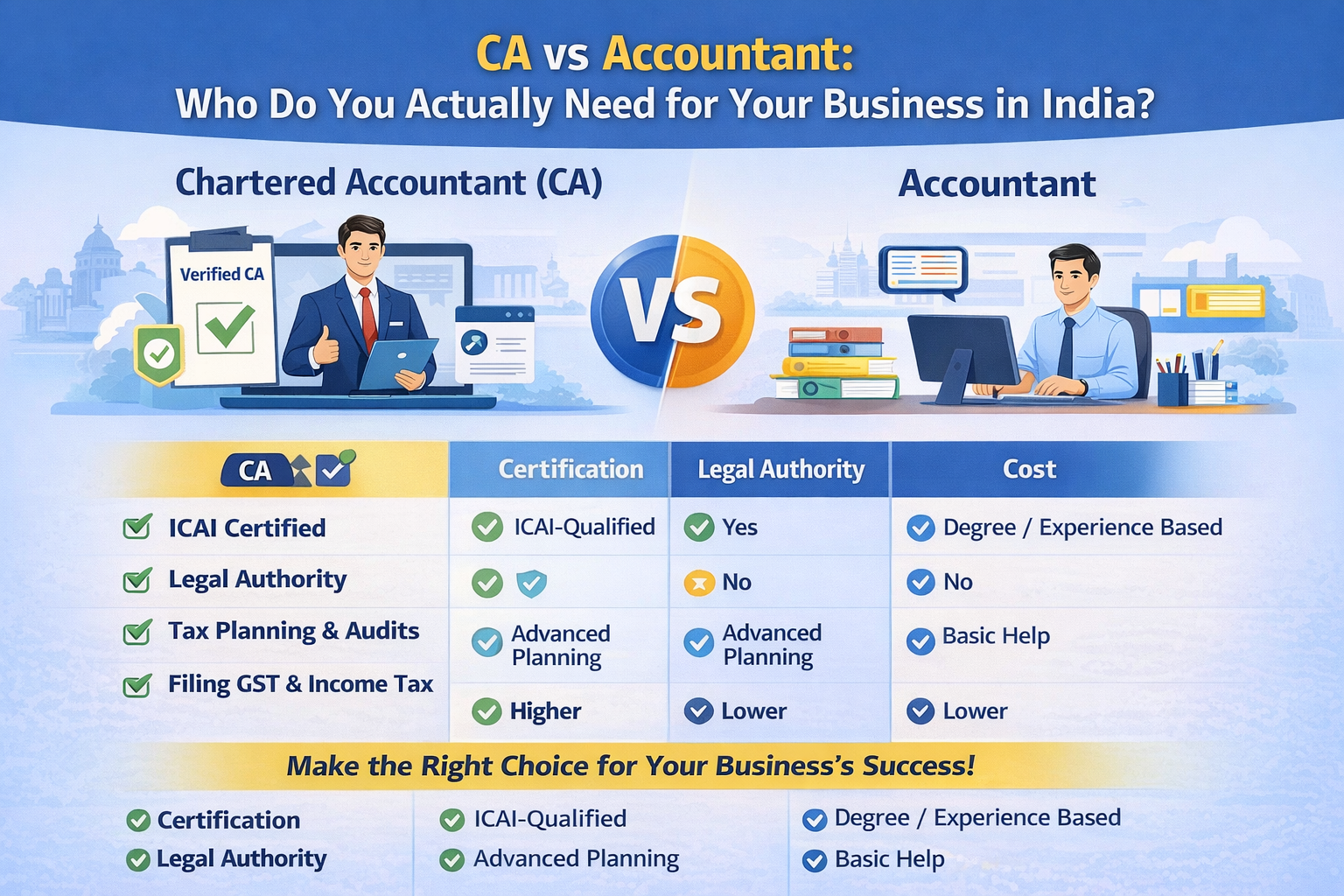
Why Businesses Still Need a CA or Finance Professional
Even as AI adoption increases, businesses continue to need professionals who understand:
- Accounting standards
- Tax laws
- Corporate compliance
- Financial reporting
- Audit
- Internal controls
- Business strategy
AI can process information.
A professional can interpret it in context and take responsibility for the advice and decisions.
This distinction is especially important in taxation, where laws and interpretations can change.
For example, ICAI currently provides resources on the Income-tax Act, 2025 and Income-tax Rules, 2026, reflecting the continuing evolution of India’s tax framework.
What Does the Future of AI in Accounting Look Like?
The future will likely involve increasing integration between:
Accounting Software + AI + Data Analytics + Automation + Human Expertise
Instead of waiting until the end of the month to understand financial performance, businesses may increasingly move toward near-real-time financial intelligence.
Imagine a system that automatically tells the CEO:
Revenue is 12% above forecast.
Gross margin is 3% below target.
Customer payment delays increased this month.
Marketing cost per acquisition increased by 15%.
Cash runway has fallen from 10 months to 8 months.
This is the direction in which financial management is moving.
10 AI Use Cases Every Business Should Consider
If you’re unsure where to begin, consider these ten applications:
- Automated invoice processing
- Expense categorization
- Bank reconciliation
- Financial report generation
- Cash-flow forecasting
- Expense anomaly detection
- Receivables analysis
- Budget forecasting
- Tax-document organization
- Management KPI dashboards
Start with repetitive, measurable tasks before moving into high-risk decision-making.
AI Accounting Checklist for Business Owners
Before implementing an AI solution, ask:
☐ What problem are we trying to solve?
☐ How much time does the current process consume?
☐ What financial data will the system access?
☐ Where will the data be stored?
☐ Who can access it?
☐ Can the AI output be verified?
☐ Is human approval required?
☐ What happens if the AI makes a mistake?
☐ Can transactions be audited?
☐ Does the solution integrate with our accounting software?
☐ Can we measure the ROI?
☐ Are our employees trained to use it?
Frequently Asked Questions
Is AI going to replace accountants?
AI is likely to automate many repetitive accounting tasks, but accounting also requires professional judgment, regulatory knowledge, interpretation and accountability. The more likely model is accountants using AI to become more productive and strategic.
Can AI file taxes automatically?
Some technology platforms can automate portions of tax preparation and filing workflows. However, businesses should not assume that AI-generated tax information is correct. Applicable requirements should be verified and filings reviewed appropriately.
Can AI help with GST compliance?
Yes. AI and automation can assist with invoice processing, reconciliation, anomaly detection and other GST-related workflows. GSTN itself uses AI/ML in its HSN search functionality.
Is AI safe for financial data?
It depends on the technology, configuration, provider and security controls. Businesses should carefully evaluate data privacy, access controls, storage, security and retention before providing sensitive financial information to an AI system.
Can small businesses use AI in accounting?
Absolutely. Small businesses can start with relatively simple applications such as invoice processing, expense categorization, reconciliation, reporting and cash-flow forecasting.
Should a CA review AI-generated tax information?
For important tax decisions, filings and compliance matters, professional review is strongly advisable. AI can assist research and preparation, but it should not be treated as an independent authority on tax law.
Final Thoughts: AI Will Change Accounting—But Trust Still Matters
AI is transforming the accounting and taxation landscape.
It can automate repetitive processes, analyze huge amounts of financial information, identify unusual transactions, improve forecasting and provide business owners with faster financial insights.
But there is an important difference between processing financial information and taking professional responsibility for financial decisions.
AI can help answer:
“What happened?”
It can increasingly help answer:
“What might happen next?”
But businesses still need qualified professionals to determine:
“What should we do about it?”
That is why the future of accounting is unlikely to be simply human versus machine.
It will be:
Human expertise + Artificial Intelligence + Reliable financial data
For Indian businesses, adopting this combination can create faster reporting, better financial visibility, stronger controls and more informed decision-making.
And as AI becomes more powerful, accuracy, data security, professional judgment and human oversight will become more—not less—important.
Need Help Modernizing Your Business Finances?
The right technology can automate repetitive accounting work. The right financial professional can help you understand what the numbers mean.
Expenect connects businesses with Chartered Accountants, accountants and Virtual CFOs who can help with accounting, taxation, compliance, financial reporting, forecasting and strategic financial management.
The future of accounting isn’t about replacing financial experts with AI. It’s about giving financial experts better tools to help businesses make better decisions.