
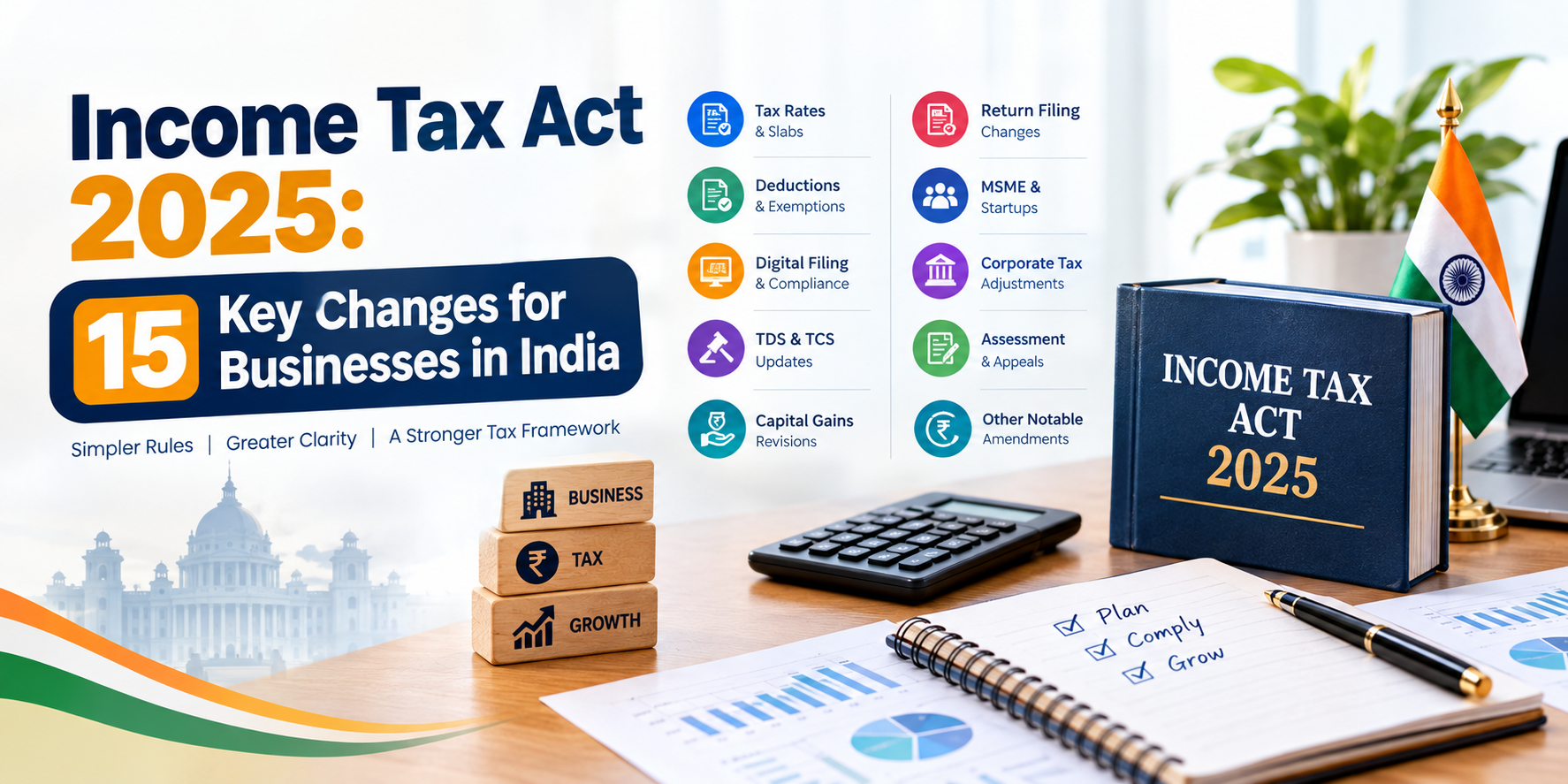
Income Tax Act 2025: 15 Key Changes for Businesses in India
India has entered a major new phase in direct taxation with the Income Tax Act, 2025, which replaced the Income Tax Act, 1961 from 1 April 2026 for tax years beginning on or after that date.
For business owners, startups, MSMEs, companies, LLPs, professionals and finance teams, the biggest change is not necessarily a completely different tax system. Instead, the new law restructures and simplifies many provisions, changes terminology and consolidates several compliance provisions.
The Income Tax Department says the new Act contains 536 sections and 16 schedules, compared with 819 sections and 14 schedules under the 1961 Act. The government says the objective is to make the law easier to understand, reduce duplication and simplify compliance.
Here are 15 important changes businesses should understand in 2026.
1. Income Tax Act, 1961 Has Been Replaced
The Income Tax Act, 2025 came into force on 1 April 2026.
However, this does not mean that all historical tax matters suddenly move to the new Act. Tax years beginning before 1 April 2026 continue to be governed by the old law, subject to the transitional provisions.
For example, income earned during FY 2025–26 is still dealt with under the Income Tax Act, 1961.
2. “Previous Year” and “Assessment Year” Are Replaced by “Tax Year”
One of the most visible changes is terminology.
Under the old system:
Previous Year → Assessment Year
Under the new Act:
Tax Year → corresponding financial year
For example, income earned from 1 April 2026 to 31 March 2027 is referred to as Tax Year 2026–27.
The Income Tax Department says the Tax Year concept is intended to remove confusion created by referring to two different years.
3. Businesses Do Not Need to Change Their Accounting Year
The introduction of the Tax Year does not require businesses to change their accounting period.
Businesses can continue following the normal April–March financial year.
So your accounting software, financial statements and internal reporting calendar do not need to be redesigned simply because the terminology has changed.
4. The New Act Is Structurally Simpler
The new legislation consolidates and reorganises provisions that had become complicated after decades of amendments.
The Income Tax Department states that the Act uses more tables and formulas, incorporates explanations and provisos into provisions and removes redundant or obsolete provisions.
For businesses, this can make tax research and compliance easier—but professional interpretation may still be necessary for complex transactions.
5. TDS Provisions Are Consolidated
TDS compliance has been significantly reorganised.
Instead of navigating numerous separate TDS provisions, the new Act consolidates TDS provisions into Section 393, with tables covering different categories of payees and payments.
Importantly, the Income Tax Department says the TDS rates and monetary thresholds have generally been retained, so consolidation should not automatically be interpreted as a change in tax rates.
Businesses should nevertheless update their accounting, payroll and TDS software to use the new section references.
6. TDS Transition Depends on the Date of Credit or Payment
Businesses handling regular vendor, contractor, professional or salary payments need to pay attention to the transition rule.
For TDS, the applicable law depends on the earlier of credit or payment.
Payments or credits up to 31 March 2026 generally fall under the 1961 Act, while those occurring from 1 April 2026 fall under the 2025 Act.
This is particularly important for companies with monthly contracts and recurring vendor payments.
7. Income-Tax Return Provisions Are Consolidated
The new Act brings provisions for original, belated, revised and updated returns together under Section 263.
The fundamental obligation to file returns remains broadly similar, but businesses and taxpayers will need to use the new statutory references for Tax Year 2026–27 onwards.
Finance teams should therefore update their tax compliance checklists before the first return cycle under the new Act.
8. Presumptive Taxation Is Consolidated
Small businesses and professionals using presumptive taxation should pay attention to the new structure.
The Income Tax Department says the presumptive taxation provisions previously spread across sections such as 44AD, 44ADA and 44AE have been consolidated into Section 58 in a tabular format.
This covers eligible resident businesses, professionals and certain goods-carriage businesses.
For eligible sole proprietorships, freelancers and professionals, this can make the applicable provisions easier to locate.
9. Existing Tax Options Generally Continue
Businesses and taxpayers do not automatically lose choices exercised under the previous law simply because the legislation has changed.
The transition provisions provide that certain options exercised under the old Act are treated as having been exercised under corresponding provisions of the new Act.
This is particularly relevant when reviewing existing tax positions, approvals and elections.
10. Existing PAN, TAN and Faceless Assessments Continue
The basic tax administration infrastructure continues.
The Income Tax Department has confirmed that PAN, TAN, faceless assessment and faceless appeals continue under the Income Tax Act, 2025.
Therefore, businesses should not assume that the introduction of the new Act means they need completely new tax registrations.
11. Capital-Gains Rules Are Carried Into the New Framework
The capital-gains framework already changed significantly through amendments made from 2024, and these provisions are incorporated into the new Act.
For example, the current framework generally uses a 24-month holding period for determining long-term capital assets, while listed securities generally use a 12-month period.
Long-term capital gains are generally taxed at 12.5% without indexation, subject to the applicable exceptions and provisions.
This matters to businesses involved in investments, restructuring, sale of assets, securities or other capital transactions.
12. Buyback Tax Treatment Has Changed
For buybacks undertaken on or after 1 April 2026, the tax treatment of buybacks has shifted.
PwC notes that the difference between consideration received on buyback and the issue price is now dealt with under capital gains, rather than the previous deemed-dividend treatment applicable to earlier buybacks.
Companies considering buybacks should therefore review the transaction with their tax advisors before implementation.
13. The New Act Does Not Mean Every Business Pays More Tax
A common misunderstanding is that replacing the Income Tax Act automatically creates a new tax burden.
The Income Tax Department explicitly states that the new Act does not introduce a new tax merely because the legislation has been replaced. Its stated objective is simplification, clearer drafting and reduced compliance friction.
Actual tax liability still depends on the applicable provisions, tax rates, deductions, exemptions, income and taxpayer category.
14. Businesses Still Need to Manage the Transition Carefully
The biggest practical challenge for many businesses may be the transition between the two Acts.
During the transition period, a company may simultaneously deal with:
- FY 2025–26 matters under the 1961 Act
- AY 2026–27 return filing under the old framework
- Tax Year 2026–27 advance-tax obligations under the new Act
- TDS under different Acts depending on transaction timing
- Pending assessments and appeals under the earlier law
The Income Tax Department specifically confirms that old proceedings relating to earlier years can continue under the transitional framework.
15. Businesses Should Update Their Finance Systems
The most practical takeaway is simple: do not treat the new Act as merely a change in the name of the law.
Businesses should review:
- Accounting software
- Payroll and salary TDS
- TDS/TCS configuration
- Tax calculation systems
- Invoice and payment workflows
- Vendor master data
- ITR compliance calendars
- Tax documentation
- Contracts containing tax references
- Capital-gains calculations
- Presumptive-taxation applicability
- Internal finance SOPs
- CFO and management reporting
For startups, MSMEs, sole proprietorships, partnerships, LLPs, OPCs, private limited companies, public companies, HUFs, AOPs, BOIs, trusts and non-resident businesses, the exact impact can differ depending on the entity type and transaction.
What Should Indian Businesses Do Now?
A practical transition checklist is:
Step 1: Identify whether each tax matter relates to a period before or after 1 April 2026.
Step 2: Update accounting and payroll systems with new section references.
Step 3: Review TDS rules and transaction dates.
Step 4: Check whether existing tax options, approvals and registrations carry forward.
Step 5: Review capital-gains and investment transactions.
Step 6: Update your tax-compliance calendar from Tax Year 2026–27.
Step 7: Ask a CA, tax professional or Virtual CFO to review areas where the new provisions affect your business.
How Expenect Can Help
Understanding a new tax law is only one part of financial management. Businesses also need accurate accounting, tax compliance, cash-flow planning, financial reporting and strategic financial decisions.
Through Expenect, businesses can connect with finance professionals for areas such as Accounting & Bookkeeping, Business Financial Strategy, Financial Health Checkups, Auditing & Due Diligence, Compliance & Legal, Cash Flow & Working Capital Management and Growth & Scaling.
A professional review can help your business identify which changes under the Income Tax Act, 2025 actually apply to you rather than relying on generic tax information.
Final Takeaway
The Income Tax Act, 2025 represents a major restructuring of India’s direct-tax framework. The most important changes for businesses include the introduction of the Tax Year, consolidation of TDS and return-filing provisions, simplified presumptive-taxation provisions, revised statutory references and detailed transitional rules.
The fundamental lesson for business owners is to update systems, not panic. The new law is designed to simplify the framework, but businesses still need to ensure that their accounting, payroll, TDS, tax-return and financial processes are aligned with the rules applicable from 1 April 2026.
For complex transactions, tax planning or compliance decisions, professional advice remains important.
Source note: This article is based primarily on the Income Tax Department’s 2025 Act FAQs and transition guidance, supplemented by PwC’s 2026 tax analysis.