
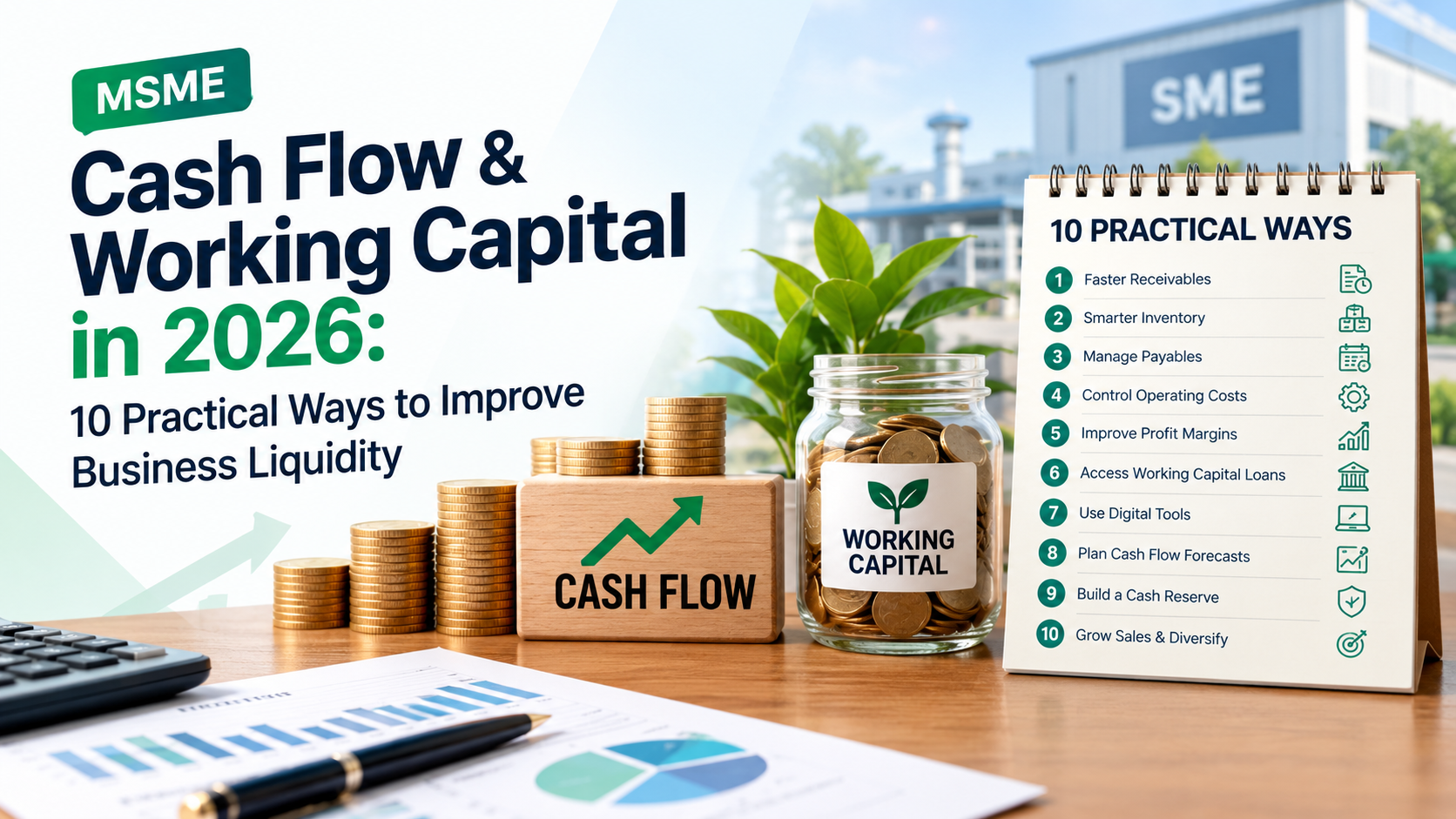
MSME Cash Flow & Working Capital in 2026: 10 Practical Ways to Improve Business Liquidity
For an MSME, profit is important—but cash is what keeps the business alive.
A company can show healthy sales and even report a profit while struggling to pay salaries, suppliers, rent, GST, loan instalments or other operating expenses. This usually happens because money is stuck in unpaid invoices, excess inventory or inefficient working-capital cycles.
The issue is particularly relevant in India, where delayed customer payments have historically been a major challenge for micro and small enterprises.
In 2026, the ecosystem around MSME working capital is changing. The government has strengthened TReDS, introduced credit-guarantee support for eligible invoice financing, and made TReDS settlement mandatory for transactions between operating Central Public Sector Enterprises (CPSEs) and their MSME suppliers.
So, how can an MSME improve cash flow in 2026?
What Is Working Capital?
Working capital is the money available to run the day-to-day operations of a business.
A simple formula is:
Working Capital = Current Assets − Current Liabilities
Current assets may include:
- Cash and bank balances
- Accounts receivable
- Inventory
- Short-term investments
Current liabilities may include:
- Supplier payables
- Short-term loans
- Accrued expenses
- Other amounts due within the operating cycle
But having positive working capital does not automatically mean that a business has healthy cash flow.
For example, a manufacturer may have ₹50 lakh in receivables and ₹20 lakh in inventory but only ₹2 lakh in its bank account.
On paper, the company may look financially healthy.
In reality, it could struggle to pay its next supplier bill.
Why Cash Flow Is a Major MSME Challenge
The Ministry of MSME has identified delayed payments as a persistent problem for micro and small enterprises. The government has consequently been strengthening TReDS and other mechanisms designed to improve the speed at which MSMEs convert invoices into cash.
The scale of India’s MSME ecosystem makes this particularly important.
The Ministry’s 2026 data shows millions of enterprises registered through the Udyam ecosystem, spanning manufacturing, services and trading activities.
For a growing MSME, cash-flow management should therefore be treated as a management discipline, not something the accountant checks only at the end of the month.
10 Ways MSMEs Can Improve Cash Flow and Working Capital in 2026
1. Reduce Your Receivable Days
One of the fastest ways to improve cash flow is to collect money faster.
Suppose your business generates ₹1 crore in annual credit sales.
If your average collection period falls from 60 days to 45 days, approximately ₹4.1 lakh less capital is tied up in receivables, assuming sales are reasonably spread throughout the year.
Review:
- Customer payment terms
- Outstanding invoices
- Overdue invoices
- Credit limits
- Customer-wise payment history
- Collection follow-ups
Don’t wait until an invoice becomes 90 days overdue before contacting the customer.
2. Create a Weekly Cash-Flow Forecast
A monthly profit-and-loss statement cannot tell you exactly how much cash will be available next Tuesday.
Create a 13-week cash-flow forecast showing:
Opening Cash + Expected Receipts − Expected Payments = Closing Cash
Track:
- Customer collections
- Salaries
- Rent
- GST and taxes
- Supplier payments
- Loan EMIs
- Marketing expenditure
- Utilities
- Capital expenditure
This gives the owner an early warning before a cash shortage becomes an emergency.
3. Use TReDS to Unlock Receivables
Trade Receivables Discounting System (TReDS) can be particularly useful for eligible MSMEs selling to larger buyers.
TReDS is an RBI-regulated electronic platform through which MSME receivables can be financed or discounted through multiple financiers. Participants include MSME sellers, buyers and financiers such as banks and NBFC-Factors.
The basic process is:
Invoice → Buyer Acceptance → Financier Bidding → Discounting → Early Payment
Instead of waiting for the buyer’s payment date, an MSME can potentially convert an eligible approved invoice into cash earlier.
In 2026, TReDS has become even more relevant because the government has strengthened its role in MSME liquidity.
The Ministry of MSME reported that invoice discounting on TReDS increased from ₹40,000 crore in FY 2021–22 to about ₹3.5 lakh crore in FY 2025–26.
4. Understand the 2026 TReDS Changes
The MSMED framework was amended in 2026 to facilitate faster payments to MSMEs.
The government has mandated operating CPSEs to route settlement of invoices for goods and services purchased from MSMEs through TReDS. The reform is intended to improve liquidity and reduce payment delays.
This is particularly relevant for MSMEs supplying:
- Government enterprises
- Public-sector organisations
- Large corporates
- Institutional buyers
If your business supplies eligible buyers, discuss TReDS with your finance team or banking partner rather than automatically treating long credit periods as unavoidable.
5. Control Inventory More Aggressively
Inventory is cash sitting on shelves.
Too little inventory can cause stock-outs.
Too much inventory can lock up valuable working capital.
Track:
- Inventory turnover
- Slow-moving stock
- Dead stock
- Reorder levels
- Safety stock
- Product-wise margins
A simple ABC analysis can help:
A items: High-value items requiring close monitoring
B items: Moderate-value items
C items: Lower-value, high-volume items
The goal is not simply to reduce inventory. It is to maintain the right inventory for the level of demand.
6. Negotiate Better Supplier Payment Terms
Working capital is affected by both money coming in and money going out.
If customers pay in 60 days but you must pay suppliers in 15 days, your business has a financing gap.
Where commercially reasonable, negotiate:
- 30/45/60-day payment terms
- Milestone-based payments
- Partial advance arrangements
- Volume-based terms
- Seasonal payment schedules
However, do not delay payments simply to improve your own cash position if it damages supplier relationships or violates contractual/legal obligations.
7. Separate Profitable Sales From Cash-Generating Sales
Not every sale improves your financial position.
A ₹10 lakh order with:
- 5% margin,
- 90-day payment terms,
- high inventory requirements
may be less attractive from a cash-flow perspective than a ₹6 lakh order with:
- 20% margin,
- 30-day payment terms,
- low working-capital requirements.
Business owners should therefore evaluate customers using both:
Profitability + Cash Conversion
A finance dashboard should show revenue, gross margin, receivable days and contribution—not revenue alone.
8. Build a Working-Capital Reserve
MSMEs should avoid operating with every rupee already committed.
A practical target depends on the business model, but management should know:
How many months can the business operate if collections suddenly fall?
Maintain a liquidity buffer for:
- Payroll
- Rent
- Utilities
- Debt servicing
- Taxes
- Critical suppliers
- Emergency expenses
The appropriate reserve varies significantly between a consulting business, manufacturing company, retailer and SaaS startup.
9. Use Credit Strategically—Not Emotionally
External finance can help bridge a temporary working-capital gap.
Potential options may include:
- Cash-credit facilities
- Overdrafts
- Working-capital loans
- Invoice financing
- TReDS
- Business credit lines
- Equipment finance
The objective should be to finance productive working capital, not permanently cover an unprofitable business model.
Before borrowing, calculate:
Cost of Finance vs Expected Return on Working Capital
If borrowed money generates ₹1 lakh of additional contribution but costs ₹1.5 lakh, borrowing is not solving the problem.
10. Build a Monthly Working-Capital Dashboard
A professional finance dashboard should track at least:
| KPI | What It Tells You |
|---|---|
| Cash Balance | Immediate liquidity |
| DSO | How quickly customers pay |
| DPO | How quickly suppliers are paid |
| Inventory Days | Capital tied in inventory |
| Cash Conversion Cycle | Overall working-capital efficiency |
| Overdue Receivables | Collection risk |
| Gross Margin | Profitability of sales |
| Operating Cash Flow | Cash generated by operations |
| Current Ratio | Short-term financial position |
| Cash Runway | How long available cash can support operations |
One of the most useful measures is the Cash Conversion Cycle (CCC):
CCC = Inventory Days + Receivable Days − Payable Days
The lower the cycle, the faster the business generally converts operating investment back into cash, although the appropriate target differs by industry.
Government Support for MSME Working Capital in 2026
The working-capital ecosystem is also receiving policy support.
In September 2026, the Ministry of MSME announced that CGTMSE credit-guarantee coverage had gone live on TReDS through platforms including M1xchange, RXIL and DTX (KredX). The initiative is intended to support faster working-capital access through invoice discounting for eligible micro and small enterprises.
The Ministry reported that the guarantee can cover 75% of the amount in default, subject to the applicable limits and conditions.
This adds another layer to the MSME liquidity ecosystem involving:
- Ministry of MSME
- CGTMSE
- RBI
- TReDS platforms
- Banks
- NBFC-Factors
- Corporate buyers
- CPSEs
- MSME suppliers
What If a Customer Does Not Pay?
Eligible micro and small enterprises have mechanisms under the MSMED framework for delayed-payment disputes.
The MSME Samadhaan system enables eligible MSEs with valid Udyam Registration to seek assistance relating to delayed payments, with matters potentially proceeding to the Micro and Small Enterprise Facilitation Council (MSEFC).
The Ministry also operates an MSME ODR Portal designed to facilitate digital dispute avoidance, containment and resolution.
Businesses should maintain proper:
- Purchase orders
- Contracts
- Invoices
- Delivery proofs
- Acceptance records
- Payment correspondence
- Udyam documentation
Good documentation can become extremely important when recovering overdue receivables.
A Simple 30-Day Cash-Flow Improvement Plan
Week 1: Find the problem
Prepare an ageing report of all receivables and identify your top 20 overdue customers.
Week 2: Improve collections
Contact overdue customers, establish payment commitments and review credit limits.
Week 3: Review working capital
Analyse inventory, supplier terms, TReDS eligibility and available financing.
Week 4: Build the system
Create a weekly cash-flow forecast and monthly dashboard.
Then repeat the process every month.
How Expenect Can Help MSMEs
Cash-flow problems are rarely solved by looking at one number.
An MSME may need help with Accounting & Bookkeeping, Financial Health Checkups, Cash Flow & Working Capital Management, Business Financial Strategy, Compliance & Legal, Auditing & Due Diligence, or Growth & Scaling.
Through Expenect, business owners can connect with finance professionals who can help analyse financial performance, identify working-capital bottlenecks and build better financial processes.
Final Takeaway
For an MSME, cash flow is not just an accounting metric—it is a growth strategy.
The businesses that manage working capital well can pay suppliers on time, maintain inventory, take larger orders, invest in marketing and survive temporary market slowdowns without constantly searching for emergency funding.
In 2026, tools such as TReDS, invoice discounting, CGTMSE support, digital dispute resolution and better financial forecasting are making the working-capital ecosystem more accessible.
But technology and government schemes cannot replace financial discipline.
The best starting point is simple:
Collect faster. Control inventory. Negotiate intelligently. Forecast cash weekly. Monitor working-capital KPIs.
And most importantly, never confuse profit with cash.
For an MSME, a healthy bank balance gives the business something that a profit-and-loss statement alone cannot provide: the ability to keep operating and keep growing.