
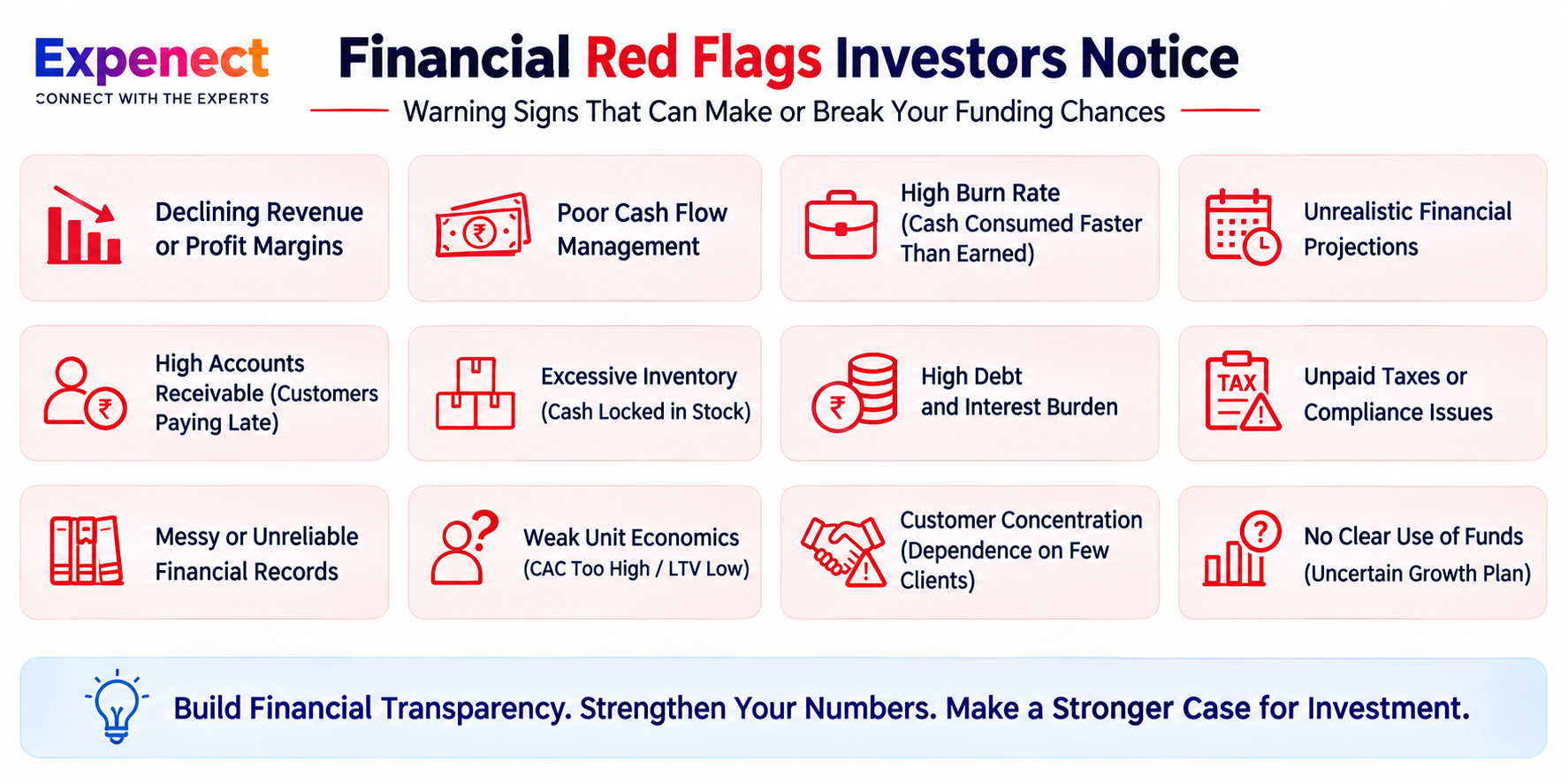
Financial Red Flags Investors Notice Before Investing in Your Business
Financial Red Flags Investors Notice Before Investing in Your Business
Raising funding can be a major milestone for a startup or growing business.
You may have an excellent product, a strong team and an impressive growth story. But when investors start evaluating your business, they don’t look at your pitch deck alone.
They look at the numbers behind the story.
Investors want to understand whether your business is financially healthy, whether its growth is sustainable and whether their capital can generate an attractive return.
A company reporting ₹10 crore in revenue may look impressive. But if its margins are collapsing, customers aren’t paying on time and the business is burning ₹1 crore every month, investors will want to know why.
This is why financial due diligence is such an important part of fundraising.
In this guide, we’ll explore the major financial red flags investors commonly notice before investing in a business—and what founders can do to address them.
Important: The specific information investors request varies by company, industry, transaction and funding stage. This article is an educational guide, not investment, tax or legal advice.
What Is Financial Due Diligence?
Financial due diligence is the process of examining a company’s financial information before an investment or transaction.
Investors may review:
- Revenue
- Profit and loss statements
- Balance sheets
- Cash flow
- Bank statements
- Tax filings
- GST records
- Accounts receivable
- Accounts payable
- Debt
- Cap table
- Financial projections
- Customer concentration
- Major contracts
- Related-party transactions
The objective is to determine whether the company’s financial position matches what management has presented.
Why Financial Red Flags Matter
Investors understand that startups don’t always have perfect financials.
A young company may not yet be profitable.
That’s not necessarily a problem.
The bigger concern is whether the founder understands the financial situation and has a credible plan to improve it.
For example:
Company A
- Revenue growing 60%
- Gross margin stable
- Cash burn understood
- Clean accounting
- Realistic forecast
- Clear use of funds
Company B
- Revenue growing 70%
- Gross margin declining
- Unexplained expenses
- Overdue taxes
- Poor bookkeeping
- Aggressive projections
Even though Company B is growing faster, Company A may appear considerably more investable.
1. Inconsistent or Unreliable Financial Statements
One of the biggest red flags is when financial statements don’t match each other.
For example:
Your pitch deck says:
FY 2026 Revenue: ₹5 crore
But your accounting records show:
Revenue: ₹4.2 crore
And your bank statements show something different again.
Investors will immediately ask:
“Why don’t these numbers match?”
Small accounting differences can happen.
Large unexplained differences can seriously damage credibility.
How to Fix It
Before fundraising, reconcile:
- Accounting records
- Bank statements
- GST records
- Tax filings
- Sales reports
- Payment gateway records
Your financial information should tell one consistent story.
2. Poor Bookkeeping
Messy accounting can make investors question the quality of your overall financial management.
Warning signs include:
- Missing invoices
- Duplicate transactions
- Unreconciled bank accounts
- Unclassified expenses
- Personal transactions in business accounts
- Incorrect revenue recognition
- Missing supporting documents
If basic bookkeeping isn’t under control, investors may wonder whether more serious problems exist.
Solution
Maintain organized monthly books and conduct regular reconciliations before starting the fundraising process.
3. Declining Gross Profit Margins
Revenue growth looks impressive.
But investors also want to know:
“How much money does the company actually make from each sale?”
Suppose:
Year 1
Revenue = ₹2 crore
Gross Margin = 60%
Year 2
Revenue = ₹5 crore
Gross Margin = 42%
Revenue increased significantly.
But gross margin dropped dramatically.
Possible causes include:
- Rising production costs
- Discounting
- Higher vendor prices
- Poor product mix
- Increasing fulfilment costs
A declining gross margin can indicate that growth isn’t translating into stronger economics.
4. Negative or Weak Cash Flow
Profit and cash are not the same.
A business may report accounting profit while cash remains tied up in:
- Unpaid invoices
- Inventory
- Advances
- Other working-capital items
Investors will examine cash generation closely.
They may ask:
- How much cash does the company generate?
- How much cash does it consume?
- What is the monthly burn?
- How long will the existing cash last?
If the company is continuously running out of cash, investors need to understand why.
5. Excessive Burn Rate
Burn rate is particularly important for startups.
Suppose your startup has:
Cash reserves: ₹1.2 crore
Monthly net burn: ₹20 lakh
Your approximate runway is:
6 months
If you’re planning to raise funding, investors will want to understand why the company is burning cash at that rate and what the additional capital will accomplish.
High burn isn’t automatically a red flag.
Uncontrolled burn is.
6. Short Cash Runway
Investors may become concerned if the business is only a few months away from running out of cash.
This can put the founder in a weak negotiating position.
You may end up raising money because you have to, rather than because you’ve chosen the right investor and terms.
Ideally, fundraising should begin before the company reaches a financial emergency.
7. Unrealistic Financial Projections
One of the biggest fundraising mistakes is presenting unrealistic forecasts.
For example:
Current revenue:
₹2 crore
Forecast next year:
₹20 crore
That’s a 10x increase.
It isn’t impossible.
But investors will ask:
- What will drive this growth?
- How many customers are required?
- What marketing budget is needed?
- Can operations support it?
- What hiring is required?
- What conversion rates are assumed?
Every major assumption should have a logical basis.
Better Approach
Build projections using:
- Historical performance
- Customer pipeline
- Conversion rates
- Pricing
- Market size
- Capacity
- Hiring plans
- Marketing investment
8. High Customer Concentration
Imagine 70% of your revenue comes from one customer.
Your revenue looks strong.
But investors may see significant risk.
What happens if that customer:
- Leaves
- Renegotiates pricing
- Reduces orders
- Delays payments
Customer concentration can make revenue less predictable.
Track revenue concentration by:
- Customer
- Geography
- Product
- Industry
- Channel
9. Increasing Accounts Receivable
If revenue is growing but receivables are growing even faster, investors may become concerned.
Example:
Revenue
₹10 crore → ₹15 crore
Receivables
₹1 crore → ₹5 crore
This may indicate that customers are taking increasingly longer to pay.
Investors will want to understand your collection cycle and working-capital requirements.
10. Excessive Inventory
Inventory can tie up significant amounts of cash.
Investors may investigate:
- Inventory turnover
- Slow-moving stock
- Dead inventory
- Obsolete inventory
- Inventory valuation
A large inventory balance isn’t necessarily bad.
But unexplained inventory growth can be a warning sign.
11. Heavy Dependence on Debt
Debt can be useful for growing businesses.
But excessive debt can create financial pressure.
Investors may examine:
- Total debt
- Interest expense
- EMI obligations
- Debt maturity
- Debt-to-equity
- Secured vs unsecured borrowing
If a significant portion of your future cash flow is already committed to debt servicing, the company may have less financial flexibility.
12. Unpaid Taxes or Compliance Issues
Tax and regulatory issues can become major concerns during due diligence.
Depending on the business, investors may review:
- Income-tax filings
- GST filings
- TDS compliance
- PF/ESI obligations
- ROC filings
- Other applicable statutory requirements
Outstanding liabilities can reduce the attractiveness of an investment and may require corrective action before closing.
13. Mixing Personal and Business Expenses
This is particularly common in small businesses.
Examples include:
- Personal travel
- Household expenses
- Personal shopping
- Family expenses
- Personal loans
being recorded through the business.
This makes it difficult to determine the company’s true operating profitability.
Solution
Keep personal and business finances completely separate.
14. No Clear Financial Controls
As companies grow, informal financial processes become risky.
Investors may look for:
- Approval processes
- Expense policies
- Payment authorization
- Bank controls
- Accounting procedures
- Financial reporting
- Budget controls
If one person can approve, execute and record every transaction without oversight, internal-control risk may increase.
15. Founder Salaries or Expenses That Don’t Make Sense
Investors understand that founders need compensation.
However, unusually high salaries, personal expenses or related-party payments may raise questions.
Investors may ask:
“Is this expense necessary for the business?”
The best approach is transparency.
Clearly document:
- Founder compensation
- Related-party transactions
- Reimbursements
- Loans to/from founders
- Other unusual transactions
16. Unexplained Related-Party Transactions
Transactions involving:
- Founders
- Directors
- Family members
- Related companies
may receive additional scrutiny.
For example:
Your company pays ₹50 lakh annually to another company owned by a founder’s family member.
Investors will want to know:
- Why does this relationship exist?
- Is the pricing commercially reasonable?
- Is there a written agreement?
- Is the transaction properly recorded and disclosed?
Transparency is critical.
17. Weak Unit Economics
Investors increasingly look beyond total revenue.
They want to understand the economics of acquiring and serving customers.
Important metrics may include:
- Customer Acquisition Cost (CAC)
- Customer Lifetime Value (LTV)
- Gross margin
- Contribution margin
- Average Revenue per Customer
- Churn
- Retention
For example:
CAC = ₹20,000
Customer contribution = ₹15,000
The business may be losing money on every acquired customer.
Growing this model faster won’t necessarily solve the underlying problem.
18. High Customer Acquisition Cost
If marketing costs continue rising while customer value remains unchanged, profitability can deteriorate.
Suppose:
Last year
CAC = ₹5,000
This year
CAC = ₹12,000
But customer contribution hasn’t increased.
Investors may question whether the acquisition model can scale efficiently.
19. High Churn
For subscription and recurring-revenue businesses, customer retention is extremely important.
High churn means customers are leaving quickly.
This can lead to:
- Increasing acquisition costs
- Unpredictable revenue
- Lower LTV
- Higher marketing requirements
Investors may examine:
- Monthly churn
- Annual churn
- Revenue churn
- Retention
- Cohort performance
20. No Clear Use of Funds
One of the most important fundraising questions is:
“What will you do with our money?”
A weak answer is:
“We need money to grow.”
A stronger answer is:
“We plan to allocate the capital across product development, hiring, customer acquisition and working capital, with defined milestones for each area.”
Investors want to understand how their capital will create value.
21. Too Much Revenue From Discounts
Revenue generated through aggressive discounting may not be sustainable.
For example:
Normal price:
₹10,000
Selling price:
₹5,000
Revenue increases rapidly.
But margins may collapse.
Investors will examine whether customers are willing to pay sustainable prices without excessive incentives.
22. Poor Revenue Recognition Practices
Revenue should be recorded appropriately according to applicable accounting principles.
Problems can arise when businesses:
- Record future revenue too early
- Count cancelled orders
- Recognize unsigned contracts
- Treat advances incorrectly
- Manipulate month-end sales
Investors may scrutinize revenue recognition during due diligence.
Accurate accounting is essential.
23. Large Unexplained Expense Spikes
Imagine monthly operating expenses suddenly increase:
₹20 lakh → ₹40 lakh
without an obvious business reason.
Investors will ask why.
Major expense movements should be explainable through:
- Hiring
- Expansion
- Marketing
- Technology
- Infrastructure
- One-time events
Maintain documentation for significant expenses.
24. No Financial Forecasting System
If the founder can’t answer:
“What will your cash position look like six months from now?”
investors may question financial management.
A strong forecasting system should include:
- Revenue forecast
- Expense forecast
- Cash-flow forecast
- Hiring plan
- Capital expenditure
- Funding requirements
25. Founder Doesn’t Understand the Numbers
This may be one of the biggest red flags.
You don’t need to be an accountant to run a business.
But as a CEO, you should understand your company’s core numbers.
You should know:
- Revenue
- Gross margin
- Net margin
- Cash balance
- Burn rate
- Runway
- Receivables
- Debt
- CAC
- LTV
If the finance team gives you a number and you cannot explain what it means, prepare before entering investor discussions.
The Investor’s Financial Due Diligence Checklist
Before approaching investors, organize the following.
Financial Statements
☐ Profit & Loss statements
☐ Balance Sheets
☐ Cash Flow Statements
☐ Monthly management accounts
Banking
☐ Bank statements
☐ Bank reconciliations
☐ Loan statements
☐ Credit facilities
Revenue
☐ Sales reports
☐ Customer revenue breakdown
☐ Revenue by product
☐ Revenue by geography
☐ Recurring revenue metrics where applicable
Receivables & Payables
☐ Accounts receivable ageing
☐ Accounts payable ageing
☐ Major customer balances
☐ Major supplier balances
Tax & Compliance
☐ Income-tax filings
☐ GST records/returns where applicable
☐ TDS records where applicable
☐ Other applicable statutory filings
Corporate Information
☐ Cap table
☐ Shareholding records
☐ Founder agreements
☐ Material contracts
☐ Related-party transaction details
Forecasting
☐ Financial model
☐ Revenue forecast
☐ Expense forecast
☐ Cash-flow forecast
☐ Funding requirement
☐ Use-of-funds plan
How to Fix Financial Red Flags Before Fundraising
If you discover problems, don’t hide them.
Instead:
Step 1: Identify the Problem
Create a complete financial health assessment.
Step 2: Quantify the Impact
Determine how much the problem affects:
- Revenue
- Profit
- Cash
- Debt
- Valuation
Step 3: Correct Historical Issues
Reconcile books and correct accounting errors with appropriate professional guidance.
Step 4: Improve Financial Controls
Create processes for:
- Expenses
- Payments
- Collections
- Reporting
- Approvals
Step 5: Create Reliable Forecasts
Build realistic financial projections based on defensible assumptions.
Step 6: Prepare Explanations
Investors may still discover problems.
Be ready to explain:
What happened → Why it happened → What you did → What will change.
What Investors Want to See
Financially prepared businesses generally demonstrate:
Clean Books
Financial information is organized and reconciled.
Predictable Revenue
Revenue quality and customer concentration are understood.
Healthy Unit Economics
The economics of acquiring and serving customers make sense.
Controlled Expenses
Management understands where money is being spent.
Strong Cash Management
The company understands its runway and working-capital needs.
Realistic Forecasts
Projections are based on measurable assumptions.
Financial Transparency
Potential problems are disclosed rather than hidden.
A Simple Financial Readiness Scorecard
Before fundraising, rate your business from 1–5:
| Area | Score |
|---|---|
| Bookkeeping | /5 |
| Revenue Reporting | /5 |
| Profitability | /5 |
| Cash Flow | /5 |
| Working Capital | /5 |
| Tax Compliance | /5 |
| Financial Forecasting | /5 |
| Unit Economics | /5 |
| Internal Controls | /5 |
| Investor Data Room | /5 |
A low score doesn’t necessarily mean you cannot raise funding.
It tells you where you need to improve before investors start asking questions.
Why Financial Preparation Can Improve Your Fundraising
Financial preparation doesn’t guarantee funding.
However, it can make the fundraising process more efficient.
When your numbers are organized, you can:
- Respond to investor questions faster
- Identify financial weaknesses
- Build credible projections
- Explain your business model
- Negotiate from a stronger position
- Reduce due-diligence surprises
- Demonstrate financial discipline
Most importantly, preparation helps you understand your own business better.
Should You Hire a Virtual CFO Before Fundraising?
For many startups and growing businesses, a Virtual CFO can be valuable before a funding round.
A Virtual CFO can help with:
- Financial modeling
- Cash-flow forecasting
- KPI dashboards
- Investor reporting
- Financial due diligence
- Budgeting
- Working-capital management
- Business valuation support
- Fundraising preparation
- Financial controls
You don’t necessarily need a full-time CFO at an early stage.
A Virtual CFO can provide strategic financial expertise based on the company’s needs.
Final Thoughts
Investors don’t expect every startup to be perfect.
They do expect founders to understand their numbers, maintain financial discipline and be transparent about risks.
The biggest financial red flag isn’t always a low profit margin or a high burn rate.
Sometimes, the biggest red flag is not knowing why the numbers look the way they do.
Before approaching investors, make sure your financial records are accurate, your cash flow is understood, your projections are realistic and your business economics make sense.
Your pitch deck tells investors what you want them to believe.
Your financial statements show them what is actually happening.
Make sure the two tell the same story.
Frequently Asked Questions
1. What financial red flags do investors look for?
Common red flags include inconsistent financial statements, poor bookkeeping, declining margins, weak cash flow, excessive burn, unrealistic projections, high customer concentration, unpaid taxes, excessive debt and weak unit economics.
2. Can a startup raise funding if it isn’t profitable?
Yes. Many early-stage startups are not yet profitable. Investors may instead focus on growth, market opportunity, unit economics, cash burn, runway and the path toward sustainable economics.
3. Why do investors examine cash flow?
Cash flow shows how much actual cash the business generates or consumes. A company can report accounting profits while still experiencing cash shortages.
4. How far back do investors typically examine financial records?
The period varies depending on the investor, transaction and stage of the company. Investors may request multiple years of financial statements and supporting records where relevant.
5. What is a financial red flag during due diligence?
Any unexplained inconsistency, liability, unusual transaction or financial practice that materially changes the investor’s understanding of the company’s financial position can become a red flag.
6. Should startups hire a Virtual CFO before fundraising?
A Virtual CFO can be particularly useful when a startup is preparing for fundraising, because they can help organize financial reporting, forecasts, KPIs, cash flow and due-diligence materials.
Prepare Your Business Before Investors Ask the Questions
Fundraising becomes easier to manage when your financial house is already in order.
Expenect helps businesses connect with Chartered Accountants, accountants and Virtual CFOs who can assist with financial reporting, accounting, compliance, forecasting, financial health checks and investor-readiness.
Before you ask investors to believe in your business, make sure your numbers give them a reason to believe.