

Startup Financial Due Diligence in 2026: What Investors Check Before Funding
Raising funding is often presented as a numbers game: build a strong pitch deck, demonstrate market potential and convince investors to write a cheque.
In reality, getting a term sheet is only part of the fundraising process.
Before capital is transferred, investors and their advisors typically conduct due diligence to verify whether the company’s financial, legal, tax, ownership and operational information matches what founders have presented.
This has become particularly important in India’s startup ecosystem. EY-IVCA reported US$20.5 billion of PE/VC investment across 604 deals in the first half of 2026, while August alone recorded US$5.7 billion of PE/VC investments.
At the same time, investor scrutiny around governance and financial integrity has increased. For founders, this means financial readiness is no longer something to fix after receiving a term sheet—it should be built before fundraising begins.
So, what exactly do investors check?
What Is Startup Financial Due Diligence?
Financial due diligence (FDD) is the process of independently examining a startup’s financial information to determine whether its reported performance, financial position and projections are reliable.
Investors typically look at:
- Historical financial statements
- Revenue and revenue recognition
- Gross margins
- Expenses
- Cash flow
- Burn rate
- Runway
- Working capital
- Debt
- Customer concentration
- Financial projections
- Tax liabilities
- Bank statements
- Accounting records
- Key business metrics
However, modern startup due diligence goes beyond finance.
A comprehensive review can also cover legal, tax, corporate/ROC, regulatory, intellectual property, human resources, contracts, cap table and founder-related matters. The Startup India financial due-diligence checklist itself asks for business-model information, revenue streams, customer details, products, margins and key vendors.
1. Investors Check Whether Revenue Is Real
Revenue is usually one of the first areas investors investigate.
They want to know:
Is the reported revenue actually generated from genuine customers and sustainable business activity?
Investors may compare:
- Sales ledger
- Invoices
- Bank statements
- GST returns
- Customer contracts
- Payment receipts
- Revenue-recognition policies
- CRM data
- Subscription data
For SaaS startups, investors may examine MRR, ARR, churn and customer retention.
For marketplaces, they may examine GMV, take rate and net revenue.
For D2C businesses, they may look at orders, returns, discounts, contribution margins and repeat purchases.
The numbers presented in the pitch deck should ultimately reconcile with the accounting records.
2. Investors Examine Gross Margin and Unit Economics
Growing revenue is not enough.
An investor wants to understand whether the company can eventually generate attractive economics.
Important metrics can include:
Gross Margin = (Revenue − Cost of Goods Sold) ÷ Revenue × 100
Depending on the business model, investors may also examine:
- Customer Acquisition Cost (CAC)
- Customer Lifetime Value (LTV)
- Average Revenue Per User (ARPU)
- Contribution margin
- Payback period
- Churn
- Retention
- Repeat purchase rate
A startup showing rapid revenue growth but deteriorating unit economics may attract significantly more scrutiny.
3. Cash Burn and Runway Matter
Investors want to know where the company’s money is going.
Two critical metrics are:
Monthly Burn = Monthly Cash Outflows − Monthly Cash Inflows
and
Runway = Available Cash ÷ Monthly Net Burn
For example, if a startup has ₹1.2 crore in available cash and its average monthly net burn is ₹10 lakh:
Runway = ₹1.2 crore ÷ ₹10 lakh = 12 months
Investors will then ask whether the company can reach its next major milestone before the cash runs out.
4. Bank Statements Are Compared With the Books
A startup’s accounting records should tell the same story as its bank accounts.
Investors may request:
- Operating-account statements
- Current accounts
- Loan accounts
- Investment accounts
- Payment-gateway statements
- Foreign bank accounts, where applicable
They may compare bank receipts with reported revenue and investigate unexplained transfers, unusual expenses or large related-party transactions.
This is one reason startups should avoid mixing personal and business expenses.
5. The Cap Table Is Examined in Detail
The capitalisation table (cap table) tells investors who owns the company and how ownership changes after the new investment.
Investors may verify:
- Founder ownership
- Previous investors
- Share allotments
- Share transfers
- ESOP pool
- Convertible instruments
- Preference shares
- Warrants or other rights
- Historical funding rounds
The cap table should reconcile with the company’s statutory records and corporate filings.
A discrepancy between the spreadsheet shown to an investor and the underlying corporate records can delay a transaction.
Indian startup due-diligence guidance commonly highlights reconciliation between the cap table, allotment filings, share certificates, board/shareholder resolutions and the register of members.
6. Investors Check Debt and Hidden Liabilities
Investors don’t only look at equity.
They want to know whether the startup has:
- Bank loans
- Working-capital facilities
- Founder loans
- Convertible notes
- Outstanding vendor payments
- Guarantees
- Leases
- Contingent liabilities
- Litigation-related exposure
A company with apparently strong cash reserves can look very different once outstanding obligations are considered.
Prepare a clear debt schedule showing lender, principal, interest rate, maturity, outstanding amount and security/guarantees.
7. GST, TDS and Income Tax Compliance Is Reviewed
Tax compliance is an important part of financial due diligence.
Investors may request evidence relating to:
- Income-tax returns
- GST returns
- TDS returns
- Tax payments
- GST reconciliations
- Outstanding tax demands
- Notices
- Assessments
- Statutory dues
A startup should be able to explain any unpaid or disputed tax amount.
For an Indian startup, financial statements that look clean while GST or TDS records contain unresolved issues can create an avoidable diligence problem.
8. Investors Examine Financial Projections
Your financial model needs more than attractive numbers.
Investors may ask:
Why will revenue grow 100% next year?
What supports the expected customer acquisition?
Why will margins improve?
What happens if growth is 30% instead of 100%?
How much funding is required to reach profitability or the next milestone?
A strong model should include:
- Revenue assumptions
- Customer assumptions
- Pricing
- Gross margins
- Employee costs
- Marketing expenditure
- Technology costs
- Working capital
- Capex
- Cash burn
- Funding requirement
- Base case
- Downside case
- Upside case
The Startup India FDD checklist recommends detailed historical information and financial projections supported by underlying assumptions.
9. Customer Concentration Is a Major Risk
Imagine a startup generating ₹10 crore in revenue, but ₹6 crore comes from one customer.
The headline revenue looks impressive.
The underlying risk is much higher.
Investors therefore examine:
- Top 5 customers
- Top 10 customers
- Revenue concentration
- Contract duration
- Renewal rates
- Customer churn
- Customer acquisition sources
The Startup India FDD checklist specifically asks for large customers and their product-usage patterns.
10. Working Capital and Receivables Are Checked
Revenue does not necessarily mean cash.
Investors examine:
- Accounts receivable
- Accounts payable
- Inventory
- Collection period
- Customer advances
- Working-capital requirements
- Cash-conversion cycle
A startup reporting ₹5 crore in annual sales but carrying ₹2 crore of overdue receivables may have a very different financial profile from what its revenue suggests.
11. Investors Review Related-Party Transactions
Founders sometimes operate several businesses or have family members involved in the company.
Investors may therefore examine transactions involving:
- Founder-owned companies
- Family businesses
- Directors
- Promoters
- Related vendors
- Related customers
- Founder loans
- Shared employees
- Shared office or infrastructure
These transactions aren’t automatically problematic.
The important issue is whether they are properly disclosed, documented and commercially reasonable.
12. Legal Ownership and Intellectual Property Matter
Investors need confidence that the startup actually owns the assets that create its value.
This can include:
- Trademarks
- Patents
- Copyright
- Software code
- Domains
- Databases
- Proprietary technology
- Product designs
- Brand assets
Founder and employee agreements should clearly address intellectual-property ownership and assignment.
If the company’s core technology was developed by a founder or contractor but ownership was never properly assigned to the company, the issue can become significant during diligence.
13. Corporate and ROC Compliance Is Checked
For an Indian company, investors may review:
- Certificate of Incorporation
- MOA and AOA
- MCA filings
- Board resolutions
- Shareholder resolutions
- Statutory registers
- Share allotments
- Share transfers
- ESOP approvals
- Director records
- Charges
- Previous investment documents
A clean cap table alone is not enough if the supporting corporate records do not match.
14. Founder and Employee Matters Are Also Important
Investors are backing the team—not just the spreadsheet.
They may examine:
- Founder agreements
- Founder vesting
- Employment agreements
- ESOP documentation
- Key employee retention
- Consultant contracts
- Employee disputes
- PF/ESI compliance where applicable
- Confidentiality agreements
- IP assignment
This becomes particularly important when a startup depends heavily on a small number of founders or technical employees.
15. Investors Look for Consistency Across the Entire Business
This is perhaps the most important point.
Investors don’t examine financials in isolation.
They compare the story across multiple sources.
For example:
Pitch Deck → Financial Model → Accounting Books → Bank Statements → GST → Contracts → CRM → Cap Table
If these tell substantially different stories, questions will follow.
A well-prepared startup should be able to explain how its operating metrics flow into its financial statements.
Startup Investor Due-Diligence Checklist
Before approaching investors, founders should prepare a structured data room containing:
Financial
- Audited financial statements
- Management accounts
- Bank statements
- Revenue reports
- Expense reports
- Cash-flow statements
- Financial projections
- Debt schedule
- Working-capital analysis
Tax
- Income-tax returns
- GST returns
- TDS returns
- Tax-payment records
- Outstanding demands
- Tax notices
Corporate
- Incorporation documents
- MOA/AOA
- MCA filings
- Board minutes
- Shareholder resolutions
- Statutory registers
Ownership
- Current cap table
- Historical cap tables
- Share certificates
- Allotment records
- ESOP documentation
- Convertible instruments
Legal & IP
- Customer contracts
- Vendor contracts
- Founder agreements
- Employment agreements
- IP registrations
- IP assignment agreements
- Litigation details
Business
- Customer list
- Revenue by customer
- Product information
- Pricing
- Unit economics
- CAC
- LTV
- Churn
- MRR/ARR where relevant
How Founders Can Prepare 30 Days Before Fundraising
Week 1: Reconcile accounting records, bank statements and revenue.
Week 2: Clean the cap table and verify MCA/corporate records.
Week 3: Review GST, TDS, income tax, contracts, IP and employee documentation.
Week 4: Build the investor data room and run a mock due-diligence exercise.
The goal is simple:
Don’t wait for the investor to discover the problem. Find it yourself first.
Why Due Diligence Matters More in 2026
India’s investment ecosystem remains active, but investors are increasingly focused on quality, governance and sustainable business fundamentals.
EY-IVCA reported that 2026 had already become the strongest year on record for Indian PE/VC fundraising, with US$23.7 billion raised across 56 fundraises by August.
At the same time, industry commentary indicates a broader shift toward more independent financial and integrity checks rather than relying solely on founder-provided information.
For founders, this creates a simple competitive advantage:
A startup that is diligence-ready can move faster when the right investor appears.
How Expenect Can Help Startups Prepare for Funding
Preparing for investment requires more than creating a pitch deck.
A startup may need support with Financial Health Checkups, Accounting & Bookkeeping, Business Financial Strategy, Auditing & Due Diligence, Cash Flow & Working Capital Management, Compliance & Legal and Growth & Scaling.
Through Expenect, startups can connect with finance professionals who can help identify financial gaps, improve reporting and prepare the business for investor scrutiny.
Final Takeaway
Investor due diligence is not designed to catch founders out. It is designed to answer one fundamental question:
“If we invest in this company, do the numbers, ownership, legal documents and business operations support the story we were told?”
The strongest startups can answer that question with documentation—not just explanations.
Before your next funding round, make sure your financial statements, bank accounts, GST/TDS records, cap table, contracts, IP, projections and business metrics tell the same story.
Because when an investor starts asking questions, financial transparency can become one of your strongest fundraising assets.
Disclaimer: This article is for general educational purposes and is not legal, tax, accounting or investment advice. Due-diligence requirements vary by investor, funding stage, sector and transaction structure.

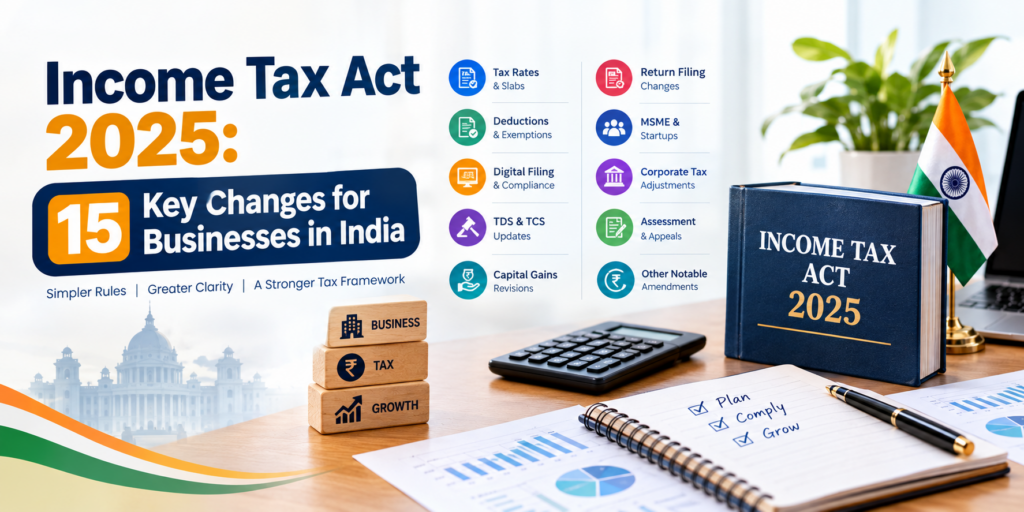
Income Tax Act 2025: 15 Key Changes for Businesses in India
India has entered a major new phase in direct taxation with the Income Tax Act, 2025, which replaced the Income Tax Act, 1961 from 1 April 2026 for tax years beginning on or after that date.
For business owners, startups, MSMEs, companies, LLPs, professionals and finance teams, the biggest change is not necessarily a completely different tax system. Instead, the new law restructures and simplifies many provisions, changes terminology and consolidates several compliance provisions.
The Income Tax Department says the new Act contains 536 sections and 16 schedules, compared with 819 sections and 14 schedules under the 1961 Act. The government says the objective is to make the law easier to understand, reduce duplication and simplify compliance.
Here are 15 important changes businesses should understand in 2026.
1. Income Tax Act, 1961 Has Been Replaced
The Income Tax Act, 2025 came into force on 1 April 2026.
However, this does not mean that all historical tax matters suddenly move to the new Act. Tax years beginning before 1 April 2026 continue to be governed by the old law, subject to the transitional provisions.
For example, income earned during FY 2025–26 is still dealt with under the Income Tax Act, 1961.
2. “Previous Year” and “Assessment Year” Are Replaced by “Tax Year”
One of the most visible changes is terminology.
Under the old system:
Previous Year → Assessment Year
Under the new Act:
Tax Year → corresponding financial year
For example, income earned from 1 April 2026 to 31 March 2027 is referred to as Tax Year 2026–27.
The Income Tax Department says the Tax Year concept is intended to remove confusion created by referring to two different years.
3. Businesses Do Not Need to Change Their Accounting Year
The introduction of the Tax Year does not require businesses to change their accounting period.
Businesses can continue following the normal April–March financial year.
So your accounting software, financial statements and internal reporting calendar do not need to be redesigned simply because the terminology has changed.
4. The New Act Is Structurally Simpler
The new legislation consolidates and reorganises provisions that had become complicated after decades of amendments.
The Income Tax Department states that the Act uses more tables and formulas, incorporates explanations and provisos into provisions and removes redundant or obsolete provisions.
For businesses, this can make tax research and compliance easier—but professional interpretation may still be necessary for complex transactions.
5. TDS Provisions Are Consolidated
TDS compliance has been significantly reorganised.
Instead of navigating numerous separate TDS provisions, the new Act consolidates TDS provisions into Section 393, with tables covering different categories of payees and payments.
Importantly, the Income Tax Department says the TDS rates and monetary thresholds have generally been retained, so consolidation should not automatically be interpreted as a change in tax rates.
Businesses should nevertheless update their accounting, payroll and TDS software to use the new section references.
6. TDS Transition Depends on the Date of Credit or Payment
Businesses handling regular vendor, contractor, professional or salary payments need to pay attention to the transition rule.
For TDS, the applicable law depends on the earlier of credit or payment.
Payments or credits up to 31 March 2026 generally fall under the 1961 Act, while those occurring from 1 April 2026 fall under the 2025 Act.
This is particularly important for companies with monthly contracts and recurring vendor payments.
7. Income-Tax Return Provisions Are Consolidated
The new Act brings provisions for original, belated, revised and updated returns together under Section 263.
The fundamental obligation to file returns remains broadly similar, but businesses and taxpayers will need to use the new statutory references for Tax Year 2026–27 onwards.
Finance teams should therefore update their tax compliance checklists before the first return cycle under the new Act.
8. Presumptive Taxation Is Consolidated
Small businesses and professionals using presumptive taxation should pay attention to the new structure.
The Income Tax Department says the presumptive taxation provisions previously spread across sections such as 44AD, 44ADA and 44AE have been consolidated into Section 58 in a tabular format.
This covers eligible resident businesses, professionals and certain goods-carriage businesses.
For eligible sole proprietorships, freelancers and professionals, this can make the applicable provisions easier to locate.
9. Existing Tax Options Generally Continue
Businesses and taxpayers do not automatically lose choices exercised under the previous law simply because the legislation has changed.
The transition provisions provide that certain options exercised under the old Act are treated as having been exercised under corresponding provisions of the new Act.
This is particularly relevant when reviewing existing tax positions, approvals and elections.
10. Existing PAN, TAN and Faceless Assessments Continue
The basic tax administration infrastructure continues.
The Income Tax Department has confirmed that PAN, TAN, faceless assessment and faceless appeals continue under the Income Tax Act, 2025.
Therefore, businesses should not assume that the introduction of the new Act means they need completely new tax registrations.
11. Capital-Gains Rules Are Carried Into the New Framework
The capital-gains framework already changed significantly through amendments made from 2024, and these provisions are incorporated into the new Act.
For example, the current framework generally uses a 24-month holding period for determining long-term capital assets, while listed securities generally use a 12-month period.
Long-term capital gains are generally taxed at 12.5% without indexation, subject to the applicable exceptions and provisions.
This matters to businesses involved in investments, restructuring, sale of assets, securities or other capital transactions.
12. Buyback Tax Treatment Has Changed
For buybacks undertaken on or after 1 April 2026, the tax treatment of buybacks has shifted.
PwC notes that the difference between consideration received on buyback and the issue price is now dealt with under capital gains, rather than the previous deemed-dividend treatment applicable to earlier buybacks.
Companies considering buybacks should therefore review the transaction with their tax advisors before implementation.
13. The New Act Does Not Mean Every Business Pays More Tax
A common misunderstanding is that replacing the Income Tax Act automatically creates a new tax burden.
The Income Tax Department explicitly states that the new Act does not introduce a new tax merely because the legislation has been replaced. Its stated objective is simplification, clearer drafting and reduced compliance friction.
Actual tax liability still depends on the applicable provisions, tax rates, deductions, exemptions, income and taxpayer category.
14. Businesses Still Need to Manage the Transition Carefully
The biggest practical challenge for many businesses may be the transition between the two Acts.
During the transition period, a company may simultaneously deal with:
- FY 2025–26 matters under the 1961 Act
- AY 2026–27 return filing under the old framework
- Tax Year 2026–27 advance-tax obligations under the new Act
- TDS under different Acts depending on transaction timing
- Pending assessments and appeals under the earlier law
The Income Tax Department specifically confirms that old proceedings relating to earlier years can continue under the transitional framework.
15. Businesses Should Update Their Finance Systems
The most practical takeaway is simple: do not treat the new Act as merely a change in the name of the law.
Businesses should review:
- Accounting software
- Payroll and salary TDS
- TDS/TCS configuration
- Tax calculation systems
- Invoice and payment workflows
- Vendor master data
- ITR compliance calendars
- Tax documentation
- Contracts containing tax references
- Capital-gains calculations
- Presumptive-taxation applicability
- Internal finance SOPs
- CFO and management reporting
For startups, MSMEs, sole proprietorships, partnerships, LLPs, OPCs, private limited companies, public companies, HUFs, AOPs, BOIs, trusts and non-resident businesses, the exact impact can differ depending on the entity type and transaction.
What Should Indian Businesses Do Now?
A practical transition checklist is:
Step 1: Identify whether each tax matter relates to a period before or after 1 April 2026.
Step 2: Update accounting and payroll systems with new section references.
Step 3: Review TDS rules and transaction dates.
Step 4: Check whether existing tax options, approvals and registrations carry forward.
Step 5: Review capital-gains and investment transactions.
Step 6: Update your tax-compliance calendar from Tax Year 2026–27.
Step 7: Ask a CA, tax professional or Virtual CFO to review areas where the new provisions affect your business.
How Expenect Can Help
Understanding a new tax law is only one part of financial management. Businesses also need accurate accounting, tax compliance, cash-flow planning, financial reporting and strategic financial decisions.
Through Expenect, businesses can connect with finance professionals for areas such as Accounting & Bookkeeping, Business Financial Strategy, Financial Health Checkups, Auditing & Due Diligence, Compliance & Legal, Cash Flow & Working Capital Management and Growth & Scaling.
A professional review can help your business identify which changes under the Income Tax Act, 2025 actually apply to you rather than relying on generic tax information.
Final Takeaway
The Income Tax Act, 2025 represents a major restructuring of India’s direct-tax framework. The most important changes for businesses include the introduction of the Tax Year, consolidation of TDS and return-filing provisions, simplified presumptive-taxation provisions, revised statutory references and detailed transitional rules.
The fundamental lesson for business owners is to update systems, not panic. The new law is designed to simplify the framework, but businesses still need to ensure that their accounting, payroll, TDS, tax-return and financial processes are aligned with the rules applicable from 1 April 2026.
For complex transactions, tax planning or compliance decisions, professional advice remains important.
Source note: This article is based primarily on the Income Tax Department’s 2025 Act FAQs and transition guidance, supplemented by PwC’s 2026 tax analysis.

GST 2.0 in 2026: What Indian Businesses Need to Know About the Next Generation of GST Compliance
India’s Goods and Services Tax system is moving into another phase of digital and compliance reform.
After the major rate rationalisation recommended by the 56th GST Council, attention in 2026 has increasingly shifted toward making GST easier to administer. The next phase—often referred to as “GST 2.0”—is focused less on simply changing tax rates and more on improving registration, invoicing, Input Tax Credit (ITC), refunds, return filing, penalties and technology.
The GST Council, CBIC, GSTN, Invoice Registration Portal (IRP) and businesses themselves all have an important role in this transition.
In September 2026, Finance Minister Nirmala Sitharaman said the GST Council’s October 7, 2026 meeting would discuss process reforms under GST 2.0, including e-invoicing and ITC rules.
Here is what Indian businesses should know.
What Is GST 2.0?
GST 2.0 is not a separate tax replacing GST.
It broadly refers to the next generation of GST reforms designed to make the existing GST framework more technology-driven, predictable and easier to comply with.
The reform agenda includes areas such as:
- GST registration
- E-invoicing
- Input Tax Credit
- GST refunds
- Return filing
- Penalties
- E-commerce compliance
- Invoice reconciliation
- GST dispute resolution
- Digital compliance
The GST Council had already identified technology-driven registration, pre-filled returns and faster refund processing as important areas for the next generation of GST reforms.
1. GST Rate Rationalisation Is Already Part of the GST 2.0 Story
One of the biggest recent GST changes came from the 56th GST Council meeting in September 2025.
The Council recommended significant rate rationalisation, including movement toward a simpler structure with standard and merit rates, alongside special treatment for selected products.
For businesses, this means GST 2.0 is not just about compliance technology. Product classification, pricing, invoices and accounting systems also need to remain aligned with applicable GST rates.
Businesses should review their HSN/SAC mapping whenever rate notifications change.
2. E-Invoicing Is Becoming More Important
E-invoicing is one of the central pillars of digital GST compliance.
Under the system, applicable businesses report specified invoices to the Invoice Registration Portal (IRP) and receive an Invoice Reference Number (IRN) and QR code.
A major operational change already in force is the 30-day reporting restriction for businesses with annual aggregate turnover of ₹10 crore or more. From April 1, 2025, such businesses must report eligible e-invoices within 30 days of the invoice date.
Businesses should therefore avoid treating e-invoicing as an end-of-month accounting task.
Invoice generation, ERP systems and GST reporting need to work together.
3. Input Tax Credit Will Remain a Major Focus
For many businesses, ITC is one of the most important financial aspects of GST.
A business may pay GST on purchases and claim eligible credit against its output tax liability, subject to the applicable conditions.
CBIC’s framework requires eligible taxpayers to maintain appropriate supporting documents and satisfy prescribed conditions for claiming ITC.
GST 2.0 discussions are increasingly focused on making ITC rules easier to administer while reducing mismatches and disputes. Finance Minister Sitharaman specifically identified ITC rules as an area for process reform discussions in October 2026.
4. Invoice Management System Is Becoming More Useful
The Invoice Management System (IMS) is another important part of GST’s digital transformation.
IMS helps taxpayers review supplier invoices and take appropriate actions that support ITC reconciliation.
GSTN introduced an offline Excel-based IMS utility in April 2026, providing taxpayers another way to manage invoice-related data.
For finance teams, the message is straightforward:
Do not wait until GSTR-3B filing to discover purchase-invoice mismatches.
Regular reconciliation can help identify:
- Missing invoices
- Incorrect GSTINs
- Wrong tax amounts
- Duplicate invoices
- Supplier filing issues
- Credit-note mismatches
- Potential ITC problems
5. GST Registration Could Become Easier for Low-Risk Businesses
GST registration has traditionally involved documentation and verification requirements.
The reform direction is toward more technology-driven and time-bound registration, particularly for small and low-risk businesses.
The GST Council had recommended an optional simplified registration scheme under which eligible low-risk applicants could receive registration through an automated process within three working days, subject to prescribed conditions.
This could be particularly relevant for:
- Startups
- Freelancers
- Small businesses
- MSMEs
- New service providers
- Small e-commerce sellers
However, businesses should check the applicable notification and eligibility conditions rather than assuming every applicant automatically qualifies.
6. GST Refunds Are Moving Toward Faster Processing
Refunds are particularly important for exporters and businesses facing accumulated ITC because of an inverted duty structure.
The GST reform agenda has included faster and more automated refund processing.
This can have a direct impact on working capital.
For an export-oriented business, delayed GST refunds can effectively lock up cash. Better digital processing can therefore become a financial-management issue, not simply a tax-compliance issue.
7. Penalty and Notice Processes May Become More Proportionate
Another major GST 2.0 discussion concerns penalties and notices.
Reports ahead of the October 2026 GST Council meeting indicate proposals to simplify penalty procedures, including changes for non-fraud cases and lower general penalties. These are reported proposals under discussion, not final rules.
This distinction is important.
Businesses should not change their compliance practices based solely on a news report. The final position should be confirmed through GST Council recommendations, notifications, circulars and amendments.
8. E-Commerce Businesses Are Also in Focus
GST compliance can be complicated for businesses selling through platforms such as online marketplaces.
The reform agenda has included simplified registration mechanisms for certain small suppliers selling through Electronic Commerce Operators (ECOs) across multiple states.
This could be relevant to:
- D2C brands
- Online retailers
- Small manufacturers
- Home-based businesses
- Marketplace sellers
- Digital entrepreneurs
However, e-commerce sellers should continue following the GST provisions applicable to their specific business model.
9. E-Way Bill Technology Is Also Evolving
GST compliance is increasingly connected across invoices, e-way bills and taxpayer data.
GSTN’s 2026 advisories include enhancements relating to the e-Way Bill portal, mandatory capture of certain “Ship To GSTIN” information and voluntary closure functionality.
For businesses moving goods, this means logistics teams and accounting teams should not operate GST processes independently.
Invoice → E-Invoice → E-Way Bill → GST Return
These systems increasingly need to match.
10. GST Compliance Is Becoming a Real-Time Finance Function
The biggest change may not be one particular rule.
It is the movement from periodic compliance to continuous compliance.
A business should monitor GST throughout the month instead of checking everything immediately before the return deadline.
A practical monthly GST dashboard could include:
| Area | What to Monitor |
|---|---|
| Sales | GST rate, HSN/SAC and tax liability |
| Purchases | Eligible ITC |
| E-Invoices | IRN generation and reporting |
| E-Way Bills | Invoice and movement matching |
| IMS | Supplier invoice reconciliation |
| GSTR-1 | Sales reporting |
| GSTR-3B | Tax liability and ITC |
| Refunds | Pending claims |
| Notices | Outstanding GST communications |
| Cash Flow | GST payable vs available cash |
Who Should Pay Attention to GST 2.0?
GST 2.0 developments are relevant to almost every GST-registered business, including:
Sole Proprietorships, Partnerships, LLPs, One Person Companies (OPCs), Private Limited Companies, Public Limited Companies, Startups, MSMEs, Manufacturers, Wholesalers, Distributors, Service Businesses, Consultants, Professionals, D2C Brands, E-commerce Sellers, Exporters, Importers, SaaS Companies and Multi-State Businesses.
The exact impact depends on the nature of the business, turnover, registration status, transactions and applicable GST provisions.
GST 2.0 Compliance Checklist for 2026
Businesses should consider the following steps:
1. Review your GST registration
Confirm that your business details, bank information, address and authorised signatories are updated.
2. Audit your HSN/SAC codes
Make sure products and services are mapped correctly.
3. Review GST rates
Update your accounting and billing software whenever applicable rate changes take effect.
4. Strengthen e-invoice processes
If e-invoicing applies to you, monitor IRN generation and reporting timelines.
5. Reconcile ITC regularly
Don’t wait until the return deadline.
6. Use IMS effectively
Review supplier invoices and identify discrepancies early.
7. Monitor e-way bills
Ensure logistics and finance data match.
8. Track GST cash flow
Know your expected GST liability before the payment deadline.
9. Monitor GSTN advisories
GST technology changes can affect your daily workflow.
10. Get professional review
A CA, tax professional or Virtual CFO can review complex transactions and compliance risks.
What GST 2.0 Means for Indian Businesses
GST 2.0 is ultimately about making GST more digital, integrated and process-oriented.
The direction is clear: businesses will increasingly be expected to maintain accurate transaction-level data, reconcile invoices regularly and connect accounting systems with GST technology.
At the same time, proposed reforms around registration, refunds, ITC and penalties could reduce compliance friction for eligible taxpayers if and when implemented through the required legal process.
For business owners, the best approach is not to wait for the next GST deadline.
Build a GST process that is accurate every week—not just compliant once a month.
How Expenect Can Help
Managing GST is only one part of business finance. Companies also need proper Accounting & Bookkeeping, Business Financial Strategy, Cash Flow & Working Capital Management, Financial Health Checkups, Compliance & Legal support, Auditing & Due Diligence and Growth & Scaling.
Through Expenect, businesses can connect with finance professionals who can help review accounting processes, GST compliance, financial controls, working capital and broader financial strategy.
A strong finance system can help business owners understand not only how much GST they need to pay, but also how taxes, working capital and compliance affect their overall business cash flow.
Final Takeaway
GST 2.0 in 2026 is less about one single “new GST rule” and more about the evolution of India’s GST ecosystem.
E-invoicing, IMS, ITC reconciliation, digital registration, automated refunds, e-way bills and technology-driven compliance are becoming increasingly interconnected.
Businesses that keep their accounting data clean and reconcile GST continuously will be better positioned to adapt as further reforms are notified.
Always verify the latest GST notification, circular or GSTN advisory before acting on a proposed reform, because discussions reported as “GST 2.0” may change before becoming legally effective. The official GST Council and GSTN portals should be treated as the primary sources for implementation updates.
Disclaimer: This article is for educational and general informational purposes. GST treatment varies according to the taxpayer, transaction and applicable law. For specific tax positions, consult a qualified CA or GST professional.
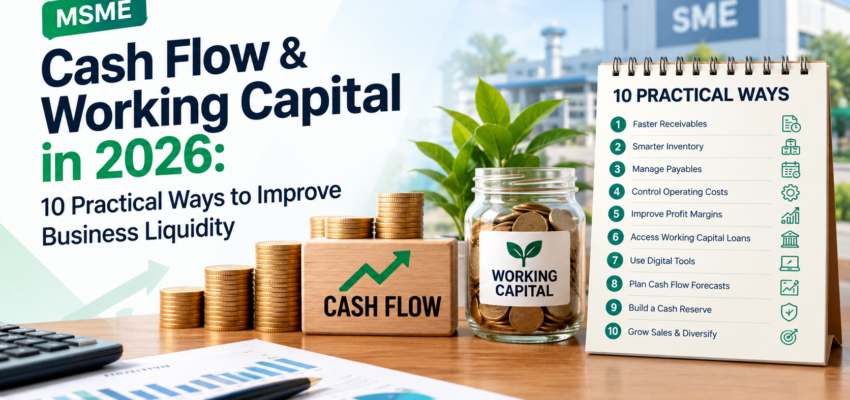
MSME Cash Flow & Working Capital in 2026: 10 Practical Ways to Improve Business Liquidity
For an MSME, profit is important—but cash is what keeps the business alive.
A company can show healthy sales and even report a profit while struggling to pay salaries, suppliers, rent, GST, loan instalments or other operating expenses. This usually happens because money is stuck in unpaid invoices, excess inventory or inefficient working-capital cycles.
The issue is particularly relevant in India, where delayed customer payments have historically been a major challenge for micro and small enterprises.
In 2026, the ecosystem around MSME working capital is changing. The government has strengthened TReDS, introduced credit-guarantee support for eligible invoice financing, and made TReDS settlement mandatory for transactions between operating Central Public Sector Enterprises (CPSEs) and their MSME suppliers.
So, how can an MSME improve cash flow in 2026?

What Is Working Capital?
Working capital is the money available to run the day-to-day operations of a business.
A simple formula is:
Working Capital = Current Assets − Current Liabilities
Current assets may include:
- Cash and bank balances
- Accounts receivable
- Inventory
- Short-term investments
Current liabilities may include:
- Supplier payables
- Short-term loans
- Accrued expenses
- Other amounts due within the operating cycle
But having positive working capital does not automatically mean that a business has healthy cash flow.
For example, a manufacturer may have ₹50 lakh in receivables and ₹20 lakh in inventory but only ₹2 lakh in its bank account.
On paper, the company may look financially healthy.
In reality, it could struggle to pay its next supplier bill.
Why Cash Flow Is a Major MSME Challenge
The Ministry of MSME has identified delayed payments as a persistent problem for micro and small enterprises. The government has consequently been strengthening TReDS and other mechanisms designed to improve the speed at which MSMEs convert invoices into cash.
The scale of India’s MSME ecosystem makes this particularly important.
The Ministry’s 2026 data shows millions of enterprises registered through the Udyam ecosystem, spanning manufacturing, services and trading activities.
For a growing MSME, cash-flow management should therefore be treated as a management discipline, not something the accountant checks only at the end of the month.
10 Ways MSMEs Can Improve Cash Flow and Working Capital in 2026
1. Reduce Your Receivable Days
One of the fastest ways to improve cash flow is to collect money faster.
Suppose your business generates ₹1 crore in annual credit sales.
If your average collection period falls from 60 days to 45 days, approximately ₹4.1 lakh less capital is tied up in receivables, assuming sales are reasonably spread throughout the year.
Review:
- Customer payment terms
- Outstanding invoices
- Overdue invoices
- Credit limits
- Customer-wise payment history
- Collection follow-ups
Don’t wait until an invoice becomes 90 days overdue before contacting the customer.
2. Create a Weekly Cash-Flow Forecast
A monthly profit-and-loss statement cannot tell you exactly how much cash will be available next Tuesday.
Create a 13-week cash-flow forecast showing:
Opening Cash + Expected Receipts − Expected Payments = Closing Cash
Track:
- Customer collections
- Salaries
- Rent
- GST and taxes
- Supplier payments
- Loan EMIs
- Marketing expenditure
- Utilities
- Capital expenditure
This gives the owner an early warning before a cash shortage becomes an emergency.
3. Use TReDS to Unlock Receivables
Trade Receivables Discounting System (TReDS) can be particularly useful for eligible MSMEs selling to larger buyers.
TReDS is an RBI-regulated electronic platform through which MSME receivables can be financed or discounted through multiple financiers. Participants include MSME sellers, buyers and financiers such as banks and NBFC-Factors.
The basic process is:
Invoice → Buyer Acceptance → Financier Bidding → Discounting → Early Payment
Instead of waiting for the buyer’s payment date, an MSME can potentially convert an eligible approved invoice into cash earlier.
In 2026, TReDS has become even more relevant because the government has strengthened its role in MSME liquidity.
The Ministry of MSME reported that invoice discounting on TReDS increased from ₹40,000 crore in FY 2021–22 to about ₹3.5 lakh crore in FY 2025–26.
4. Understand the 2026 TReDS Changes
The MSMED framework was amended in 2026 to facilitate faster payments to MSMEs.
The government has mandated operating CPSEs to route settlement of invoices for goods and services purchased from MSMEs through TReDS. The reform is intended to improve liquidity and reduce payment delays.
This is particularly relevant for MSMEs supplying:
- Government enterprises
- Public-sector organisations
- Large corporates
- Institutional buyers
If your business supplies eligible buyers, discuss TReDS with your finance team or banking partner rather than automatically treating long credit periods as unavoidable.
5. Control Inventory More Aggressively
Inventory is cash sitting on shelves.
Too little inventory can cause stock-outs.
Too much inventory can lock up valuable working capital.
Track:
- Inventory turnover
- Slow-moving stock
- Dead stock
- Reorder levels
- Safety stock
- Product-wise margins
A simple ABC analysis can help:
A items: High-value items requiring close monitoring
B items: Moderate-value items
C items: Lower-value, high-volume items
The goal is not simply to reduce inventory. It is to maintain the right inventory for the level of demand.
6. Negotiate Better Supplier Payment Terms
Working capital is affected by both money coming in and money going out.
If customers pay in 60 days but you must pay suppliers in 15 days, your business has a financing gap.
Where commercially reasonable, negotiate:
- 30/45/60-day payment terms
- Milestone-based payments
- Partial advance arrangements
- Volume-based terms
- Seasonal payment schedules
However, do not delay payments simply to improve your own cash position if it damages supplier relationships or violates contractual/legal obligations.
7. Separate Profitable Sales From Cash-Generating Sales
Not every sale improves your financial position.
A ₹10 lakh order with:
- 5% margin,
- 90-day payment terms,
- high inventory requirements
may be less attractive from a cash-flow perspective than a ₹6 lakh order with:
- 20% margin,
- 30-day payment terms,
- low working-capital requirements.
Business owners should therefore evaluate customers using both:
Profitability + Cash Conversion
A finance dashboard should show revenue, gross margin, receivable days and contribution—not revenue alone.
8. Build a Working-Capital Reserve
MSMEs should avoid operating with every rupee already committed.
A practical target depends on the business model, but management should know:
How many months can the business operate if collections suddenly fall?
Maintain a liquidity buffer for:
- Payroll
- Rent
- Utilities
- Debt servicing
- Taxes
- Critical suppliers
- Emergency expenses
The appropriate reserve varies significantly between a consulting business, manufacturing company, retailer and SaaS startup.
9. Use Credit Strategically—Not Emotionally
External finance can help bridge a temporary working-capital gap.
Potential options may include:
- Cash-credit facilities
- Overdrafts
- Working-capital loans
- Invoice financing
- TReDS
- Business credit lines
- Equipment finance
The objective should be to finance productive working capital, not permanently cover an unprofitable business model.
Before borrowing, calculate:
Cost of Finance vs Expected Return on Working Capital
If borrowed money generates ₹1 lakh of additional contribution but costs ₹1.5 lakh, borrowing is not solving the problem.
10. Build a Monthly Working-Capital Dashboard
A professional finance dashboard should track at least:
| KPI | What It Tells You |
|---|---|
| Cash Balance | Immediate liquidity |
| DSO | How quickly customers pay |
| DPO | How quickly suppliers are paid |
| Inventory Days | Capital tied in inventory |
| Cash Conversion Cycle | Overall working-capital efficiency |
| Overdue Receivables | Collection risk |
| Gross Margin | Profitability of sales |
| Operating Cash Flow | Cash generated by operations |
| Current Ratio | Short-term financial position |
| Cash Runway | How long available cash can support operations |
One of the most useful measures is the Cash Conversion Cycle (CCC):
CCC = Inventory Days + Receivable Days − Payable Days
The lower the cycle, the faster the business generally converts operating investment back into cash, although the appropriate target differs by industry.
Government Support for MSME Working Capital in 2026
The working-capital ecosystem is also receiving policy support.
In September 2026, the Ministry of MSME announced that CGTMSE credit-guarantee coverage had gone live on TReDS through platforms including M1xchange, RXIL and DTX (KredX). The initiative is intended to support faster working-capital access through invoice discounting for eligible micro and small enterprises.
The Ministry reported that the guarantee can cover 75% of the amount in default, subject to the applicable limits and conditions.
This adds another layer to the MSME liquidity ecosystem involving:
- Ministry of MSME
- CGTMSE
- RBI
- TReDS platforms
- Banks
- NBFC-Factors
- Corporate buyers
- CPSEs
- MSME suppliers
What If a Customer Does Not Pay?
Eligible micro and small enterprises have mechanisms under the MSMED framework for delayed-payment disputes.
The MSME Samadhaan system enables eligible MSEs with valid Udyam Registration to seek assistance relating to delayed payments, with matters potentially proceeding to the Micro and Small Enterprise Facilitation Council (MSEFC).
The Ministry also operates an MSME ODR Portal designed to facilitate digital dispute avoidance, containment and resolution.
Businesses should maintain proper:
- Purchase orders
- Contracts
- Invoices
- Delivery proofs
- Acceptance records
- Payment correspondence
- Udyam documentation
Good documentation can become extremely important when recovering overdue receivables.
A Simple 30-Day Cash-Flow Improvement Plan
Week 1: Find the problem
Prepare an ageing report of all receivables and identify your top 20 overdue customers.
Week 2: Improve collections
Contact overdue customers, establish payment commitments and review credit limits.
Week 3: Review working capital
Analyse inventory, supplier terms, TReDS eligibility and available financing.
Week 4: Build the system
Create a weekly cash-flow forecast and monthly dashboard.
Then repeat the process every month.
How Expenect Can Help MSMEs
Cash-flow problems are rarely solved by looking at one number.
An MSME may need help with Accounting & Bookkeeping, Financial Health Checkups, Cash Flow & Working Capital Management, Business Financial Strategy, Compliance & Legal, Auditing & Due Diligence, or Growth & Scaling.
Through Expenect, business owners can connect with finance professionals who can help analyse financial performance, identify working-capital bottlenecks and build better financial processes.
Final Takeaway
For an MSME, cash flow is not just an accounting metric—it is a growth strategy.
The businesses that manage working capital well can pay suppliers on time, maintain inventory, take larger orders, invest in marketing and survive temporary market slowdowns without constantly searching for emergency funding.
In 2026, tools such as TReDS, invoice discounting, CGTMSE support, digital dispute resolution and better financial forecasting are making the working-capital ecosystem more accessible.
But technology and government schemes cannot replace financial discipline.
The best starting point is simple:
Collect faster. Control inventory. Negotiate intelligently. Forecast cash weekly. Monitor working-capital KPIs.
And most importantly, never confuse profit with cash.
For an MSME, a healthy bank balance gives the business something that a profit-and-loss statement alone cannot provide: the ability to keep operating and keep growing.

AI in Accounting & Taxation: How Artificial Intelligence Is Transforming Finance for Indian Businesses
AI in Accounting & Taxation: How Artificial Intelligence Is Transforming Finance for Indian Businesses
Artificial Intelligence is no longer limited to technology companies, chatbots and automation.
It is rapidly becoming part of how businesses manage accounting, taxation, financial reporting, compliance and decision-making.
For decades, accounting has depended heavily on manual data entry, spreadsheets, reconciliations, document processing and repetitive compliance tasks.
AI is changing that model.
Today, businesses can use AI-powered tools to identify unusual transactions, extract information from invoices, automate reconciliation, analyze financial data, assist with tax research, generate reports and identify potential financial risks.
The transformation is significant enough that the Institute of Chartered Accountants of India (ICAI) held its AI Innovation Summit 2026 around the theme “Transforming Accounting, Audit, Tax, and Governance.” ICAI highlighted areas including AI, data analytics, cybersecurity, automation and the future of financial reporting and assurance.
At the same time, businesses need to understand an important principle:
AI can assist accounting and taxation, but it should not replace professional judgment, verification and accountability.
This article explains how AI is changing accounting and taxation, the benefits for Indian businesses, the risks involved and how companies can start adopting AI responsibly.

What Is AI in Accounting?
AI in accounting refers to using artificial intelligence and machine-learning technologies to automate, analyze or assist with financial processes.
Traditional accounting often involves:
Collect → Enter → Reconcile → Review → Report
AI can help transform this into:
Capture → Automate → Analyze → Flag → Review → Decide
Examples include:
- Automated invoice processing
- Expense categorization
- Bank reconciliation
- Transaction classification
- Fraud detection
- Cash-flow forecasting
- Financial analysis
- Tax-document extraction
- Anomaly detection
- Management reporting
Instead of spending hours processing repetitive information, finance professionals can spend more time analyzing the business and advising management.
Why AI Is Becoming Important for Accounting
The volume of financial information businesses generate continues to increase.
A typical business may have data coming from:
- Bank accounts
- UPI
- Credit cards
- Payment gateways
- GST systems
- E-commerce platforms
- Payroll
- Accounting software
- Invoices
- Expense-management systems
- CRM platforms
- Inventory systems
Manually processing all this information can be time-consuming.
AI can help finance teams process large amounts of structured and unstructured data more efficiently.
This is one reason AI is becoming increasingly relevant to accountants and finance professionals.
1. Automated Bookkeeping
One of the most obvious applications of AI is bookkeeping automation.
AI-enabled accounting systems can assist with:
- Transaction categorization
- Expense classification
- Invoice recording
- Payment matching
- Recurring transaction recognition
- Data extraction
For example, when an invoice is uploaded, an AI-powered system may extract:
- Vendor name
- Invoice number
- Date
- Tax details
- Amount
- Line items
This reduces manual data entry.
However, automated entries should still be reviewed according to the business’s accounting controls.
2. AI-Powered Invoice Processing
Businesses receive hundreds or thousands of invoices.
Traditionally, employees may manually enter invoice information into accounting software.
AI and OCR-based systems can extract information automatically.
Traditional Process
Invoice → Employee reads → Data entry → Verification → Accounting system
AI-Assisted Process
Invoice → AI extracts data → System validates → Exception flagged → Human review
This can significantly reduce repetitive work.
3. Bank Reconciliation
Bank reconciliation is another area where automation can provide significant benefits.
AI-powered systems can compare:
Bank transactions ↔ Accounting records
and identify potential matches.
For example:
Bank transaction:
₹25,000 — ABC Technologies
Accounting record:
ABC Technologies — ₹25,000
The system can suggest a match.
Transactions that don’t match can be flagged for human review.
4. Expense Categorization
Businesses make hundreds of payments every month.
AI can learn from historical accounting classifications and help categorize transactions into areas such as:
- Travel
- Advertising
- Software
- Office expenses
- Professional fees
- Utilities
- Rent
- Employee expenses
This can save finance teams significant amounts of repetitive work.
However, businesses should establish clear accounting rules because similar transactions may sometimes require different treatment.
5. Detecting Financial Anomalies
AI can analyze transaction patterns and identify unusual activity.
For example, suppose a company normally spends:
₹2–3 lakh per month on a particular category.
Suddenly, spending increases to:
₹10 lakh.
An AI system can flag the transaction pattern for review.
Other examples include:
- Duplicate invoices
- Unusual payments
- Unexpected vendor changes
- Abnormal expense patterns
- Unusual transaction timing
- Sudden changes in customer payments
AI doesn’t automatically prove fraud.
It helps identify transactions that deserve investigation.
6. Fraud Detection
Financial fraud can be difficult to identify using simple rules alone.
AI can analyze large numbers of transactions and look for patterns that humans may miss.
Potential applications include:
- Duplicate payment detection
- Suspicious vendor activity
- Unusual reimbursement claims
- Unusual employee transactions
- Fake invoice patterns
- Unusual payment behaviour
This is particularly useful for businesses with high transaction volumes.
7. AI in GST Compliance
GST compliance generates significant amounts of financial data.
AI and data analytics can assist with:
- Invoice matching
- Transaction classification
- Exception detection
- Reconciliation
- HSN/SAC analysis
- Identifying unusual GST patterns
Interestingly, GSTN itself uses AI/ML in its revamped HSN search facility. The GST portal says its HSN search algorithm is linked to the e-invoice declaration database and uses taxpayer-declared information to assist users in finding relevant HSN/description matches. The portal also explicitly states that this facility is not legally binding advice.
This illustrates an important point:
AI can assist tax-related processes, but the final legal and tax determination still requires appropriate verification.
8. AI for Tax Data Preparation
Tax compliance involves collecting and organizing significant amounts of information.
AI can help businesses prepare information for professional review by:
- Extracting data from invoices
- Categorizing transactions
- Identifying missing information
- Comparing accounting records
- Organizing supporting documents
- Highlighting potential inconsistencies
This can reduce the time accountants spend on repetitive preparation.
9. AI-Assisted Tax Research
Generative AI can help finance professionals quickly:
- Summarize tax provisions
- Compare rules
- Identify relevant concepts
- Draft research notes
- Prepare questions for further investigation
- Organize large amounts of information
But this is an area where businesses need to be particularly careful.
AI-generated tax answers can be incomplete, outdated or incorrect.
The answer generated by an AI system should not automatically be treated as tax advice.
Tax professionals should verify important conclusions against authoritative legislation, rules, notifications, circulars and official guidance.
10. AI and the Changing Indian Tax Environment
AI becomes even more relevant as India’s tax and compliance ecosystem becomes increasingly digital.
India’s direct-tax framework has also undergone a major transition.
The Income-tax Act, 2025 came into force from 1 April 2026, and ICAI has published updated resources relating to the Income-tax Act, 2025 and Income-tax Rules, 2026.
For businesses, this reinforces the importance of keeping accounting and tax systems updated.
AI can help organize and process information, but businesses should ensure their software, accounting rules and tax workflows reflect the currently applicable law.
11. AI-Powered Financial Forecasting
AI can analyze historical financial data to assist with forecasting.
For example, it can analyze:
- Historical sales
- Seasonal trends
- Customer behaviour
- Expenses
- Collections
- Inventory
- Cash flow
and help generate forecasts.
A business might use these models to estimate:
Expected revenue → Expected expenses → Expected cash position
This can help management identify potential cash shortages earlier.
12. Cash-Flow Management
Cash flow is one of the biggest challenges for growing businesses.
AI can assist with:
- Predicting collections
- Identifying overdue customers
- Forecasting expenses
- Modeling different scenarios
- Monitoring cash balances
For example:
Scenario A: Revenue grows 20%
Scenario B: Revenue remains flat
Scenario C: A major customer delays payment by 45 days
AI-assisted forecasting can help management understand how these scenarios may affect cash.
13. AI for Financial Reporting
Instead of manually preparing every management report, businesses can use AI-assisted systems to generate summaries such as:
- Monthly revenue report
- Expense analysis
- Profitability report
- Cash-flow summary
- Budget variance
- Receivables ageing
- Business KPI dashboard
For example:
“Revenue increased 18% compared with the previous month, while gross margin decreased by 4 percentage points due primarily to higher direct costs.”
A management report like this can be generated from structured financial data and then reviewed by a finance professional.
14. AI Can Help CEOs Understand Financial Data
One of the most exciting applications is making financial information easier for non-finance executives to understand.
Instead of opening a complex spreadsheet, a CEO could ask:
“Why did profit fall this month?”
An AI-assisted reporting system could analyze the underlying data and identify possible contributors such as:
- Revenue decline
- Increased salaries
- Higher marketing costs
- Lower gross margins
- Increased finance costs
The CEO can then investigate the underlying figures.
This makes financial information more accessible to business owners.
15. AI for Accounts Receivable Management
Late payments can create serious cash-flow problems.
AI can help businesses analyze customer payment behaviour.
For example:
| Customer | Average Payment Time |
|---|---|
| Customer A | 18 days |
| Customer B | 32 days |
| Customer C | 67 days |
| Customer D | 85 days |
AI can identify customers whose payment patterns are deteriorating.
Businesses can then prioritize collection efforts.
16. AI for Accounts Payable
AI can also assist with supplier payments.
Possible applications include:
- Invoice matching
- Duplicate invoice detection
- Payment scheduling
- Vendor analysis
- Identifying unusual payment requests
- Cash-flow prioritization
The objective isn’t simply to delay payments.
It’s to manage supplier obligations efficiently while maintaining healthy working capital.
17. AI for Budgeting
Traditional budgeting often relies heavily on historical spreadsheets.
AI can assist businesses by analyzing historical patterns and creating scenario-based budgets.
For example:
Conservative Scenario
Revenue growth: 10%
Base Scenario
Revenue growth: 20%
Aggressive Scenario
Revenue growth: 35%
Management can then estimate how each scenario affects:
- Hiring
- Marketing
- Profit
- Cash flow
- Working capital
- Funding requirements
18. AI Can Help Identify Cost-Saving Opportunities
AI can analyze expense data and identify recurring costs.
For example:
A business may discover that it is paying for:
- 35 software subscriptions
- 12 unused licenses
- Multiple overlapping tools
- Expensive vendor contracts
AI can highlight patterns for management to investigate.
Even small savings across many recurring expenses can improve margins.
19. AI in Audit and Assurance
AI is also changing audit processes.
Auditors can use technology to analyze large datasets rather than relying only on small samples.
Potential applications include:
- Transaction analysis
- Anomaly detection
- Risk assessment
- Duplicate detection
- Pattern recognition
- Document review
ICAI’s AI initiatives specifically highlight AI’s role in accounting, audit, tax and governance.
The future of auditing is therefore likely to involve a combination of technology + professional judgment, rather than technology replacing professional judgment.
20. AI Can Improve Accounting Productivity
Consider a finance employee spending several hours each week on:
- Data entry
- Invoice processing
- Reconciliation
- Report formatting
- Document classification
Automation can reduce some of this repetitive workload.
The employee can then spend more time on:
- Financial analysis
- Business partnering
- Forecasting
- Internal controls
- Management reporting
This is one of the biggest potential benefits of AI.
AI Does Not Replace Accountants
This is an important misconception.
AI may automate repetitive accounting activities.
But accounting involves much more than data entry.
Accountants and finance professionals provide:
- Professional judgment
- Financial interpretation
- Tax expertise
- Regulatory understanding
- Risk assessment
- Audit judgment
- Business advice
- Ethical accountability
ICAI itself has emphasized the importance of professional judgment alongside AI. Its 2025 AI summit described AI as a tool to empower professionals rather than replace human wisdom.
The future is therefore likely to be:
Accountant + AI
rather than:
Accountant vs AI
The Benefits of AI in Accounting & Taxation
1. Saves Time
Automation reduces repetitive manual work.
2. Reduces Data-Entry Errors
Automated extraction and validation can reduce certain types of manual errors.
3. Improves Financial Visibility
Businesses can access financial information faster.
4. Helps Identify Anomalies
AI can identify unusual patterns that deserve investigation.
5. Supports Better Forecasting
Historical and current data can be used for scenario analysis.
6. Improves Scalability
A growing business can process more financial information without increasing manual workload at the same rate.
7. Supports Better Decisions
CEOs can receive faster insights from financial data.
The Risks of AI in Accounting
AI also creates new risks.
Businesses should not assume that an AI-generated answer is automatically correct.
1. AI Hallucinations
Generative AI systems can produce plausible but incorrect information.
This is particularly dangerous in taxation.
An AI system could provide an incorrect:
- Tax provision
- Section reference
- Deduction
- Filing requirement
- Due date
Therefore, important tax conclusions should be independently verified.
2. Data Privacy
Accounting systems contain sensitive information.
This may include:
- Bank details
- PAN
- GSTIN
- Employee information
- Customer information
- Vendor information
- Financial statements
Businesses should carefully evaluate how AI tools store, process and protect data.
Never upload sensitive financial information to an AI system without understanding its data-handling and security arrangements.
3. Cybersecurity
AI creates new technology risks.
Businesses should consider:
- Access controls
- Password security
- User permissions
- Encryption
- Audit logs
- Vendor security
- Data retention
The more financial systems become connected, the more important cybersecurity becomes.
4. Incorrect Automated Entries
Automation can make mistakes at scale.
If a system incorrectly categorizes one transaction, it may be easy to fix.
If it incorrectly categorizes thousands of transactions, the consequences can be much larger.
That’s why businesses need:
Automation + Validation + Human Oversight
5. Lack of Explainability
Sometimes management needs to understand:
“Why did the system flag this transaction?”
AI systems should ideally provide enough explanation for finance professionals to investigate important decisions.
How Indian Businesses Can Start Using AI in Accounting
You don’t need to completely transform your finance department overnight.
Start with low-risk, repetitive processes.
Step 1: Identify Repetitive Tasks
List activities such as:
- Data entry
- Invoice extraction
- Reconciliation
- Report generation
- Document classification
Step 2: Choose Appropriate Tools
Select software designed for the relevant accounting or financial workflow.
Step 3: Establish Human Review
Don’t automate critical decisions without controls.
Step 4: Protect Financial Data
Review:
- Data access
- Storage
- Security
- Permissions
- Vendor policies
Step 5: Measure Results
Track:
- Hours saved
- Error rates
- Processing time
- Cost savings
- Productivity
A Practical AI Adoption Roadmap for Businesses
Phase 1: Basic Automation
Start with:
- Invoice extraction
- Expense categorization
- Bank reconciliation
- Document organization
Phase 2: Financial Intelligence
Add:
- KPI dashboards
- Automated reporting
- Anomaly detection
- Cash-flow forecasting
Phase 3: Advanced Analysis
Use AI for:
- Scenario planning
- Customer profitability
- Predictive cash-flow analysis
- Risk identification
- Working-capital optimization
Phase 4: Strategic Finance
Integrate AI-assisted insights into:
- Budgeting
- Business planning
- Fundraising
- Expansion decisions
- Pricing
- Investment decisions
At every stage, maintain appropriate human oversight.
AI vs Traditional Accounting
| Area | Traditional Approach | AI-Assisted Approach |
|---|---|---|
| Invoice Entry | Manual | Automated extraction |
| Categorization | Manual rules | AI-assisted classification |
| Reconciliation | Manual matching | Automated matching + exceptions |
| Reporting | Spreadsheet-heavy | Automated dashboards |
| Fraud Detection | Rule/sample-based | Pattern and anomaly analysis |
| Forecasting | Historical spreadsheet | AI-assisted scenarios |
| Tax Research | Manual research | AI-assisted research + verification |
| Decision Support | Periodic | More continuous |
The objective isn’t to eliminate accounting processes.
It’s to make them faster, more data-driven and more scalable.
The Role of the Modern Accountant
The accountant of the future may spend less time on repetitive data processing and more time on higher-value activities.
For example:
Traditional Role
“Here is your monthly P&L.”
Modern Finance Role
“Your gross margin declined by 5 percentage points because of three cost categories. If the current trend continues, cash flow may become constrained within four months. Here are three possible actions.”
The second role is much closer to a financial advisor and business partner.
Why Businesses Still Need a CA or Finance Professional
Even as AI adoption increases, businesses continue to need professionals who understand:
- Accounting standards
- Tax laws
- Corporate compliance
- Financial reporting
- Audit
- Internal controls
- Business strategy
AI can process information.
A professional can interpret it in context and take responsibility for the advice and decisions.
This distinction is especially important in taxation, where laws and interpretations can change.
For example, ICAI currently provides resources on the Income-tax Act, 2025 and Income-tax Rules, 2026, reflecting the continuing evolution of India’s tax framework.
What Does the Future of AI in Accounting Look Like?
The future will likely involve increasing integration between:
Accounting Software + AI + Data Analytics + Automation + Human Expertise
Instead of waiting until the end of the month to understand financial performance, businesses may increasingly move toward near-real-time financial intelligence.
Imagine a system that automatically tells the CEO:
Revenue is 12% above forecast.
Gross margin is 3% below target.
Customer payment delays increased this month.
Marketing cost per acquisition increased by 15%.
Cash runway has fallen from 10 months to 8 months.
This is the direction in which financial management is moving.
10 AI Use Cases Every Business Should Consider
If you’re unsure where to begin, consider these ten applications:
- Automated invoice processing
- Expense categorization
- Bank reconciliation
- Financial report generation
- Cash-flow forecasting
- Expense anomaly detection
- Receivables analysis
- Budget forecasting
- Tax-document organization
- Management KPI dashboards
Start with repetitive, measurable tasks before moving into high-risk decision-making.
AI Accounting Checklist for Business Owners
Before implementing an AI solution, ask:
☐ What problem are we trying to solve?
☐ How much time does the current process consume?
☐ What financial data will the system access?
☐ Where will the data be stored?
☐ Who can access it?
☐ Can the AI output be verified?
☐ Is human approval required?
☐ What happens if the AI makes a mistake?
☐ Can transactions be audited?
☐ Does the solution integrate with our accounting software?
☐ Can we measure the ROI?
☐ Are our employees trained to use it?
Frequently Asked Questions
Is AI going to replace accountants?
AI is likely to automate many repetitive accounting tasks, but accounting also requires professional judgment, regulatory knowledge, interpretation and accountability. The more likely model is accountants using AI to become more productive and strategic.
Can AI file taxes automatically?
Some technology platforms can automate portions of tax preparation and filing workflows. However, businesses should not assume that AI-generated tax information is correct. Applicable requirements should be verified and filings reviewed appropriately.
Can AI help with GST compliance?
Yes. AI and automation can assist with invoice processing, reconciliation, anomaly detection and other GST-related workflows. GSTN itself uses AI/ML in its HSN search functionality.
Is AI safe for financial data?
It depends on the technology, configuration, provider and security controls. Businesses should carefully evaluate data privacy, access controls, storage, security and retention before providing sensitive financial information to an AI system.
Can small businesses use AI in accounting?
Absolutely. Small businesses can start with relatively simple applications such as invoice processing, expense categorization, reconciliation, reporting and cash-flow forecasting.
Should a CA review AI-generated tax information?
For important tax decisions, filings and compliance matters, professional review is strongly advisable. AI can assist research and preparation, but it should not be treated as an independent authority on tax law.
Final Thoughts: AI Will Change Accounting—But Trust Still Matters
AI is transforming the accounting and taxation landscape.
It can automate repetitive processes, analyze huge amounts of financial information, identify unusual transactions, improve forecasting and provide business owners with faster financial insights.
But there is an important difference between processing financial information and taking professional responsibility for financial decisions.
AI can help answer:
“What happened?”
It can increasingly help answer:
“What might happen next?”
But businesses still need qualified professionals to determine:
“What should we do about it?”
That is why the future of accounting is unlikely to be simply human versus machine.
It will be:
Human expertise + Artificial Intelligence + Reliable financial data
For Indian businesses, adopting this combination can create faster reporting, better financial visibility, stronger controls and more informed decision-making.
And as AI becomes more powerful, accuracy, data security, professional judgment and human oversight will become more—not less—important.
Need Help Modernizing Your Business Finances?
The right technology can automate repetitive accounting work. The right financial professional can help you understand what the numbers mean.
Expenect connects businesses with Chartered Accountants, accountants and Virtual CFOs who can help with accounting, taxation, compliance, financial reporting, forecasting and strategic financial management.
The future of accounting isn’t about replacing financial experts with AI. It’s about giving financial experts better tools to help businesses make better decisions.

Financial Red Flags Investors Notice Before Investing in Your Business
Financial Red Flags Investors Notice Before Investing in Your Business
Raising funding can be a major milestone for a startup or growing business.
You may have an excellent product, a strong team and an impressive growth story. But when investors start evaluating your business, they don’t look at your pitch deck alone.
They look at the numbers behind the story.
Investors want to understand whether your business is financially healthy, whether its growth is sustainable and whether their capital can generate an attractive return.
A company reporting ₹10 crore in revenue may look impressive. But if its margins are collapsing, customers aren’t paying on time and the business is burning ₹1 crore every month, investors will want to know why.
This is why financial due diligence is such an important part of fundraising.
In this guide, we’ll explore the major financial red flags investors commonly notice before investing in a business—and what founders can do to address them.
Important: The specific information investors request varies by company, industry, transaction and funding stage. This article is an educational guide, not investment, tax or legal advice.

What Is Financial Due Diligence?
Financial due diligence is the process of examining a company’s financial information before an investment or transaction.
Investors may review:
- Revenue
- Profit and loss statements
- Balance sheets
- Cash flow
- Bank statements
- Tax filings
- GST records
- Accounts receivable
- Accounts payable
- Debt
- Cap table
- Financial projections
- Customer concentration
- Major contracts
- Related-party transactions
The objective is to determine whether the company’s financial position matches what management has presented.
Why Financial Red Flags Matter
Investors understand that startups don’t always have perfect financials.
A young company may not yet be profitable.
That’s not necessarily a problem.
The bigger concern is whether the founder understands the financial situation and has a credible plan to improve it.
For example:
Company A
- Revenue growing 60%
- Gross margin stable
- Cash burn understood
- Clean accounting
- Realistic forecast
- Clear use of funds
Company B
- Revenue growing 70%
- Gross margin declining
- Unexplained expenses
- Overdue taxes
- Poor bookkeeping
- Aggressive projections
Even though Company B is growing faster, Company A may appear considerably more investable.
1. Inconsistent or Unreliable Financial Statements
One of the biggest red flags is when financial statements don’t match each other.
For example:
Your pitch deck says:
FY 2026 Revenue: ₹5 crore
But your accounting records show:
Revenue: ₹4.2 crore
And your bank statements show something different again.
Investors will immediately ask:
“Why don’t these numbers match?”
Small accounting differences can happen.
Large unexplained differences can seriously damage credibility.
How to Fix It
Before fundraising, reconcile:
- Accounting records
- Bank statements
- GST records
- Tax filings
- Sales reports
- Payment gateway records
Your financial information should tell one consistent story.
2. Poor Bookkeeping
Messy accounting can make investors question the quality of your overall financial management.
Warning signs include:
- Missing invoices
- Duplicate transactions
- Unreconciled bank accounts
- Unclassified expenses
- Personal transactions in business accounts
- Incorrect revenue recognition
- Missing supporting documents
If basic bookkeeping isn’t under control, investors may wonder whether more serious problems exist.
Solution
Maintain organized monthly books and conduct regular reconciliations before starting the fundraising process.
3. Declining Gross Profit Margins
Revenue growth looks impressive.
But investors also want to know:
“How much money does the company actually make from each sale?”
Suppose:
Year 1
Revenue = ₹2 crore
Gross Margin = 60%
Year 2
Revenue = ₹5 crore
Gross Margin = 42%
Revenue increased significantly.
But gross margin dropped dramatically.
Possible causes include:
- Rising production costs
- Discounting
- Higher vendor prices
- Poor product mix
- Increasing fulfilment costs
A declining gross margin can indicate that growth isn’t translating into stronger economics.
4. Negative or Weak Cash Flow
Profit and cash are not the same.
A business may report accounting profit while cash remains tied up in:
- Unpaid invoices
- Inventory
- Advances
- Other working-capital items
Investors will examine cash generation closely.
They may ask:
- How much cash does the company generate?
- How much cash does it consume?
- What is the monthly burn?
- How long will the existing cash last?
If the company is continuously running out of cash, investors need to understand why.
5. Excessive Burn Rate
Burn rate is particularly important for startups.
Suppose your startup has:
Cash reserves: ₹1.2 crore
Monthly net burn: ₹20 lakh
Your approximate runway is:
6 months
If you’re planning to raise funding, investors will want to understand why the company is burning cash at that rate and what the additional capital will accomplish.
High burn isn’t automatically a red flag.
Uncontrolled burn is.
6. Short Cash Runway
Investors may become concerned if the business is only a few months away from running out of cash.
This can put the founder in a weak negotiating position.
You may end up raising money because you have to, rather than because you’ve chosen the right investor and terms.
Ideally, fundraising should begin before the company reaches a financial emergency.
7. Unrealistic Financial Projections
One of the biggest fundraising mistakes is presenting unrealistic forecasts.
For example:
Current revenue:
₹2 crore
Forecast next year:
₹20 crore
That’s a 10x increase.
It isn’t impossible.
But investors will ask:
- What will drive this growth?
- How many customers are required?
- What marketing budget is needed?
- Can operations support it?
- What hiring is required?
- What conversion rates are assumed?
Every major assumption should have a logical basis.
Better Approach
Build projections using:
- Historical performance
- Customer pipeline
- Conversion rates
- Pricing
- Market size
- Capacity
- Hiring plans
- Marketing investment
8. High Customer Concentration
Imagine 70% of your revenue comes from one customer.
Your revenue looks strong.
But investors may see significant risk.
What happens if that customer:
- Leaves
- Renegotiates pricing
- Reduces orders
- Delays payments
Customer concentration can make revenue less predictable.
Track revenue concentration by:
- Customer
- Geography
- Product
- Industry
- Channel
9. Increasing Accounts Receivable
If revenue is growing but receivables are growing even faster, investors may become concerned.
Example:
Revenue
₹10 crore → ₹15 crore
Receivables
₹1 crore → ₹5 crore
This may indicate that customers are taking increasingly longer to pay.
Investors will want to understand your collection cycle and working-capital requirements.
10. Excessive Inventory
Inventory can tie up significant amounts of cash.
Investors may investigate:
- Inventory turnover
- Slow-moving stock
- Dead inventory
- Obsolete inventory
- Inventory valuation
A large inventory balance isn’t necessarily bad.
But unexplained inventory growth can be a warning sign.
11. Heavy Dependence on Debt
Debt can be useful for growing businesses.
But excessive debt can create financial pressure.
Investors may examine:
- Total debt
- Interest expense
- EMI obligations
- Debt maturity
- Debt-to-equity
- Secured vs unsecured borrowing
If a significant portion of your future cash flow is already committed to debt servicing, the company may have less financial flexibility.
12. Unpaid Taxes or Compliance Issues
Tax and regulatory issues can become major concerns during due diligence.
Depending on the business, investors may review:
- Income-tax filings
- GST filings
- TDS compliance
- PF/ESI obligations
- ROC filings
- Other applicable statutory requirements
Outstanding liabilities can reduce the attractiveness of an investment and may require corrective action before closing.
13. Mixing Personal and Business Expenses
This is particularly common in small businesses.
Examples include:
- Personal travel
- Household expenses
- Personal shopping
- Family expenses
- Personal loans
being recorded through the business.
This makes it difficult to determine the company’s true operating profitability.
Solution
Keep personal and business finances completely separate.
14. No Clear Financial Controls
As companies grow, informal financial processes become risky.
Investors may look for:
- Approval processes
- Expense policies
- Payment authorization
- Bank controls
- Accounting procedures
- Financial reporting
- Budget controls
If one person can approve, execute and record every transaction without oversight, internal-control risk may increase.
15. Founder Salaries or Expenses That Don’t Make Sense
Investors understand that founders need compensation.
However, unusually high salaries, personal expenses or related-party payments may raise questions.
Investors may ask:
“Is this expense necessary for the business?”
The best approach is transparency.
Clearly document:
- Founder compensation
- Related-party transactions
- Reimbursements
- Loans to/from founders
- Other unusual transactions
16. Unexplained Related-Party Transactions
Transactions involving:
- Founders
- Directors
- Family members
- Related companies
may receive additional scrutiny.
For example:
Your company pays ₹50 lakh annually to another company owned by a founder’s family member.
Investors will want to know:
- Why does this relationship exist?
- Is the pricing commercially reasonable?
- Is there a written agreement?
- Is the transaction properly recorded and disclosed?
Transparency is critical.
17. Weak Unit Economics
Investors increasingly look beyond total revenue.
They want to understand the economics of acquiring and serving customers.
Important metrics may include:
- Customer Acquisition Cost (CAC)
- Customer Lifetime Value (LTV)
- Gross margin
- Contribution margin
- Average Revenue per Customer
- Churn
- Retention
For example:
CAC = ₹20,000
Customer contribution = ₹15,000
The business may be losing money on every acquired customer.
Growing this model faster won’t necessarily solve the underlying problem.
18. High Customer Acquisition Cost
If marketing costs continue rising while customer value remains unchanged, profitability can deteriorate.
Suppose:
Last year
CAC = ₹5,000
This year
CAC = ₹12,000
But customer contribution hasn’t increased.
Investors may question whether the acquisition model can scale efficiently.
19. High Churn
For subscription and recurring-revenue businesses, customer retention is extremely important.
High churn means customers are leaving quickly.
This can lead to:
- Increasing acquisition costs
- Unpredictable revenue
- Lower LTV
- Higher marketing requirements
Investors may examine:
- Monthly churn
- Annual churn
- Revenue churn
- Retention
- Cohort performance
20. No Clear Use of Funds
One of the most important fundraising questions is:
“What will you do with our money?”
A weak answer is:
“We need money to grow.”
A stronger answer is:
“We plan to allocate the capital across product development, hiring, customer acquisition and working capital, with defined milestones for each area.”
Investors want to understand how their capital will create value.
21. Too Much Revenue From Discounts
Revenue generated through aggressive discounting may not be sustainable.
For example:
Normal price:
₹10,000
Selling price:
₹5,000
Revenue increases rapidly.
But margins may collapse.
Investors will examine whether customers are willing to pay sustainable prices without excessive incentives.
22. Poor Revenue Recognition Practices
Revenue should be recorded appropriately according to applicable accounting principles.
Problems can arise when businesses:
- Record future revenue too early
- Count cancelled orders
- Recognize unsigned contracts
- Treat advances incorrectly
- Manipulate month-end sales
Investors may scrutinize revenue recognition during due diligence.
Accurate accounting is essential.
23. Large Unexplained Expense Spikes
Imagine monthly operating expenses suddenly increase:
₹20 lakh → ₹40 lakh
without an obvious business reason.
Investors will ask why.
Major expense movements should be explainable through:
- Hiring
- Expansion
- Marketing
- Technology
- Infrastructure
- One-time events
Maintain documentation for significant expenses.
24. No Financial Forecasting System
If the founder can’t answer:
“What will your cash position look like six months from now?”
investors may question financial management.
A strong forecasting system should include:
- Revenue forecast
- Expense forecast
- Cash-flow forecast
- Hiring plan
- Capital expenditure
- Funding requirements
25. Founder Doesn’t Understand the Numbers
This may be one of the biggest red flags.
You don’t need to be an accountant to run a business.
But as a CEO, you should understand your company’s core numbers.
You should know:
- Revenue
- Gross margin
- Net margin
- Cash balance
- Burn rate
- Runway
- Receivables
- Debt
- CAC
- LTV
If the finance team gives you a number and you cannot explain what it means, prepare before entering investor discussions.
The Investor’s Financial Due Diligence Checklist
Before approaching investors, organize the following.
Financial Statements
☐ Profit & Loss statements
☐ Balance Sheets
☐ Cash Flow Statements
☐ Monthly management accounts
Banking
☐ Bank statements
☐ Bank reconciliations
☐ Loan statements
☐ Credit facilities
Revenue
☐ Sales reports
☐ Customer revenue breakdown
☐ Revenue by product
☐ Revenue by geography
☐ Recurring revenue metrics where applicable
Receivables & Payables
☐ Accounts receivable ageing
☐ Accounts payable ageing
☐ Major customer balances
☐ Major supplier balances
Tax & Compliance
☐ Income-tax filings
☐ GST records/returns where applicable
☐ TDS records where applicable
☐ Other applicable statutory filings
Corporate Information
☐ Cap table
☐ Shareholding records
☐ Founder agreements
☐ Material contracts
☐ Related-party transaction details
Forecasting
☐ Financial model
☐ Revenue forecast
☐ Expense forecast
☐ Cash-flow forecast
☐ Funding requirement
☐ Use-of-funds plan
How to Fix Financial Red Flags Before Fundraising
If you discover problems, don’t hide them.
Instead:
Step 1: Identify the Problem
Create a complete financial health assessment.
Step 2: Quantify the Impact
Determine how much the problem affects:
- Revenue
- Profit
- Cash
- Debt
- Valuation
Step 3: Correct Historical Issues
Reconcile books and correct accounting errors with appropriate professional guidance.
Step 4: Improve Financial Controls
Create processes for:
- Expenses
- Payments
- Collections
- Reporting
- Approvals
Step 5: Create Reliable Forecasts
Build realistic financial projections based on defensible assumptions.
Step 6: Prepare Explanations
Investors may still discover problems.
Be ready to explain:
What happened → Why it happened → What you did → What will change.
What Investors Want to See
Financially prepared businesses generally demonstrate:
Clean Books
Financial information is organized and reconciled.
Predictable Revenue
Revenue quality and customer concentration are understood.
Healthy Unit Economics
The economics of acquiring and serving customers make sense.
Controlled Expenses
Management understands where money is being spent.
Strong Cash Management
The company understands its runway and working-capital needs.
Realistic Forecasts
Projections are based on measurable assumptions.
Financial Transparency
Potential problems are disclosed rather than hidden.
A Simple Financial Readiness Scorecard
Before fundraising, rate your business from 1–5:
| Area | Score |
|---|---|
| Bookkeeping | /5 |
| Revenue Reporting | /5 |
| Profitability | /5 |
| Cash Flow | /5 |
| Working Capital | /5 |
| Tax Compliance | /5 |
| Financial Forecasting | /5 |
| Unit Economics | /5 |
| Internal Controls | /5 |
| Investor Data Room | /5 |
A low score doesn’t necessarily mean you cannot raise funding.
It tells you where you need to improve before investors start asking questions.
Why Financial Preparation Can Improve Your Fundraising
Financial preparation doesn’t guarantee funding.
However, it can make the fundraising process more efficient.
When your numbers are organized, you can:
- Respond to investor questions faster
- Identify financial weaknesses
- Build credible projections
- Explain your business model
- Negotiate from a stronger position
- Reduce due-diligence surprises
- Demonstrate financial discipline
Most importantly, preparation helps you understand your own business better.
Should You Hire a Virtual CFO Before Fundraising?
For many startups and growing businesses, a Virtual CFO can be valuable before a funding round.
A Virtual CFO can help with:
- Financial modeling
- Cash-flow forecasting
- KPI dashboards
- Investor reporting
- Financial due diligence
- Budgeting
- Working-capital management
- Business valuation support
- Fundraising preparation
- Financial controls
You don’t necessarily need a full-time CFO at an early stage.
A Virtual CFO can provide strategic financial expertise based on the company’s needs.
Final Thoughts
Investors don’t expect every startup to be perfect.
They do expect founders to understand their numbers, maintain financial discipline and be transparent about risks.
The biggest financial red flag isn’t always a low profit margin or a high burn rate.
Sometimes, the biggest red flag is not knowing why the numbers look the way they do.
Before approaching investors, make sure your financial records are accurate, your cash flow is understood, your projections are realistic and your business economics make sense.
Your pitch deck tells investors what you want them to believe.
Your financial statements show them what is actually happening.
Make sure the two tell the same story.
Frequently Asked Questions
1. What financial red flags do investors look for?
Common red flags include inconsistent financial statements, poor bookkeeping, declining margins, weak cash flow, excessive burn, unrealistic projections, high customer concentration, unpaid taxes, excessive debt and weak unit economics.
2. Can a startup raise funding if it isn’t profitable?
Yes. Many early-stage startups are not yet profitable. Investors may instead focus on growth, market opportunity, unit economics, cash burn, runway and the path toward sustainable economics.
3. Why do investors examine cash flow?
Cash flow shows how much actual cash the business generates or consumes. A company can report accounting profits while still experiencing cash shortages.
4. How far back do investors typically examine financial records?
The period varies depending on the investor, transaction and stage of the company. Investors may request multiple years of financial statements and supporting records where relevant.
5. What is a financial red flag during due diligence?
Any unexplained inconsistency, liability, unusual transaction or financial practice that materially changes the investor’s understanding of the company’s financial position can become a red flag.
6. Should startups hire a Virtual CFO before fundraising?
A Virtual CFO can be particularly useful when a startup is preparing for fundraising, because they can help organize financial reporting, forecasts, KPIs, cash flow and due-diligence materials.
Prepare Your Business Before Investors Ask the Questions
Fundraising becomes easier to manage when your financial house is already in order.
Expenect helps businesses connect with Chartered Accountants, accountants and Virtual CFOs who can assist with financial reporting, accounting, compliance, forecasting, financial health checks and investor-readiness.
Before you ask investors to believe in your business, make sure your numbers give them a reason to believe.

15 Accounting KPIs Every CEO Should Track Monthly
Running a business without monitoring financial KPIs is like driving a car without a dashboard.
You may know where you want to go, but you don’t know your speed, fuel level, engine temperature or whether something is going wrong.
The same applies to business.
Revenue might be increasing, but profitability could be declining. Sales might be strong, but customers could be taking longer to pay. Your company might be profitable on paper while simultaneously running short of cash.
This is why CEOs and business owners need to track the right accounting and financial Key Performance Indicators (KPIs) every month.
Financial KPIs turn accounting data into actionable information.
Instead of asking:
“How is my business doing?”
you can ask:
“Is revenue growing at the expected rate?”
“Are our margins improving?”
“How much cash do we have?”
“How quickly are customers paying?”
“How many months of runway do we have?”
“Which products or customers are actually profitable?”
This article explains 15 important accounting KPIs every CEO should consider tracking monthly and how these numbers can help improve business decisions.
What Are Accounting KPIs?
Accounting KPIs are measurable financial indicators used to evaluate the financial performance and health of a business.
They help CEOs understand:
- Revenue performance
- Profitability
- Cash flow
- Expenses
- Working capital
- Debt
- Customer economics
- Business efficiency
A good KPI should help you answer an important business question.
For example:
Revenue Growth Rate → Is the business growing?
Gross Profit Margin → Are we making enough money from what we sell?
Net Profit Margin → Is the business ultimately profitable?
Cash Flow → Do we have enough cash to operate?
Receivable Days → Are customers paying us quickly enough?
Why CEOs Should Track Financial KPIs Monthly
Annual financial statements are important, but they are often too slow for day-to-day decision-making.
Monthly KPI tracking helps identify problems early.
For example:
January
Revenue: ₹50 lakh
Gross Margin: 45%
February
Revenue: ₹55 lakh
Gross Margin: 40%
March
Revenue: ₹60 lakh
Gross Margin: 34%
Revenue appears to be growing.
But the margin is collapsing.
Without KPI monitoring, management may celebrate increasing sales while missing a serious profitability problem.
The 15 Accounting KPIs Every CEO Should Track
Let’s look at the most important KPIs.
1. Revenue Growth Rate
Revenue growth shows how quickly your business is increasing its sales.
Formula
Revenue Growth Rate =
(Current Period Revenue − Previous Period Revenue) ÷ Previous Period Revenue × 100
Example
Previous month revenue:
₹40 lakh
Current month revenue:
₹50 lakh
Revenue growth:
25%
Why CEOs Should Track It
Revenue growth helps answer:
- Are sales increasing?
- Is our growth strategy working?
- Which products are driving growth?
- Are we growing faster or slower than before?
However, remember:
Revenue growth alone doesn’t mean the business is becoming healthier.
Growth without margins and cash flow can create financial pressure.
2. Gross Profit Margin
Gross profit margin tells you how much money remains after accounting for the direct cost of delivering your products or services.
Formula
Gross Profit Margin =
Gross Profit ÷ Revenue × 100
Example
Revenue = ₹1 crore
Cost of goods/services = ₹60 lakh
Gross profit = ₹40 lakh
Gross margin = 40%
Why It Matters
A declining gross margin can indicate:
- Increasing supplier costs
- Excessive discounting
- Pricing problems
- Higher production costs
- Poor product mix
CEOs should monitor this KPI every month.
3. Net Profit Margin
Net profit margin shows how much of your revenue remains after accounting for relevant business expenses.
Formula
Net Profit Margin =
Net Profit ÷ Revenue × 100
Example
Revenue = ₹1 crore
Net profit = ₹10 lakh
Net profit margin = 10%
Why It Matters
It tells you whether your business model is actually producing bottom-line profit.
A company can have strong revenue and gross margins but still generate little net profit because of:
- Salaries
- Rent
- Marketing
- Interest
- Technology costs
- Administrative expenses
- Other operating expenses
4. EBITDA Margin
EBITDA stands for:
Earnings Before Interest, Taxes, Depreciation and Amortization.
EBITDA margin can help management evaluate operating performance before certain financing, tax and non-cash accounting effects.
Formula
EBITDA Margin =
EBITDA ÷ Revenue × 100
Why CEOs Track It
It can be useful for comparing operational performance over time and, in appropriate contexts, with businesses having different financing structures.
It is particularly relevant for:
- Growing companies
- Larger SMEs
- Investors
- Companies preparing for fundraising
- Businesses considering acquisition or expansion
5. Operating Cash Flow
Profit isn’t the same as cash.
Operating cash flow measures cash generated or consumed through the company’s core operating activities.
Why It Matters
A company can report a profit while experiencing negative operating cash flow.
For example:
You make ₹50 lakh of sales.
But customers haven’t paid you yet.
Your P&L may show revenue and profit.
Your bank account doesn’t necessarily have the corresponding cash.
That’s why CEOs should monitor operating cash flow separately.
6. Cash Conversion Cycle
The Cash Conversion Cycle (CCC) measures how long it takes a business to convert money spent on operations and inventory back into cash from customers.
It is particularly important for businesses that hold inventory.
Basic Formula
CCC = Inventory Days + Receivable Days − Payable Days
A shorter cash conversion cycle generally means cash is recovered more quickly.
Example
Inventory Days = 40
Receivable Days = 30
Payable Days = 25
CCC:
40 + 30 − 25 = 45 days
That means approximately 45 days of operating cash is tied up in the conversion cycle.
7. Accounts Receivable Days
Also known as Days Sales Outstanding (DSO), this KPI measures how quickly customers pay.
Simple Formula
Receivable Days ≈
Average Accounts Receivable ÷ Credit Sales × Number of Days
Example
If customers are taking an average of 60 days to pay, but your payment terms are 30 days, there may be a collection problem.
Why CEOs Should Track It
Increasing receivable days can create:
- Cash shortages
- Working capital pressure
- Increased borrowing
- Collection costs
Growing sales don’t help much if the cash isn’t being collected.
8. Accounts Payable Days
Accounts payable days indicate how long the business takes to pay suppliers.
Why It Matters
If you pay suppliers too quickly while customers pay slowly, your cash flow can suffer.
For example:
Customer payment period = 60 days
Supplier payment period = 15 days
You may need to finance the 45-day gap.
However, extending payments beyond agreed terms can damage supplier relationships or create contractual issues.
The goal is efficient working capital management, not simply delaying payments.
9. Working Capital
Working capital indicates the short-term financial resources available to support business operations.
Basic Formula
Working Capital = Current Assets − Current Liabilities
Current assets may include:
- Cash
- Receivables
- Inventory
- Other short-term assets
Current liabilities may include:
- Supplier payables
- Short-term debt
- Other obligations
Why CEOs Should Track It
Rapid growth can consume working capital.
For example:
Sales increase → inventory increases → receivables increase → cash gets tied up.
This is why fast-growing businesses sometimes need additional funding even when sales and profits are increasing.
10. Operating Expense Ratio
This KPI measures operating expenses relative to revenue.
Formula
Operating Expense Ratio =
Operating Expenses ÷ Revenue × 100
Example
Revenue = ₹1 crore
Operating expenses = ₹30 lakh
Operating expense ratio = 30%
Track the ratio over time.
If revenue increases by 10% but operating expenses increase by 25%, management should investigate.
11. Burn Rate
Burn rate is especially important for startups and businesses that are currently spending more cash than they generate.
Example
Suppose your business has:
Monthly cash outflow = ₹15 lakh
Monthly cash inflow = ₹10 lakh
Net burn = ₹5 lakh per month
Why It Matters
Burn rate helps CEOs understand how quickly cash reserves are being consumed.
This is critical when:
- Raising funding
- Launching a new product
- Expanding operations
- Hiring aggressively
- Entering a new market
12. Cash Runway
Cash runway tells you how long your business can continue operating at the current rate of cash burn.
Basic Formula
Cash Runway = Available Cash ÷ Monthly Net Burn
Example
Cash available = ₹60 lakh
Monthly net burn = ₹5 lakh
Runway = 12 months
This gives management an early warning about when additional funding, cost reduction or revenue improvement may be necessary.
13. Customer Acquisition Cost (CAC)
CAC measures how much it costs to acquire a new customer.
Formula
CAC =
Sales & Marketing Costs ÷ Number of New Customers Acquired
Example
Monthly sales and marketing expense:
₹10 lakh
New customers:
100
CAC = ₹10,000
Why It Matters
Increasing customer acquisition costs can reduce profitability even if revenue continues to grow.
CEOs should track CAC alongside customer lifetime value.
14. Customer Lifetime Value (LTV)
Customer Lifetime Value estimates the economic value a customer generates over the relationship with the business.
The exact calculation depends on the business model.
A simplified subscription example could consider:
Average Revenue per Customer × Gross Margin × Expected Customer Lifetime
Example
Average annual revenue per customer = ₹50,000
Gross margin = 60%
Expected relationship = 3 years
Indicative LTV:
₹50,000 × 60% × 3
= ₹90,000
If CAC is ₹10,000, the economics may be attractive.
But if CAC rises to ₹80,000, the business needs to investigate whether acquisition remains sustainable.
15. Budget vs Actual Variance
One of the most useful management KPIs is the difference between what you planned and what actually happened.
For example:
| Category | Budget | Actual | Variance |
|---|---|---|---|
| Revenue | ₹50L | ₹46L | -₹4L |
| Marketing | ₹5L | ₹7L | +₹2L |
| Salaries | ₹10L | ₹10.5L | +₹0.5L |
| Rent | ₹2L | ₹2L | ₹0 |
| Operating Profit | ₹15L | ₹9L | -₹6L |
This immediately tells management where performance differs from expectations.
Bonus KPI: Return on Marketing Investment
For businesses that spend significantly on advertising and marketing, measuring return from marketing investment can be valuable.
A simple measure can compare attributable revenue or contribution against marketing spend.
For example:
Marketing spend = ₹5 lakh
Attributable revenue = ₹20 lakh
Revenue-to-marketing-spend ratio = 4x
However, CEOs should avoid treating revenue alone as ROI. Gross margin, fulfilment costs and attribution quality also matter.
How to Build a Monthly CEO Financial Dashboard
You don’t need 100 KPIs.
A good CEO dashboard can contain around 10–15 critical numbers.
For example:
| KPI | Current Month | Previous Month | Target |
|---|---|---|---|
| Revenue | ₹50L | ₹45L | ₹55L |
| Revenue Growth | 11% | 8% | 10% |
| Gross Margin | 42% | 44% | 45% |
| Net Margin | 12% | 13% | 15% |
| Operating Cash Flow | ₹7L | ₹5L | ₹10L |
| Receivable Days | 48 | 42 | <40 |
| Payable Days | 35 | 32 | 35 |
| Working Capital | ₹25L | ₹22L | ₹30L |
| Monthly Burn | ₹3L | ₹4L | <₹3L |
| Cash Runway | 10 months | 8 months | 12+ |
| CAC | ₹8K | ₹7.5K | ₹7K |
| LTV | ₹60K | ₹58K | ₹65K |
The exact KPIs and targets should be customized to the business model and industry.
How Often Should CEOs Review KPIs?
Not every KPI needs to be reviewed at the same frequency.
Daily
For businesses with high transaction volume:
- Sales
- Cash position
- Orders
- Collections
Weekly
Consider:
- Cash flow
- Receivables
- Sales performance
- Marketing spend
- Major expenses
Monthly
Review the complete financial dashboard:
- Revenue
- Gross margin
- Net profit
- Cash flow
- Working capital
- Receivables
- Payables
- Budget variance
Quarterly
Perform a deeper strategic review:
- Business profitability
- Product profitability
- Customer profitability
- Pricing
- Cost structure
- Forecasts
- Capital requirements
How CEOs Can Use KPIs to Make Better Decisions
Financial KPIs are useful only when they lead to action.
Consider this situation:
Revenue
↑ 20%
Gross Margin
↓ 8%
Receivable Days
↑ 20 days
Operating Expenses
↑ 25%
The company appears to be growing.
But four warning signs exist.
Management may need to:
- Review pricing
- Reduce unnecessary expenses
- Improve collections
- Analyze product margins
- Reassess growth strategy
This is the real value of financial KPIs.
Don’t Track KPIs in Isolation
One KPI rarely tells the complete story.
For example:
Revenue ↑
Sounds positive.
But:
Gross Margin ↓
Potential concern.
And:
Cash Flow ↓
Bigger concern.
And:
Receivable Days ↑
Potential explanation.
The combination of KPIs gives CEOs a much clearer picture.
Financial KPIs for Different Types of Businesses
Not every business needs the same dashboard.
Service Businesses
Focus on:
- Revenue
- Gross Margin
- Net Margin
- Utilization
- Receivable Days
- Customer profitability
- Operating expenses
E-commerce Businesses
Focus on:
- Revenue
- Gross Margin
- CAC
- Average Order Value
- Return Rate
- Inventory Turnover
- Contribution Margin
- Cash Conversion Cycle
SaaS Businesses
Focus on:
- MRR
- ARR
- Churn
- CAC
- LTV
- Gross Margin
- Burn Rate
- Cash Runway
Manufacturing Businesses
Focus on:
- Gross Margin
- Production Cost
- Inventory Turnover
- Working Capital
- Receivable Days
- Payable Days
- Capacity Utilization
- Cash Conversion Cycle
Professional Firms
Focus on:
- Revenue per employee
- Billable utilization
- Receivable Days
- Gross Margin
- Net Profit Margin
- Client profitability
- Operating expenses
Common Mistakes CEOs Make With Financial KPIs
Mistake 1: Tracking Too Many Numbers
More KPIs don’t necessarily mean better management.
Focus on the numbers that influence decisions.
Mistake 2: Looking Only at Revenue
Revenue is important.
But revenue without profit and cash flow can be misleading.
Mistake 3: Reviewing KPIs Only Once a Year
Annual review is too late for many problems.
Monthly monitoring is much more useful.
Mistake 4: Ignoring Cash Flow
Profit doesn’t automatically mean cash is available.
Mistake 5: Using Industry Benchmarks Blindly
A benchmark from one industry may be inappropriate for another.
Compare your KPIs with:
- Your historical performance
- Your budget
- Your business model
- Relevant industry benchmarks
Mistake 6: Not Assigning Responsibility
Every KPI should ideally have someone responsible for monitoring and improving it.
For example:
Receivable Days → Finance/Collections
CAC → Marketing
Gross Margin → Finance + Operations
Revenue → Sales
How a CA or Virtual CFO Can Help
Many business owners have accounting data but don’t have the time or expertise to convert it into useful management information.
A CA or Virtual CFO can help businesses:
- Build financial dashboards
- Establish KPI systems
- Analyze profitability
- Forecast cash flow
- Monitor working capital
- Identify financial risks
- Prepare budgets
- Review variance
- Improve financial controls
- Support strategic decisions
This becomes increasingly valuable as the business grows.
A Practical Monthly CEO KPI Review
At the end of every month, ask these questions:
Revenue
Did we achieve our sales target?
Profitability
Are margins improving or declining?
Expenses
Which expenses exceeded budget?
Cash
How much cash do we have?
Collections
How much money are customers yet to pay?
Working Capital
How much cash is tied up in operations?
Debt
Is our debt increasing or decreasing?
Customers
Are customers becoming more or less profitable?
Growth
Is growth sustainable?
Forecast
What will our financial position look like 3–6 months from now?
These questions can turn a monthly accounting review into a powerful management meeting.
Final Thoughts
Accounting isn’t just about recording transactions and filing returns.
For a CEO, financial information should be a decision-making system.
Tracking the right KPIs every month helps you understand whether your business is:
- Growing
- Profitable
- Cash-generating
- Efficient
- Financially stable
- Ready to scale
Start with a small set of meaningful KPIs rather than trying to track everything.
At a minimum, most CEOs should understand their revenue growth, gross margin, net profit margin, operating cash flow, receivables, payables, working capital, operating expenses and cash position.
As the business becomes more sophisticated, add metrics such as CAC, LTV, burn rate, runway and cash conversion cycle where relevant.
The goal isn’t to create a complicated spreadsheet.
The goal is to know what is happening in your business before the numbers become a problem.
Frequently Asked Questions
1. What are the most important accounting KPIs for a CEO?
Key KPIs include revenue growth, gross profit margin, net profit margin, operating cash flow, accounts receivable days, working capital, operating expenses and cash position. Startups may also track CAC, LTV, burn rate and runway.
2. How often should financial KPIs be reviewed?
Most businesses should review their core financial KPIs monthly. Cash and sales may need weekly or daily monitoring depending on the business.
3. Is revenue the most important KPI?
No. Revenue shows sales performance, but it doesn’t tell you whether those sales are profitable or generating cash. Revenue should be evaluated alongside margins and cash flow.
4. What KPIs should startups track?
Startups commonly track revenue growth, MRR/ARR where applicable, gross margin, burn rate, cash runway, CAC, LTV, churn and operating cash flow.
5. How can a Virtual CFO help with KPI tracking?
A Virtual CFO can design financial dashboards, establish reporting systems, analyze trends, prepare forecasts and help management turn financial data into strategic decisions.
6. Can a small business use the same KPIs as a large company?
Not necessarily. KPIs should reflect the company’s size, business model, industry, stage of growth and strategic objectives.
Need Help Understanding Your Business Numbers?
Financial reports can tell you what happened. The right financial KPIs can help you understand why it happened and what to do next.
Expenect connects businesses with Chartered Accountants, accountants and Virtual CFOs who can help establish financial reporting systems, analyze business performance, improve financial visibility and support better decision-making.
Don’t just track your accounts. Track the numbers that drive your business.

Monthly Financial Checklist Every Indian Business Should Follow
Running a business is not just about generating sales. A financially healthy business needs consistent monitoring of cash flow, expenses, taxes, receivables, payables, payroll, profitability and compliance.
Many entrepreneurs review their finances only at the end of the financial year or when their CA asks for documents. By then, financial problems may already have become difficult or expensive to fix.
A better approach is to perform a monthly financial health check.
Whether you run a startup, MSME, agency, consultancy, manufacturing company, retail business, e-commerce brand or professional service firm, a monthly financial checklist can help you identify problems early and make better decisions.
This guide provides a practical monthly financial checklist for Indian businesses.
Important: Tax and compliance requirements depend on your business structure, turnover, registrations, industry and applicable law. Due dates can also change through notifications. Use this checklist as a management framework and confirm applicable deadlines with your CA/CS or the relevant government portal.

Why Should Businesses Review Their Finances Every Month?
Imagine discovering in March that your business has been losing money since July.
By then, you have already lost eight months.
Monthly financial reviews help you identify:
- Declining profit margins
- Cash-flow problems
- Unpaid customer invoices
- Excessive expenses
- Tax liabilities
- Inventory problems
- Increasing debt
- Payroll issues
- Compliance gaps
- Unprofitable products or customers
The objective isn’t simply to prepare accounts.
The objective is to understand what is happening inside your business before it becomes a serious problem.
The Complete Monthly Financial Checklist
Here are the key areas every Indian business should review each month.
1. Reconcile All Bank Accounts
Start the month-end review by comparing your accounting records with your actual bank transactions.
Check:
- Business bank accounts
- Current accounts
- Savings accounts used for business
- Credit cards
- Payment gateway settlements
- UPI collections
- Loans and overdraft accounts
Look for:
- Missing transactions
- Duplicate entries
- Unidentified payments
- Bank charges
- Failed transactions
- Unrecorded receipts
Why it matters
A bank reconciliation helps ensure that your accounting records accurately reflect the money actually moving through your business.
2. Review Your Cash Position
Ask a simple question:
How much cash does my business actually have today?
Prepare a summary of:
- Bank balance
- Cash in hand
- Expected customer collections
- Upcoming supplier payments
- Salaries
- Taxes
- EMIs
- Other major obligations
Don’t confuse profit with cash.
A profitable business can still face a cash shortage if customers haven’t paid their invoices.
3. Prepare a Monthly Profit & Loss Statement
Your monthly P&L should show:
Revenue – Direct Costs – Operating Expenses = Profit
Track at least:
- Revenue
- Cost of goods/services
- Gross profit
- Employee costs
- Rent
- Marketing
- Technology
- Professional fees
- Interest
- Depreciation
- Net profit
Then compare the current month with:
- Previous month
- Same month last year
- Budget
- Forecast
This allows you to identify trends instead of looking at one month’s numbers in isolation.
4. Calculate Your Gross Profit Margin
Revenue alone doesn’t tell you whether your business is healthy.
For example:
Business A
Revenue: ₹50 lakh
Gross Profit: ₹10 lakh
Gross Margin = 20%
Business B
Revenue: ₹30 lakh
Gross Profit: ₹12 lakh
Gross Margin = 40%
Business B generates less revenue but may have a stronger underlying economics.
Track your gross margin every month and investigate significant changes.
5. Review Net Profit
Next, calculate your net profitability.
Monitor:
- Net profit
- Net profit margin
- EBITDA, where relevant
- Profit before tax
- Profit after tax
If revenue is increasing but profit is declining, investigate why.
Possible reasons include:
- Rising salaries
- Higher advertising costs
- Discounting
- Increasing vendor costs
- Higher rent
- Poor pricing
- Operational inefficiencies
6. Review Accounts Receivable
Accounts receivable represents money customers owe your business.
Prepare an ageing report showing invoices such as:
| Age | Action |
|---|---|
| 0–30 days | Normal follow-up |
| 31–60 days | Follow-up required |
| 61–90 days | Strong collection action |
| 90+ days | Immediate attention |
Don’t just track total receivables.
Track how long customers are taking to pay.
A ₹20 lakh receivable balance isn’t necessarily healthy if most of it is overdue.
7. Follow Up on Outstanding Payments
Create a monthly collection process.
For overdue customers:
- Send an automated reminder.
- Contact the accounts department.
- Confirm the invoice was received.
- Resolve disputes quickly.
- Request a specific payment date.
- Escalate significantly overdue accounts.
Improving collections can sometimes improve cash flow faster than increasing sales.
8. Review Accounts Payable
Now review the money your business owes to suppliers and service providers.
Check:
- Vendor invoices
- Payment due dates
- Outstanding balances
- Credit terms
- Disputed invoices
- Upcoming large payments
Good payable management helps you maintain healthy supplier relationships without unnecessarily paying early when cash is needed elsewhere.
9. Review GST Compliance
If your business is registered under GST, include GST reconciliation in your monthly financial process.
Depending on your filing frequency and registration, review:
- Sales invoices
- Purchase invoices
- Output GST
- Input Tax Credit
- Credit/debit notes
- GSTR-1
- GSTR-3B
- GSTR-2B
- E-invoices, where applicable
- E-way bills, where applicable
For monthly GSTR-1 filers, the standard due date is generally the 11th of the following month, while GSTR-1A can be used, where applicable, to amend/add records before GSTR-3B is filed.
Businesses using the QRMP scheme have different filing/payment schedules. GST guidance states that eligible taxpayers with aggregate turnover up to ₹5 crore can use QRMP, subject to the scheme’s conditions.
Important
Don’t wait until the GST filing deadline to discover that your sales register doesn’t match your books.
Perform the reconciliation during your monthly close.
10. Check Input Tax Credit
If you’re eligible for Input Tax Credit, reconcile your purchase records with the relevant GST data.
Check for:
- Missing invoices
- Incorrect GSTIN
- Wrong tax amounts
- Duplicate invoices
- Vendor filing issues
- Credit notes
Your accounting records and GST data should be consistent.
11. Review TDS
If your business deducts TDS, check all applicable transactions.
Common areas include:
- Salaries
- Professional fees
- Contractor payments
- Rent
- Commission
- Interest
- Other applicable payments
For many regular TDS obligations, tax deducted during a month is generally deposited by the 7th of the following month, with specific exceptions.
Since India’s tax framework transitioned to the Income Tax Act, 2025 from 1 April 2026, businesses should ensure their accounting and TDS systems use the applicable provisions and updated section references for transactions occurring from that date.
12. Review Payroll
Payroll should be reviewed every month.
Check:
- Employee salaries
- Attendance
- Bonuses
- Incentives
- Overtime
- Salary deductions
- TDS
- PF
- ESI, where applicable
- Professional tax, where applicable
- Salary advances
Make sure payroll records agree with the accounting system.
13. Check EPF and ESI Compliance
If your business is covered by applicable social-security requirements, review statutory contributions every month.
EPFO guidance states that employer PF contributions are generally required to be remitted on or before the 15th of the following month.
Don’t simply check whether the payment was made.
Also verify:
- Employee details
- Wage data
- Contribution calculations
- New employees
- Employees who left
- ECR/payment records
14. Review Business Expenses
Go through every major expense category.
Check:
- Office rent
- Salaries
- Marketing
- Software
- Travel
- Utilities
- Professional fees
- Logistics
- Insurance
- Repairs
- Subscriptions
Ask:
“Is this expense generating enough business value?”
Cancel unused subscriptions and identify unnecessary recurring expenses.
15. Compare Actual Expenses With Your Budget
A budget is useful only if you compare it against actual performance.
For example:
| Expense | Budget | Actual | Difference |
|---|---|---|---|
| Marketing | ₹2,00,000 | ₹2,40,000 | +₹40,000 |
| Salaries | ₹5,00,000 | ₹5,10,000 | +₹10,000 |
| Software | ₹50,000 | ₹35,000 | -₹15,000 |
| Travel | ₹75,000 | ₹1,20,000 | +₹45,000 |
Large differences should be investigated.
16. Review Inventory
For businesses that sell physical products, inventory can consume a significant amount of working capital.
Review:
- Opening inventory
- Purchases
- Sales
- Closing inventory
- Slow-moving products
- Damaged goods
- Expired products
- Dead stock
Ask:
“How much cash is currently sitting in inventory?”
Reducing unnecessary inventory can release cash for business operations.
17. Calculate Your Working Capital
Working capital gives you an idea of your short-term financial position.
A simple formula is:
Working Capital = Current Assets – Current Liabilities
Monitor:
- Receivables
- Inventory
- Bank balances
- Payables
- Short-term loans
- Other current liabilities
A business growing rapidly can actually experience greater working-capital pressure because it needs more cash to support that growth.
18. Review Business Loans and EMIs
If your business has loans, review:
- Outstanding principal
- Interest rate
- EMI
- Remaining tenure
- Prepayment options
- Upcoming payments
Don’t take additional debt simply because your business qualifies for it.
Ask:
“Will this borrowing generate enough return to justify its cost?”
19. Calculate Your Cash Runway
This is particularly important for startups.
A simple calculation is:
Cash Runway = Available Cash ÷ Average Monthly Cash Burn
For example:
Available cash = ₹60 lakh
Average monthly burn = ₹10 lakh
Estimated runway = 6 months
This tells you how long your business can continue operating at the current burn rate if additional cash doesn’t come in.
20. Review Customer and Product Profitability
Revenue isn’t everything.
A customer generating ₹10 lakh in sales may be less profitable than one generating ₹5 lakh.
Analyze:
- Revenue per customer
- Gross margin
- Customer acquisition cost
- Support costs
- Discounts
- Payment collection time
For product businesses, review profitability by SKU or product category where practical.
This can reveal which customers and products actually contribute to your bottom line.
21. Review Pricing
Your costs may change every year.
Suppliers increase prices.
Salaries increase.
Advertising becomes more expensive.
Software subscriptions increase.
If your pricing stays unchanged, your margins may gradually disappear.
Review:
- Product pricing
- Service pricing
- Discounts
- Vendor costs
- Gross margins
At least once a month, identify products or services where margins have deteriorated significantly.
22. Check Recurring Subscriptions
Businesses often accumulate dozens of subscriptions.
Review:
- SaaS tools
- CRM
- Accounting software
- Cloud storage
- Design tools
- Marketing platforms
- Communication tools
- Website services
Ask:
“Did we actually use this during the last 30 days?”
Cancel what you don’t need.
23. Review Financial Ratios
You don’t need dozens of complicated financial ratios.
Start with a few important ones:
Gross Profit Margin
Gross Profit ÷ Revenue × 100
Net Profit Margin
Net Profit ÷ Revenue × 100
Current Ratio
Current Assets ÷ Current Liabilities
Receivable Days
Measures how quickly customers pay.
Inventory Turnover
Measures how efficiently inventory is being sold.
Debt-to-Equity
Helps understand financial leverage.
The right benchmark varies by industry, so don’t compare your business blindly with another sector.
24. Update Your Cash Flow Forecast
At the end of every month, create or update a 90-day cash flow forecast.
Include:
Expected Cash Inflows
- Customer collections
- New sales
- Loans
- Investments
- Other income
Expected Cash Outflows
- Salaries
- Rent
- Suppliers
- Taxes
- Marketing
- EMIs
- Capital expenditure
This gives you visibility into potential cash shortages before they happen.
25. Check for Financial Red Flags
At the end of every month, ask:
- Are sales falling?
- Is profit margin declining?
- Are customers paying late?
- Is debt increasing?
- Is inventory increasing faster than sales?
- Are expenses growing faster than revenue?
- Is cash balance declining?
- Are taxes unpaid?
- Are suppliers demanding faster payments?
- Are we repeatedly using short-term borrowing?
If several answers are “Yes,” investigate immediately.
A Simple Monthly Financial Closing Process
You can organize your monthly review into four stages.
Days 1–5: Collect Data
Gather:
- Sales invoices
- Purchase invoices
- Bank statements
- Expense bills
- Payroll information
- Inventory data
- Payment gateway reports
Days 6–10: Reconcile
Complete:
- Bank reconciliation
- GST reconciliation
- Payment gateway reconciliation
- Customer receivables
- Vendor payables
Days 11–15: Analyze
Prepare:
- P&L
- Balance Sheet
- Cash Flow
- Budget vs actual
- Receivables ageing
- Payables ageing
- Key financial ratios
Days 16–20: Take Action
Decide:
- Which expenses to reduce?
- Which customers require collection follow-up?
- Whether pricing needs adjustment?
- Whether inventory needs reduction?
- Whether additional funding is required?
- Whether hiring should be delayed or accelerated?
The important point is:
Don’t just prepare reports. Take action based on them.
Monthly Financial Dashboard Every Business Owner Should Have
A simple dashboard can include:
| Metric | Current Month | Previous Month | Target |
|---|---|---|---|
| Revenue | ₹ | ₹ | ₹ |
| Gross Profit | ₹ | ₹ | ₹ |
| Gross Margin | % | % | % |
| Net Profit | ₹ | ₹ | ₹ |
| Net Margin | % | % | % |
| Cash Balance | ₹ | ₹ | ₹ |
| Receivables | ₹ | ₹ | ₹ |
| Payables | ₹ | ₹ | ₹ |
| Inventory | ₹ | ₹ | ₹ |
| Monthly Burn | ₹ | ₹ | ₹ |
| Cash Runway | Months | Months | Months |
This dashboard can often give the business owner a much clearer picture than looking at a bank balance alone.
The 10 Numbers Every Business Owner Should Know
If you don’t have time to review everything every day, know these ten numbers every month:
- Total Revenue
- Gross Profit
- Net Profit
- Cash in Bank
- Accounts Receivable
- Accounts Payable
- Monthly Expenses
- Tax Liability
- Debt Outstanding
- Cash Runway
If you understand these numbers, you are already much closer to understanding the financial health of your business.
Monthly Financial Checklist: One-Page Version
Accounting
☐ Bank reconciliation completed
☐ Credit cards reconciled
☐ Sales recorded
☐ Purchases recorded
☐ Expenses recorded
☐ P&L prepared
☐ Balance Sheet reviewed
☐ Cash Flow reviewed
Cash Flow
☐ Cash balance checked
☐ Receivables reviewed
☐ Overdue invoices followed up
☐ Payables reviewed
☐ 90-day cash forecast updated
☐ Emergency reserve reviewed
Tax & Compliance
☐ GST records reconciled
☐ GST returns/payment checked where applicable
☐ Input Tax Credit reviewed
☐ TDS deducted correctly
☐ TDS payment checked
☐ Payroll statutory obligations checked
☐ PF/ESI reviewed where applicable
Business Performance
☐ Revenue compared with previous month
☐ Gross margin reviewed
☐ Net margin reviewed
☐ Expenses compared with budget
☐ Product/service profitability reviewed
☐ Customer profitability reviewed
☐ Pricing reviewed
Management
☐ Financial dashboard updated
☐ Major financial risks identified
☐ Corrective actions assigned
☐ Next month’s budget reviewed
☐ 90-day forecast updated
What Happens If You Don’t Review Your Finances Monthly?
Ignoring financial monitoring can lead to:
Cash Flow Crisis
You may discover too late that customers aren’t paying fast enough.
Tax Problems
Missing or incorrect compliance can create interest, penalties and additional administrative work.
Falling Profitability
Small margin declines can go unnoticed for months.
Excessive Debt
Businesses may borrow money to solve problems that could have been identified earlier.
Poor Business Decisions
Without reliable financial information, decisions become based on assumptions rather than data.
Should You Manage Your Finances Yourself or Hire a Professional?
Small businesses can often handle basic financial monitoring using accounting software and structured processes.
However, professional support becomes increasingly valuable when you have:
- Multiple employees
- Significant GST activity
- Multiple branches
- Complex transactions
- High revenue
- External investors
- Business loans
- International transactions
- Rapid growth
- Multiple business entities
A Chartered Accountant, accountant or Virtual CFO can help transform financial data into actionable business decisions.
Final Thoughts
A monthly financial review doesn’t need to take weeks.
With the right system, business owners can establish a simple monthly routine:
Record → Reconcile → Analyze → Act
The goal isn’t merely to stay compliant.
It’s to understand:
Where is my money coming from?
Where is it going?
Am I actually making money?
Do I have enough cash to operate?
Which areas of my business are growing?
Which areas are losing money?
Businesses that consistently answer these questions are better positioned to control costs, manage cash flow, identify risks and make informed growth decisions.
Your financial year may be annual, but your financial management should be monthly.
Frequently Asked Questions
How often should a small business review its finances?
A detailed financial review should ideally be performed every month. Cash position, bank balances and major receivables/payables can be monitored even more frequently.
What financial statements should a business review monthly?
At minimum, review the Profit & Loss Statement, Balance Sheet and Cash Flow Statement. Businesses should also review receivables, payables and relevant compliance reports.
Should GST be included in a monthly financial checklist?
Yes. GST-registered businesses should reconcile sales, purchases, Input Tax Credit and applicable GST returns as part of their regular financial process.
What is the most important financial metric for a small business?
There isn’t one universal metric. Revenue, gross margin, net profit, cash flow, receivables and working capital should be considered together.
Can a CA manage monthly financial reporting?
Yes. A Chartered Accountant or accounting professional can help with bookkeeping oversight, reconciliations, financial statements, taxation and compliance. A Virtual CFO can additionally provide strategic financial planning and management insights.
Need Help Managing Your Business Finances?
Managing accounting, taxation, GST, compliance and financial planning can become increasingly complicated as your business grows.
Expenect connects businesses with verified Chartered Accountants, accountants, Virtual CFOs and finance professionals across India who can help businesses manage their finances and make better financial decisions.
A monthly financial review isn’t just an accounting exercise—it’s a business-growth tool.

How to Choose the Right Business Structure in India: Proprietorship vs LLP vs Pvt Ltd vs OPC
Starting a business is an exciting journey. You have an idea, a product or service, and a plan to generate revenue. But before you start accepting customers or investing heavily in your business, there is one important decision you need to make:
What legal structure should your business have?
In India, entrepreneurs commonly consider structures such as:
- Sole Proprietorship
- Limited Liability Partnership (LLP)
- Private Limited Company (Pvt Ltd)
- One Person Company (OPC)
Choosing the right structure affects your personal liability, taxation, compliance requirements, ability to raise funding, ownership, credibility, and long-term growth.
There is no single structure that is best for every business.
A freelancer starting a consulting business may have very different requirements from a technology startup planning to raise ₹5 crore from investors.
This guide explains the major differences between Proprietorship vs LLP vs Pvt Ltd vs OPC and helps you understand which structure may be suitable for different business situations.
Important: Business structure, tax treatment and compliance requirements can depend on your specific circumstances and may change with amendments to Indian law. This article is for general educational purposes and should not replace advice from a qualified CA, CS or legal professional.

What Is a Business Structure?
A business structure defines how your business is legally organized.
It determines important factors such as:
- Who owns the business?
- Who is responsible for its debts?
- How are profits taxed?
- How can new owners/investors come in?
- What compliance is required?
- How easily can the business raise capital?
- What happens if the owner leaves or dies?
Choosing the right structure at the beginning can make future growth significantly easier.
The 4 Popular Business Structures in India
Let’s first understand the four structures.
1. Sole Proprietorship
A proprietorship is a business owned and operated by one individual.
The business and owner are generally not separate legal persons in the way a company is.
It is commonly used by:
- Freelancers
- Consultants
- Small retailers
- Local service providers
- Individual professionals
- Small traders
2. Limited Liability Partnership (LLP)
An LLP combines elements of a traditional partnership with limited liability and a separate legal identity.
The Ministry of Corporate Affairs describes an LLP as a separate legal entity from its partners, with the partners’ liability generally limited to their agreed contribution, subject to the law. An LLP requires at least two partners.
LLPs are particularly useful for businesses where two or more founders want flexibility in managing the business while maintaining limited liability.
3. Private Limited Company
A Private Limited Company is a separate incorporated entity owned by its shareholders.
Under the Companies Act, 2013, a private company can be formed by two or more persons, while an OPC can be formed by one person.
Pvt Ltd companies are commonly preferred by:
- Startups
- Technology companies
- E-commerce businesses
- High-growth businesses
- Businesses planning to raise external investment
4. One Person Company (OPC)
An OPC is a type of private company with a single member.
It allows an individual entrepreneur to operate through a corporate structure rather than a traditional proprietorship.
The Companies Act defines an OPC as a company having only one person as a member.
Proprietorship vs LLP vs Pvt Ltd vs OPC: Quick Comparison
| Feature | Proprietorship | LLP | Pvt Ltd | OPC |
|---|---|---|---|---|
| Owners | 1 | 2 or more | 2 or more members | 1 |
| Separate legal entity | No | Yes | Yes | Yes |
| Limited liability | Generally no | Yes, subject to law | Yes, subject to law | Yes, subject to law |
| Compliance | Low | Moderate | High | Moderate/High |
| Suitable for | Small businesses | Professional/partner businesses | Growth startups | Solo entrepreneurs |
| External equity funding | Difficult | Limited suitability | Strong option | More limited |
| Ownership flexibility | Low | High flexibility | High | Limited |
| Corporate structure | No | Yes | Yes | Yes |
| Scalability | Moderate | High | Very high | Moderate |
| Investor friendliness | Low | Moderate | High | Limited |
| Best for | Small/simple businesses | Partnerships | High-growth businesses | Solo founders wanting corporate status |
This table is a general comparison; the actual legal, tax and compliance position depends on the business and applicable rules.
1. Sole Proprietorship: Is It Right for You?
A proprietorship is often the simplest structure for starting a small business.
You operate the business in your own name or under a trade name, subject to applicable registrations and licenses.
Advantages of Proprietorship
Simple to Start
Compared with incorporated structures, a proprietorship generally has fewer formalities.
This can make it attractive for entrepreneurs testing a business idea.
Lower Compliance Burden
There are generally fewer corporate compliance requirements compared with an incorporated company.
Complete Control
The owner controls:
- Business decisions
- Revenue
- Expenses
- Operations
- Business strategy
There are no shareholders or partners to consult.
Suitable for Small Businesses
A proprietorship may work well when:
- Business risk is relatively low
- Revenue is modest
- You are the only owner
- You don’t need external equity funding
- You want to keep administration simple
Disadvantages of Proprietorship
The biggest concern is personal liability.
Because the proprietor and business are not separate legal persons in the same way as an incorporated entity, business liabilities can potentially expose the proprietor personally.
Other limitations include:
- Difficult to bring in equity investors
- Business continuity depends heavily on the owner
- Lower suitability for venture-funded businesses
- Limited ownership flexibility
Example
Suppose you run a small freelance graphic design business.
You have:
- ₹10 lakh annual revenue
- Low operating risk
- No employees
- No plans to raise investment
A proprietorship may be sufficient, subject to your specific tax, licensing and liability requirements.
2. LLP: Is an LLP Right for Your Business?
An LLP is often attractive to two or more founders who want limited liability with a flexible partnership-style operating arrangement.
The MCA describes LLPs as separate legal entities with perpetual succession, while the internal rights and duties of partners can be governed substantially by the LLP agreement.
Advantages of LLP
Limited Liability
Partners generally have limited liability for LLP obligations, subject to statutory exceptions.
Flexible Management
Partners can structure responsibilities and profit-sharing through an LLP agreement.
Separate Legal Identity
The LLP is legally separate from its partners.
Good for Professional Businesses
LLPs can be attractive for:
- Consulting firms
- CA/CS/legal practices where permitted
- Marketing agencies
- Architecture firms
- Professional service businesses
- Family-owned businesses
- Small and medium enterprises
Disadvantages of LLP
An LLP may not be ideal if you plan to build a venture-backed startup.
Why?
Because traditional venture capital investment is generally structured around equity ownership in a company.
An LLP can make some investment structures less straightforward than a Private Limited Company.
There are also ongoing statutory filing and accounting requirements.
3. Private Limited Company: Is It the Best Structure for Startups?
For many ambitious startups, a Private Limited Company is the preferred structure.
It provides a corporate framework that can accommodate multiple shareholders, equity ownership and future investment.
Advantages of Private Limited Company
Easy to Structure Equity
Ownership can be represented through shares.
This makes it easier to allocate ownership among:
- Founders
- Co-founders
- Employees through eligible arrangements
- Angel investors
- Venture capital investors
Better Fundraising Potential
If you plan to raise money from angel investors or venture capital funds, a Private Limited Company is often the more practical structure.
Limited Liability
Shareholders’ liability is generally limited to their shareholding, subject to applicable law and exceptions.
Better Investor Familiarity
Investors are generally familiar with the corporate structure, shareholder agreements, capitalization tables and board governance associated with companies.
Scalability
A Pvt Ltd company can be suitable for businesses planning:
- Rapid expansion
- Multiple founders
- Institutional investment
- Employee equity programs
- Acquisitions
- International expansion
Disadvantages of Private Limited Company
The major disadvantage is compliance.
A company generally requires more formal processes than a proprietorship.
Depending on the circumstances, this may include:
- Annual filings
- Financial statements
- Corporate records
- Board processes
- Statutory audit requirements
- Income-tax compliance
- ROC-related compliance
Therefore, administrative and professional costs can be higher.
4. OPC: Is One Person Company Right for You?
An OPC is designed for an individual who wants to operate through a company structure.
It can provide a middle ground between a proprietorship and a traditional private company.
Advantages of OPC
Single Owner
You can operate as the sole member of the company.
Limited Liability Structure
The company structure can provide separation between the owner and business, subject to applicable law and exceptions.
Corporate Identity
An OPC can provide a formal corporate identity that may be useful for certain businesses.
Suitable for Solo Entrepreneurs
It may be considered by:
- Consultants
- Online business owners
- Technology entrepreneurs
- Professional service providers
- Small agencies
- Independent founders
Disadvantages of OPC
The main limitation is that it is designed around a single-member structure.
If your objective is to quickly bring in multiple equity investors or co-founders, you may need to restructure or convert the business as appropriate.
There are also corporate compliance obligations.
Therefore, an OPC isn’t automatically better than a proprietorship simply because it is a company.
Proprietorship vs LLP vs Pvt Ltd vs OPC: Detailed Comparison
Ownership
Proprietorship
One owner.
LLP
Two or more partners.
Pvt Ltd
Two or more members/shareholders.
OPC
One member.
Liability
This is one of the most important differences.
Proprietorship
The owner generally has unlimited personal liability for business obligations.
LLP
Partners generally receive limited liability protection, subject to statutory exceptions.
Pvt Ltd
Shareholders generally have limited liability, subject to applicable law.
OPC
The corporate structure generally provides limited liability, subject to applicable law.
Taxation Considerations
Taxation is another major factor—but tax rate alone should not determine your structure.
For AY 2026–27, the Income Tax Department states that partnership firms, including LLPs, are generally taxed at 30%, with applicable surcharge and cess.
For individuals carrying on business, taxation follows the applicable individual tax regime and circumstances. The Income Tax Department’s AY 2026–27 guidance lists the relevant individual tax slabs and rules.
Domestic companies may have different tax regimes and rates depending on eligibility and the provisions they use.
Therefore, before choosing a structure based on taxation, consider:
- Expected profit
- Business expenses
- Owner remuneration
- Dividend/distribution strategy
- Applicable deductions
- Compliance costs
- Future funding
- Business reinvestment requirements
A lower headline tax rate does not necessarily mean a lower overall cost.
Compliance Comparison
Generally:
Proprietorship
Lowest compliance burden
Suitable when simplicity is a priority.
LLP
Moderate compliance
Requires statutory filings and maintenance of records.
OPC
Higher than proprietorship
Because it is a company, corporate compliance applies.
Pvt Ltd
Highest among these four in many cases
Requires ongoing corporate governance and statutory compliance.
The exact compliance burden depends on turnover, business activity, audit applicability and other factors.
Which Structure Is Best for a Freelancer?
If you’re a freelancer working independently, a proprietorship may be the simplest option.
Examples:
- Graphic designer
- Copywriter
- Digital marketer
- Consultant
- Developer
- Photographer
However, if your business has significant contractual or operational risk, you should consider whether a limited-liability structure is more appropriate.
Which Structure Is Best for a Small Business?
For a small business with one owner and relatively straightforward operations, a proprietorship may be appropriate.
For example:
Local retailer → Proprietorship
Independent consultant → Proprietorship
Small trading business → Proprietorship
But if the business is growing rapidly, hiring employees, entering larger contracts or taking on significant liabilities, it may be worth evaluating an LLP or company structure.
Which Structure Is Best for Two or More Founders?
An LLP or Private Limited Company can be considered.
Choose based on your long-term objectives.
Consider LLP if:
- You want partnership-style flexibility.
- You don’t expect institutional equity investment.
- You’re building a professional/service business.
- You want limited liability.
Consider Pvt Ltd if:
- You want to raise venture capital.
- You plan to issue equity.
- You expect rapid growth.
- You want multiple investors.
- You plan to create an employee equity structure.
Which Structure Is Best for a Startup Raising Funding?
For a startup planning to raise angel or venture capital funding, a Private Limited Company is often the most practical structure.
Why?
Because startups typically need:
- Shareholding structures
- Equity issuance
- Investor participation
- Cap tables
- Founder agreements
- Board governance
- Employee equity arrangements
These are naturally compatible with a corporate structure.
However, the correct choice depends on the funding strategy and investor requirements.
Which Structure Is Best for a Solo Founder?
There are two common options to evaluate:
Proprietorship
Best when:
- You want simplicity.
- Business risk is relatively low.
- You’re testing an idea.
- You don’t need external equity investment.
OPC
Worth considering when:
- You want a corporate structure.
- You want a separate legal entity.
- You expect the business to grow.
- Limited-liability protection is important.
A Simple Decision Framework
Ask yourself these seven questions:
Question 1: How many owners will the business have?
One → Proprietorship or OPC
Two or more → LLP or Pvt Ltd
Question 2: Do you plan to raise equity funding?
Yes → Pvt Ltd is often the strongest option to evaluate.
No → Proprietorship or LLP may be sufficient depending on the business.
Question 3: How much liability does the business have?
Low-risk business:
→ Proprietorship may be suitable.
Higher-risk business:
→ Consider LLP/Pvt Ltd/OPC after professional advice.
Question 4: How fast do you expect to grow?
Small/local:
→ Proprietorship
Moderate/professional:
→ LLP
High-growth/startup:
→ Pvt Ltd
Question 5: Do you need multiple owners?
Yes → LLP or Pvt Ltd
No → Proprietorship or OPC
Question 6: Do you want a corporate structure?
No → Proprietorship
Yes → OPC or Pvt Ltd
Question 7: How much compliance can you manage?
If keeping administration simple is a priority:
→ Proprietorship
If you can handle more compliance for greater structural flexibility:
→ LLP/Pvt Ltd/OPC
Example: Choosing the Right Structure
Let’s consider four hypothetical entrepreneurs.
Example 1: Freelance Designer
Revenue: ₹8 lakh/year
Employees: None
Funding: No
Risk: Low
Possible choice: Proprietorship
Example 2: Two Partners Starting a Consulting Firm
Founders: 2
Funding: No external investors
Business model: Professional services
Growth: Moderate
Possible choice: LLP
Example 3: SaaS Startup
Founders: 3
Funding: Planning to raise ₹2 crore
Growth: High
Employees: 10+
Possible choice: Private Limited Company
Example 4: Solo Technology Founder
Founder: 1
Funding: Not immediately required
Goal: Build a formal corporate business
Possible options: OPC or Proprietorship, depending on the founder’s priorities and professional advice.
Common Mistakes When Choosing a Business Structure
1. Choosing Only Based on Tax
Tax is important, but it shouldn’t be the only consideration.
Think about:
Tax + Liability + Funding + Compliance + Growth
2. Choosing Pvt Ltd Just Because It Looks Professional
A company isn’t automatically better.
If your business is tiny and has no growth or funding requirements, the additional compliance may not provide enough value.
3. Ignoring Personal Liability
Entrepreneurs often focus on registration costs while ignoring the potential financial consequences of business liabilities.
4. Not Planning for Future Investors
If you expect to raise significant equity funding later, your initial structure can affect the process.
Plan ahead.
5. Not Reviewing the Structure as the Business Grows
Your business structure doesn’t necessarily have to remain the same forever.
A business can evolve.
For example:
Freelancer → Proprietorship → Pvt Ltd
or
Professional Partnership → LLP
The appropriate transition depends on the business and legal/tax requirements.
What Should You Consider Before Registering?
Before making the decision, prepare a basic financial and business plan covering:
- Expected annual revenue
- Expected profit
- Number of founders
- Business risk
- Funding requirements
- Employee requirements
- Expansion plans
- Ownership requirements
- Tax implications
- Compliance costs
- Exit strategy
Then discuss these factors with a qualified professional.
Proprietorship vs LLP vs Pvt Ltd vs OPC: Which One Should You Choose?
There is no universal answer.
A simple way to think about it is:
Choose Proprietorship when:
You want simplicity and you’re operating a relatively small, low-risk business as an individual.
Consider LLP when:
Two or more founders want limited liability and flexible partnership-style management.
Consider Pvt Ltd when:
You’re building a scalable company, need equity investors, or expect significant growth.
Consider OPC when:
You’re a solo entrepreneur who wants to operate through a corporate structure.
Final Thoughts
Choosing the right business structure is one of the earliest—and most important—decisions an entrepreneur makes.
The right structure can help you:
- Protect your interests
- Manage taxes efficiently
- Reduce unnecessary compliance costs
- Bring in investors
- Build credibility
- Plan for growth
- Create a sustainable business
Don’t choose a structure simply because another entrepreneur is using it.
Your ideal structure depends on your business size, ownership, risk profile, funding plans, profitability, growth strategy and long-term goals.
If you’re unsure, speak with a qualified Chartered Accountant, Company Secretary or legal professional before registering your business.
Frequently Asked Questions
Is a proprietorship better than a Private Limited Company?
Not necessarily. A proprietorship is simpler and generally involves less compliance, while a Private Limited Company offers a corporate structure that may be better suited to businesses seeking investors and rapid growth.
Is LLP better than Pvt Ltd?
It depends on the business. LLP can be attractive for professional businesses and partners seeking flexibility. Pvt Ltd is generally more suitable when equity fundraising and scalable ownership are important.
Can a single person start a Private Limited Company?
A traditional private company requires at least two persons. A single-person founder can consider an OPC, subject to applicable eligibility and legal requirements.
Can an LLP raise funding?
An LLP can receive capital contributions and can have various financing arrangements, but its structure is different from a company issuing shares. Startups seeking conventional venture-capital equity investment often evaluate a Private Limited Company.
Is OPC better than proprietorship?
An OPC provides a corporate structure, while proprietorship is simpler. Whether the additional corporate compliance is worthwhile depends on the entrepreneur’s business size, risk and growth plans.
Which structure is best for a startup in India?
For a startup planning to raise equity funding and build a scalable business, a Private Limited Company is often the structure worth evaluating first. However, founders should consider their specific circumstances and obtain professional advice.
Build Your Business With the Right Financial Experts
Choosing a business structure is only the beginning. As your business grows, you’ll also need support with company registration, taxation, GST, accounting, compliance, financial planning, audits and fundraising preparation.
Expenect can help businesses connect with qualified finance professionals and Chartered Accountants who can provide guidance based on their specific business requirements.
The right structure today can make your business easier to manage, fund and scale tomorrow.

Cash Flow vs Profit: Why Profitable Businesses Still Run Out of Money
Many business owners believe that if their company is profitable, they should never face financial difficulties. Yet, every year, thousands of profitable businesses struggle to pay salaries, settle vendor bills, or even keep their doors open.
How is that possible?
The answer lies in understanding the difference between profit and cash flow.
While profit measures how much money your business earns over a specific period, cash flow determines whether you have enough actual cash available to operate your business day-to-day.
In fact, many businesses fail not because they are unprofitable—but because they run out of cash.
In this guide, we’ll explain the difference between cash flow and profit, why it matters, and how you can ensure your business stays financially healthy.

Understanding Profit
Profit is the amount of money left after deducting all business expenses from total revenue.
Formula:
Profit = Revenue – Expenses
For example:
| Particulars | Amount |
|---|---|
| Sales Revenue | ₹20,00,000 |
| Cost of Goods Sold | ₹10,00,000 |
| Operating Expenses | ₹6,00,000 |
| Net Profit | ₹4,00,000 |
On paper, this business has earned a healthy profit of ₹4 lakhs.
But does that mean it has ₹4 lakhs sitting in its bank account?
Not necessarily.
Understanding Cash Flow
Cash flow refers to the movement of actual money into and out of your business.
It answers questions like:
- How much cash is currently available?
- Can we pay salaries this month?
- Can we pay suppliers?
- Can we purchase inventory?
- Can we repay loans?
Unlike profit, cash flow focuses only on real cash transactions.
Profit Doesn’t Always Mean Cash
Let’s consider an example.
Suppose your company sells products worth ₹10 lakhs.
Your customer agrees to pay after 90 days.
Your accounting records show:
Revenue: ₹10 lakhs
Profit: ₹2 lakhs
However…
You still haven’t received any money.
Meanwhile, you must pay:
- Employees
- Rent
- Electricity
- GST
- Suppliers
- Marketing expenses
Although you’re profitable, you may not have enough cash to cover these expenses.
This is why businesses often face cash shortages despite earning profits.
Profit vs Cash Flow: Key Differences
| Profit | Cash Flow |
|---|---|
| Measures earnings | Measures available cash |
| Recorded in Profit & Loss Statement | Recorded in Cash Flow Statement |
| Includes credit sales | Includes only actual cash received |
| Can be positive even without cash | Reflects your ability to pay bills |
| Used to measure profitability | Used to measure liquidity |
| Influenced by accounting methods | Based on actual cash movement |
Both are important, but they serve different purposes.
Why Profitable Businesses Run Out of Money
Let’s look at the most common reasons.
1. Customers Pay Late
Many businesses offer credit terms such as:
- 30 days
- 60 days
- 90 days
Although sales are recorded immediately, cash may arrive months later.
Meanwhile, business expenses continue.
Solution
- Follow up on invoices regularly.
- Offer discounts for early payments.
- Automate payment reminders.
2. Too Much Money is Locked in Inventory
Inventory sitting in a warehouse cannot pay your bills.
Businesses often purchase excessive stock expecting future demand.
The result:
- Cash gets blocked.
- Storage costs increase.
- Products become obsolete.
Solution
Maintain optimal inventory levels using demand forecasting.
3. Rapid Business Growth
Growth sounds exciting.
However, growing businesses require:
- More inventory
- More employees
- More office space
- Higher marketing budgets
If growth is not supported by healthy cash flow, businesses can face liquidity problems.
4. High Operating Expenses
Sometimes profits look healthy, but operating expenses consume available cash.
Examples include:
- Office rent
- Salaries
- Software subscriptions
- Loan EMIs
- Advertising
- Utilities
Review expenses regularly and eliminate unnecessary costs.
5. Loan Repayments
Loan principal repayments do not appear as business expenses in the Profit & Loss statement.
However, they reduce your cash balance.
This creates a difference between reported profit and available cash.
6. Large Capital Purchases
Buying equipment, machinery, or vehicles requires immediate cash.
Although these assets are depreciated over time for accounting purposes, the cash leaves your bank account immediately.
7. Poor Budgeting
Without proper budgeting, businesses often:
- Overspend
- Underestimate expenses
- Ignore seasonal fluctuations
A realistic budget helps maintain healthy cash reserves.
8. Seasonal Businesses
Many businesses experience seasonal demand.
Examples:
- Tourism
- Education
- Fashion
- Agriculture
During off-seasons, profits decline while fixed expenses remain constant.
Businesses need cash reserves to survive slow periods.
9. Ignoring Tax Payments
Many business owners forget to reserve money for:
- GST
- Income Tax
- TDS
- Professional Tax
When taxes become due, cash shortages occur.
Always keep tax funds separate.
10. Weak Financial Planning
Many entrepreneurs focus only on sales.
They rarely monitor:
- Cash Flow Statement
- Accounts Receivable
- Working Capital
- Operating Cash
Financial planning prevents future cash crises.
Understanding the Cash Flow Statement
A Cash Flow Statement has three major sections.
1. Operating Activities
Cash generated from daily business operations.
Examples:
- Customer payments
- Supplier payments
- Employee salaries
- Utility bills
Positive operating cash flow indicates a healthy business.
2. Investing Activities
Cash spent on long-term assets.
Examples:
- Machinery
- Equipment
- Property
- Investments
These usually result in cash outflows.
3. Financing Activities
Cash related to financing.
Examples:
- Bank loans
- Investor funding
- Loan repayments
- Dividend payments
This section shows how the business finances its operations.
Warning Signs of Poor Cash Flow
Watch for these early indicators:
- Delayed salary payments
- Increasing overdue invoices
- Difficulty paying suppliers
- Frequent overdraft usage
- Declining bank balance
- Rising short-term debt
- Delayed tax payments
- Dependence on credit cards
Address these issues before they become serious.
How to Improve Cash Flow
Invoice Immediately
Don’t delay invoicing after delivering products or services.
Faster invoices usually mean faster payments.
Follow Up on Outstanding Payments
Establish a collection process.
- Send reminders
- Make follow-up calls
- Offer digital payment options
Reduce Unnecessary Expenses
Review monthly expenses such as:
- Software subscriptions
- Marketing campaigns
- Office supplies
- Utility costs
Every rupee saved improves cash flow.
Forecast Cash Flow
Prepare weekly and monthly cash flow forecasts.
Estimate:
- Expected receipts
- Upcoming expenses
- Tax obligations
- Loan payments
Forecasting prevents surprises.
Negotiate Better Payment Terms
Request suppliers for:
- Longer payment periods
- Flexible installment options
At the same time, encourage customers to pay faster.
Build an Emergency Cash Reserve
Maintain at least 3–6 months of operating expenses.
This protects your business during unexpected downturns.
Improve Inventory Management
Avoid overstocking.
Monitor:
- Fast-moving products
- Slow-moving inventory
- Dead stock
Inventory optimization releases valuable cash.
Monitor Financial Reports Monthly
Review:
- Profit & Loss Statement
- Cash Flow Statement
- Balance Sheet
- Accounts Receivable Aging Report
- Accounts Payable Report
Financial reports help identify problems early.
Use Technology
Accounting software can automatically track:
- Cash inflows
- Cash outflows
- Outstanding invoices
- Inventory
- Tax obligations
Automation improves financial visibility.
Real-Life Example
Imagine two companies.
Company A
- Annual Profit: ₹50 lakhs
- Cash in Bank: ₹2 lakhs
- Customer Payments: After 120 days
- High Inventory
- Large Loan Repayments
Despite being profitable, Company A struggles to pay salaries.
Company B
- Annual Profit: ₹35 lakhs
- Cash in Bank: ₹30 lakhs
- Fast Customer Collections
- Controlled Expenses
- Efficient Inventory
Although Company B earns lower profits, it has stronger cash flow and greater financial stability.
This demonstrates why cash flow often matters more than reported profit.
Profitability and Cash Flow: Both Matter
A successful business needs both.
Profit helps your business grow.
Cash flow keeps your business alive.
You should regularly monitor:
- Revenue
- Gross Profit
- Net Profit
- Operating Cash Flow
- Working Capital
- Cash Conversion Cycle
Balancing these metrics creates long-term financial strength.
Best Practices for Healthy Cash Flow
✔ Separate personal and business finances
✔ Maintain accurate bookkeeping
✔ Prepare monthly budgets
✔ Monitor outstanding receivables
✔ Keep emergency reserves
✔ Control unnecessary expenses
✔ Forecast cash flow regularly
✔ File taxes on time
✔ Review financial statements monthly
✔ Seek professional financial advice
Final Thoughts
Profit is an important indicator of business performance, but it doesn’t guarantee financial stability. Cash flow determines whether your business can meet its day-to-day obligations, invest in growth, and withstand unexpected challenges.
Many businesses that appear successful on paper struggle because cash is tied up in unpaid invoices, excessive inventory, or poor financial planning. By understanding the distinction between profit and cash flow, monitoring your finances regularly, and implementing sound cash management practices, you can build a business that is not only profitable but also financially resilient.
Remember, profit measures success—cash flow ensures survival.
Frequently Asked Questions (FAQs)
1. What is the difference between cash flow and profit?
Profit is the money left after deducting expenses from revenue, while cash flow represents the actual movement of money into and out of a business.
2. Can a profitable business go bankrupt?
Yes. A business can be profitable on paper but fail if it doesn’t have enough cash to pay salaries, suppliers, taxes, or loan obligations.
3. Which is more important: profit or cash flow?
Both are essential. Profit measures long-term performance, while cash flow ensures the business can operate smoothly every day.
4. How can businesses improve cash flow?
Businesses can improve cash flow by collecting payments faster, managing inventory efficiently, reducing unnecessary expenses, forecasting cash needs, and maintaining an emergency reserve.
5. Why should startups monitor cash flow closely?
Startups often have limited financial resources. Strong cash flow management helps them cover operating costs, extend their runway, and build investor confidence.