

Why Every Startup Needs a Virtual CFO Before Raising Funding
Launching a startup is exciting, but turning a great idea into a successful business requires more than innovation. As your business grows, so do your financial responsibilities. When the time comes to raise funding from angel investors, venture capitalists, or banks, having a solid financial foundation becomes critical.
Many startups focus heavily on product development, customer acquisition, and marketing while overlooking one of the most important aspects of scaling a business—financial management.
This is where a Virtual CFO (Chief Financial Officer) becomes a game changer.
A Virtual CFO provides strategic financial leadership without the cost of hiring a full-time CFO. They help startups prepare for fundraising, improve financial health, manage risks, and build investor confidence.
In this guide, we’ll explain why hiring a Virtual CFO before raising funding is one of the smartest investments a startup can make.

What is a Virtual CFO?
A Virtual CFO is an experienced finance professional who works remotely or on a part-time basis to manage and guide your company’s financial strategy.
Unlike traditional accountants who primarily record transactions and file taxes, a Virtual CFO helps business owners make informed financial decisions that drive growth.
Their responsibilities include:
- Financial Planning
- Cash Flow Management
- Budgeting
- Investor Reporting
- Fundraising Support
- Financial Forecasting
- Business Valuation
- Cost Optimization
- Risk Management
- Compliance Monitoring
Think of a Virtual CFO as your company’s financial strategist.
Why Financial Planning Matters Before Fundraising
Investors don’t invest in ideas alone.
They invest in businesses that demonstrate:
- Financial discipline
- Growth potential
- Sustainable revenue
- Profitability roadmap
- Risk management
- Clear financial projections
If your financial records are disorganized, investors may lose confidence—even if your product is exceptional.
A Virtual CFO ensures your startup is investment-ready.
1. Builds Investor Confidence
Investors carefully analyze financial data before making investment decisions.
They want answers to questions like:
- How much revenue are you generating?
- What are your operating expenses?
- What is your monthly burn rate?
- How long is your runway?
- How will investment capital be utilized?
- When will the company become profitable?
A Virtual CFO prepares professional reports that answer these questions clearly.
This significantly improves investor confidence.
2. Creates Financial Projections Investors Trust
One of the first documents investors request is a financial forecast.
A Virtual CFO prepares:
- Revenue projections
- Expense forecasts
- Profit & Loss statements
- Cash Flow Forecasts
- Balance Sheet projections
- Break-even analysis
Instead of unrealistic assumptions, projections are built using market research, historical performance, and financial modeling.
3. Helps Determine the Right Valuation
One of the biggest mistakes startups make is overvaluing or undervaluing their company.
Overvaluation scares investors.
Undervaluation dilutes founders’ equity.
A Virtual CFO evaluates factors such as:
- Revenue growth
- Market opportunity
- Assets
- Customer acquisition
- Profit margins
- Comparable companies
- Future earnings potential
This helps determine a realistic valuation.
4. Manages Cash Flow Efficiently
Cash flow is often the biggest reason startups fail.
Even profitable businesses can run out of cash.
A Virtual CFO continuously monitors:
- Incoming revenue
- Operating expenses
- Vendor payments
- Payroll
- Loan obligations
- Tax liabilities
This helps founders avoid unnecessary financial stress.
5. Prepares Your Startup for Due Diligence
Before investing, investors conduct financial due diligence.
They review:
- Financial statements
- Tax returns
- Bank records
- Contracts
- Payroll
- Compliance
- Liabilities
- Intellectual Property expenses
Missing or inaccurate information can delay—or even derail—a funding round.
A Virtual CFO ensures everything is organized before investors ask.
6. Helps Control Burn Rate
Burn rate measures how quickly a startup spends its available cash.
High burn rates without corresponding growth concern investors.
A Virtual CFO identifies:
- Unnecessary expenses
- Cost-saving opportunities
- Efficient resource allocation
- Hiring priorities
Reducing burn rate extends your financial runway.
7. Creates Realistic Budgets
Many startups overspend during growth.
A Virtual CFO develops budgets for:
- Marketing
- Hiring
- Product Development
- Operations
- Technology
- Office Expenses
- Legal Costs
Budgets keep spending aligned with business objectives.
8. Improves Profitability
Growth without profitability is unsustainable.
A Virtual CFO analyzes:
- Gross Profit Margin
- Net Profit Margin
- Customer Acquisition Cost (CAC)
- Customer Lifetime Value (LTV)
- Operating Expenses
- Unit Economics
These insights help improve overall financial performance.
9. Supports Better Business Decisions
Should you:
- Hire more employees?
- Expand into a new market?
- Raise another funding round?
- Launch a new product?
- Acquire another company?
Every major business decision has financial implications.
A Virtual CFO provides data-driven recommendations.
10. Assists During Investor Meetings
Founders are experts in their products.
Virtual CFOs are experts in finance.
During fundraising discussions, they help explain:
- Financial metrics
- Revenue assumptions
- Business model
- Growth strategy
- Investment utilization
- Profitability timeline
This improves the quality of investor presentations.
11. Ensures Regulatory Compliance
Startups must comply with numerous regulations.
A Virtual CFO helps manage:
- GST
- Income Tax
- TDS
- ROC Filings
- Payroll Compliance
- Accounting Standards
- Financial Reporting
Compliance reduces legal risks.
12. Develops Financial KPIs
Investors love measurable growth.
A Virtual CFO tracks important metrics including:
- Monthly Recurring Revenue (MRR)
- Annual Recurring Revenue (ARR)
- Burn Rate
- Runway
- Gross Margin
- Net Margin
- EBITDA
- CAC
- LTV
- Churn Rate
These metrics guide better decision-making.
13. Helps Build an Investor-Ready Data Room
A professional data room includes:
- Financial Statements
- Cap Table
- Business Plan
- Customer Metrics
- Tax Records
- Compliance Certificates
- Contracts
- Intellectual Property Documents
- Forecast Models
Having everything organized speeds up funding.
14. Negotiates Better Funding Terms
Funding isn’t just about valuation.
Other terms matter too:
- Equity dilution
- Board representation
- Liquidation preferences
- ESOP allocation
- Founder rights
A Virtual CFO helps founders understand the financial implications of these terms.
15. Supports Long-Term Financial Strategy
A startup’s financial journey doesn’t end after raising capital.
A Virtual CFO helps with:
- Expansion planning
- Profitability improvement
- Future fundraising
- Mergers & acquisitions
- International expansion
- Exit strategy
They remain a long-term strategic partner.
Benefits of Hiring a Virtual CFO Instead of a Full-Time CFO
| Virtual CFO | Full-Time CFO |
|---|---|
| Lower Cost | High Salary |
| Flexible Engagement | Permanent Employee |
| Startup-Friendly | Better for Large Companies |
| Access to Experienced Professionals | Limited to One Individual |
| Scalable Services | Fixed Cost |
| Immediate Availability | Recruitment Required |
For most early-stage startups, a Virtual CFO offers significant value at a fraction of the cost.
Signs Your Startup Needs a Virtual CFO
You should consider hiring a Virtual CFO if:
- You’re planning to raise funding.
- You’re experiencing rapid growth.
- Cash flow is becoming difficult to manage.
- Investors are requesting financial reports.
- You’re unsure about business valuation.
- Your expenses are increasing quickly.
- You lack long-term financial planning.
- Financial compliance feels overwhelming.
- You’re preparing for due diligence.
- You want strategic financial guidance without hiring a full-time CFO.
Common Mistakes Startups Make Before Fundraising
Avoid these common pitfalls:
- Poor bookkeeping
- Unrealistic revenue projections
- No cash flow planning
- Mixing personal and business finances
- Ignoring compliance
- Incomplete financial statements
- Overspending
- Underestimating operational costs
- Weak financial controls
- No investor reporting framework
A Virtual CFO helps eliminate these issues before they affect your funding efforts.
How to Choose the Right Virtual CFO
Look for professionals with:
- Experience working with startups
- Strong financial modeling skills
- Fundraising expertise
- Knowledge of taxation and compliance
- Industry-specific experience
- Excellent communication skills
- Strategic business understanding
- Proven track record with investors
The right Virtual CFO acts as a trusted advisor—not just a finance manager.
Final Thoughts
Raising capital is about more than delivering a compelling pitch. Investors expect startups to demonstrate financial discipline, accurate reporting, realistic forecasts, and a clear roadmap for sustainable growth.
A Virtual CFO helps transform your startup into an investor-ready business by strengthening financial planning, improving cash flow, ensuring compliance, preparing for due diligence, and supporting strategic decision-making.
Whether you’re seeking seed funding, angel investment, venture capital, or bank financing, partnering with a Virtual CFO before fundraising can improve your credibility and increase your chances of securing investment.
Frequently Asked Questions (FAQs)
1. What does a Virtual CFO do for a startup?
A Virtual CFO provides strategic financial guidance, including budgeting, forecasting, cash flow management, investor reporting, compliance, and fundraising support.
2. Is a Virtual CFO better than an accountant?
An accountant focuses on bookkeeping, taxation, and compliance, while a Virtual CFO provides strategic financial planning and business advisory services.
3. When should a startup hire a Virtual CFO?
Ideally, before raising external funding, scaling operations, or when financial complexity begins to increase.
4. Can a Virtual CFO help with investor presentations?
Yes. A Virtual CFO prepares financial models, forecasts, valuation analysis, and investor-ready reports that strengthen fundraising presentations.
5. Is a Virtual CFO suitable for early-stage startups?
Yes. It allows startups to access senior financial expertise without the cost of employing a full-time Chief Financial Officer.

25 Financial Mistakes Every Small Business Owner Should Avoid in 2026
Running a small business is exciting, but managing finances can be one of the biggest challenges. Every year, thousands of profitable businesses struggle—not because they lack customers, but because they make avoidable financial mistakes.
In 2026, businesses face increasing compliance requirements, digital competition, rising operational costs, and changing tax regulations. Financial discipline has become more important than ever.
Whether you’re a startup founder, retailer, freelancer, manufacturer, consultant, or service provider, avoiding these common financial mistakes can save your business from unnecessary losses and set you up for long-term success.
Let’s explore the 25 financial mistakes every small business owner should avoid in 2026.

1. Mixing Personal and Business Finances
One of the biggest mistakes entrepreneurs make is using one bank account for both personal and business expenses.
Why it’s harmful
- Difficult bookkeeping
- Tax filing becomes complicated
- Cash flow becomes unclear
- Higher chances of financial errors
Best Practice
Maintain separate:
- Business Bank Account
- Business Credit Card
- Business UPI/Payment Gateway
2. Ignoring Cash Flow
Many businesses are profitable on paper but fail because they run out of cash.
Cash flow keeps your business alive.
Always monitor:
- Incoming payments
- Vendor payments
- Monthly expenses
- Outstanding invoices
Remember:
Profit doesn’t pay bills—cash does.
3. Not Maintaining Proper Accounting Records
Many small businesses still depend on handwritten notebooks or incomplete Excel sheets.
Without proper records, you cannot:
- Measure profit
- Calculate taxes accurately
- Apply for loans
- Attract investors
Use professional accounting software or hire an accountant.
4. Delaying GST Filing
Late GST filing can lead to:
- Penalties
- Interest charges
- Blocked Input Tax Credit
- Compliance notices
Create a compliance calendar and file returns before due dates.
5. Ignoring Income Tax Planning
Many business owners think about taxes only during the filing season.
Smart businesses plan taxes throughout the year.
Benefits include:
- Lower tax liability
- Better investment decisions
- Improved cash management
6. Pricing Products Incorrectly
Many businesses only consider product cost while setting prices.
They forget expenses like:
- Rent
- Salaries
- Marketing
- Delivery
- Software subscriptions
- Taxes
Always calculate your complete cost before pricing.
7. Not Preparing an Annual Budget
A budget provides financial direction.
Without one:
- Spending becomes uncontrolled
- Cash shortages increase
- Profitability declines
Review your budget every month.
8. Depending on One Customer
If one customer contributes more than 40% of your revenue, your business is at risk.
Diversify your customer base.
9. Ignoring Emergency Funds
Unexpected situations happen.
Examples include:
- Equipment breakdown
- Medical emergencies
- Economic slowdown
- Delayed client payments
Maintain at least 3–6 months of operating expenses as an emergency reserve.
10. Poor Inventory Management
Excess inventory locks cash.
Insufficient inventory leads to lost sales.
Maintain optimal inventory using forecasting and regular stock audits.
11. Ignoring Outstanding Receivables
Late customer payments reduce liquidity.
Create a payment follow-up system.
Offer:
- Early payment discounts
- Automated reminders
- Digital invoices
12. Taking Loans Without Financial Planning
Borrow only when:
- ROI exceeds loan cost
- EMI fits your cash flow
- The loan supports business growth
Never borrow to cover recurring losses.
13. Not Tracking Business KPIs
Monitor financial metrics like:
- Gross Profit Margin
- Net Profit Margin
- Cash Flow
- Customer Acquisition Cost
- Customer Lifetime Value
- Inventory Turnover
- Working Capital
- Operating Margin
Data-driven businesses make better decisions.
14. Ignoring Business Insurance
Insurance protects against:
- Fire
- Theft
- Cyber attacks
- Employee liabilities
- Natural disasters
Insurance is protection—not an expense.
15. Hiring Without Budget Planning
Rapid hiring increases fixed expenses.
Before recruiting:
- Forecast revenue
- Estimate salary costs
- Consider productivity gains
16. Not Investing in Technology
Automation reduces errors and saves time.
Invest in:
- Accounting software
- CRM
- Payroll software
- Inventory management
- Cloud storage
Technology improves efficiency and profitability.
17. Ignoring Financial Reports
Every business owner should review monthly:
- Profit & Loss Statement
- Balance Sheet
- Cash Flow Statement
- GST Reports
- Outstanding Receivables
Numbers reveal problems before they become crises.
18. No Tax Saving Strategy
Legal tax-saving options include:
- Business deductions
- Depreciation benefits
- Retirement contributions
- Eligible government incentives
Consult a tax professional to optimize your tax position.
19. Ignoring Credit Score
A healthy business credit profile helps you secure:
- Business loans
- Lower interest rates
- Better supplier terms
- Increased credibility
Pay loans and credit cards on time.
20. Underestimating Marketing Costs
Marketing is an investment.
Allocate a dedicated budget for:
- Digital advertising
- SEO
- Social media
- Email marketing
- Website maintenance
- Branding
Without marketing, growth becomes difficult.
21. Not Reviewing Expenses Regularly
Many businesses continue paying for:
- Unused software
- Inefficient subscriptions
- Excess office expenses
Conduct quarterly expense reviews.
Small savings accumulate into significant profits.
22. Ignoring Professional Financial Advice
Trying to manage everything alone often leads to expensive mistakes.
A qualified financial professional can help with:
- Tax planning
- Business registration
- Compliance
- Audits
- Investment planning
- Financial forecasting
Professional advice often saves more money than it costs.
23. No Succession or Exit Planning
Even small businesses should plan for:
- Retirement
- Business sale
- Partnership changes
- Family succession
Planning ensures continuity and protects business value.
24. Making Decisions Without Financial Data
Never make major decisions based solely on intuition.
Use:
- Sales reports
- Market trends
- Financial statements
- Customer insights
- Budget forecasts
Data-driven decisions reduce risk.
25. Waiting Too Long to Seek Help
Many business owners seek professional assistance only after receiving tax notices, facing cash flow crises, or suffering losses.
The earlier you seek expert guidance, the easier it is to solve financial challenges.
Preventive financial planning is always less expensive than fixing problems later.
Quick Financial Health Checklist for 2026
Ask yourself:
- Do I have separate business finances?
- Is my bookkeeping updated?
- Am I filing GST and taxes on time?
- Do I know my monthly cash flow?
- Do I have an emergency fund?
- Are my prices covering all costs?
- Am I reviewing financial reports monthly?
- Do I track key business KPIs?
- Have I planned my taxes?
- Do I consult financial experts when needed?
If you answered “No” to several of these questions, it’s time to strengthen your financial management.
Final Thoughts
Financial success isn’t just about increasing sales—it’s about making informed decisions, maintaining healthy cash flow, complying with regulations, and planning for the future.
Avoiding these 25 common mistakes can help you reduce unnecessary costs, improve profitability, and build a resilient business in 2026 and beyond.
Remember, every successful business is built on a foundation of sound financial management. Taking proactive steps today can prevent costly mistakes tomorrow.
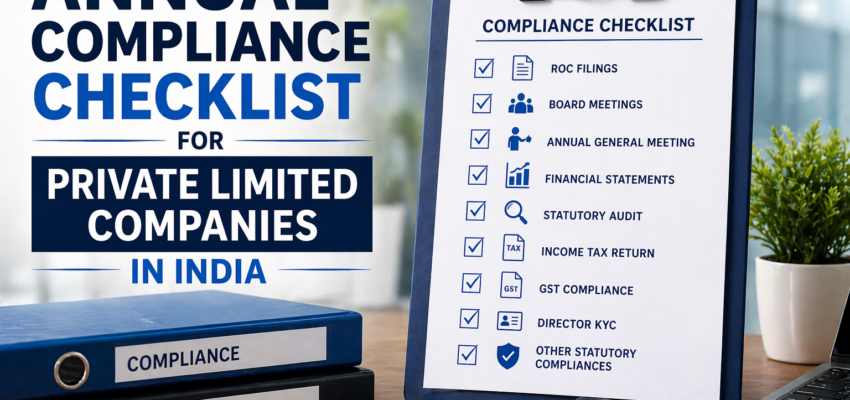
Annual Compliance Checklist for Private Limited Companies in India (2026 Guide)
Running a Private Limited Company in India comes with multiple advantages — limited liability, better credibility, and easier access to funding.
But along with these benefits comes a serious responsibility: compliance.
Many business owners focus on growth, sales, and operations — but ignore compliance until it becomes a problem.
👉 And that’s where penalties, notices, and legal risks begin.
This guide will give you a complete annual compliance checklist for Private Limited Companies in India, so you can stay compliant, avoid penalties, and run your business smoothly.
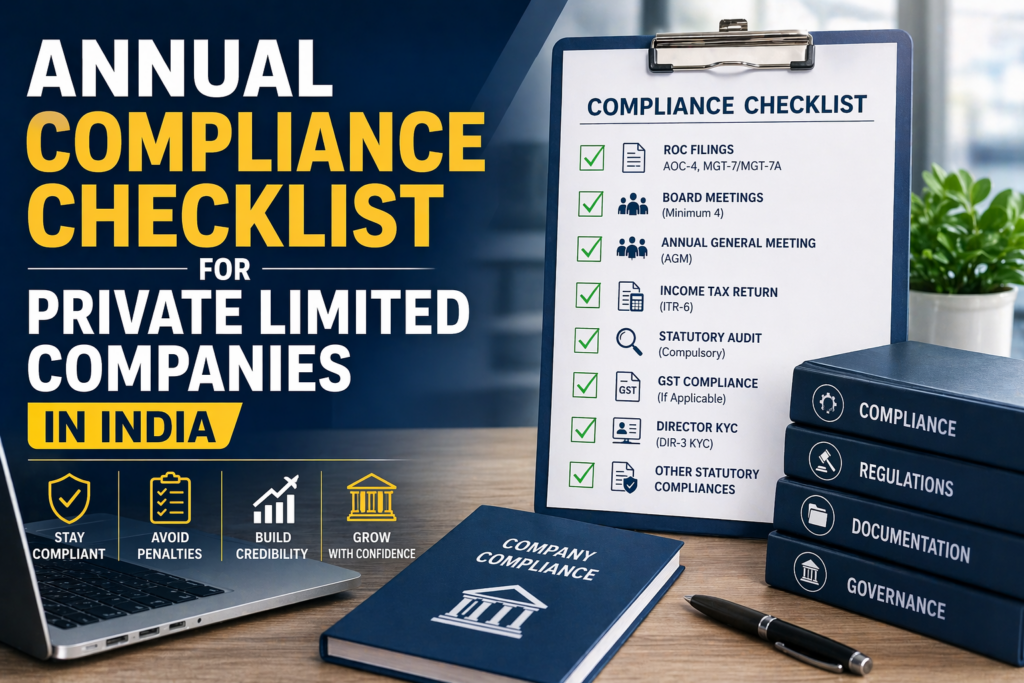
What Is Annual Compliance?
Annual compliance refers to the mandatory legal filings and requirements that every Private Limited Company must complete every year.
These are governed by:
- The Ministry of Corporate Affairs (MCA)
- The Income Tax Department
- GST authorities (if applicable)
Why Compliance Is Important
Ignoring compliance can lead to:
❌ Heavy penalties
❌ Director disqualification
❌ Company strike-off
❌ Legal notices
On the other hand, proper compliance helps you:
✔ Build credibility
✔ Attract investors
✔ Get loans easily
✔ Run a legally secure business
Complete Annual Compliance Checklist
Let’s break this down into simple, actionable steps 👇
1. Board Meetings (Minimum 4 Per Year)
Every Private Limited Company must conduct:
✔ Minimum 4 Board Meetings annually
✔ Gap between meetings should not exceed 120 days
What to Maintain:
- Meeting agenda
- Minutes of meetings
- Attendance records
👉 Even small companies must comply.
2. Annual General Meeting (AGM)
Every company must hold an AGM:
✔ Within 6 months from the end of the financial year
✔ Usually before 30th September
AGM Includes:
- Approval of financial statements
- Appointment/reappointment of auditors
- Declaration of dividends
3. Financial Statements Preparation
Prepare:
✔ Balance Sheet
✔ Profit & Loss Statement
✔ Cash Flow Statement
These must comply with:
- Accounting standards
- Proper documentation
👉 This forms the base for all filings.
4. ROC Annual Filing (Mandatory)
Filing with the Registrar of Companies (ROC) is critical.
Key Forms:
🔹 AOC-4
- Filing of financial statements
- Due within 30 days of AGM
🔹 MGT-7 / MGT-7A
- Annual return filing
- Due within 60 days of AGM
Impact of Delay:
❌ ₹100 per day penalty (no maximum limit in some cases)
5. Income Tax Return (ITR Filing)
Every Private Limited Company must file ITR.
Applicable Form:
- ITR-6
Due Date:
- Usually 31st October (subject to changes)
Requirements:
✔ Audit (if applicable)
✔ Financial statements
✔ Tax computation
6. Statutory Audit (Compulsory)
All Private Limited Companies must conduct an audit, regardless of turnover.
Conducted By:
✔ A Chartered Accountant
Purpose:
- Verify financial records
- Ensure compliance
- Detect errors or fraud
7. Director KYC (DIR-3 KYC)
Every director must complete KYC annually.
Includes:
✔ PAN
✔ Aadhaar
✔ Email & mobile verification
Due Date:
- Typically 30th September
Penalty:
❌ ₹5,000 for non-compliance
8. GST Compliance (If Registered)
If your company is GST registered, you must file:
Monthly / Quarterly:
✔ GSTR-1 (Sales return)
✔ GSTR-3B (Summary return)
Annual:
✔ GSTR-9
Key Points:
- Reconcile ITC
- Match data regularly
9. TDS & TCS Compliance
If your company deducts TDS:
✔ File quarterly TDS returns
✔ Issue TDS certificates
Forms:
- 24Q (Salary)
- 26Q (Non-salary)
Due Dates:
Quarterly deadlines apply.
10. Maintenance of Statutory Registers
Companies must maintain:
✔ Register of members
✔ Register of directors
✔ Register of charges
These must be:
👉 Updated and accessible
11. Event-Based Compliance
Some filings are not annual but event-driven:
Examples:
- Change in director
- Share transfer
- Increase in capital
- Change in registered office
👉 These must be filed within specified timelines.
12. Professional Tax (If Applicable)
In some states:
✔ Companies must register for Professional Tax
✔ File returns periodically
13. Shops & Establishment Compliance
Depending on your state:
✔ Maintain registration
✔ Renew licenses if required
14. MSME Form (If Applicable)
If your company deals with MSMEs:
✔ File MSME Form 1 (half-yearly)
👉 Important to track vendor payments.
15. Compliance Calendar (Must Have)
Every company should maintain a compliance calendar.
Include:
✔ Due dates
✔ Filing types
✔ Responsible person
👉 This helps avoid last-minute stress.
Common Mistakes Businesses Make
Avoid these mistakes:
❌ Missing deadlines
❌ Ignoring small compliances
❌ Poor documentation
❌ Not hiring professionals
❌ Delaying filings
👉 These mistakes can cost heavily.
Penalties for Non-Compliance
Here’s what can happen:
- ₹100 per day late filing fees
- Director disqualification
- Company strike-off
- Legal proceedings
👉 Compliance is cheaper than penalties.
How to Stay Compliant Easily
✅ 1. Hire a Chartered Accountant
A CA helps you:
✔ Track deadlines
✔ File returns
✔ Ensure accuracy
✅ 2. Use Accounting Software
Automation helps:
✔ Reduce errors
✔ Track compliance
✔ Save time
✅ 3. Maintain Proper Records
Keep:
- Invoices
- Bank statements
- Financial reports
✅ 4. Do Monthly Reviews
Instead of yearly panic:
✔ Check compliance monthly
✔ Fix issues early
Who Should Be Extra Careful?
- Startups
- Growing businesses
- Companies with multiple directors
- Businesses seeking funding
👉 Investors always check compliance history.
Final Thoughts
Compliance is not just a legal requirement —
👉 It’s a foundation for business growth.
Companies that stay compliant:
✔ Build trust
✔ Grow faster
✔ Avoid risks
Companies that ignore it:
❌ Face penalties
❌ Lose credibility
❌ Struggle to scale
Conclusion
Running a Private Limited Company in India requires discipline and responsibility.
The smartest approach is:
👉 Stay proactive, stay compliant, and stay ahead
🚀 Need Help with Company Compliance?
Connect with verified Chartered Accountants on Expenect and manage your company compliance without stress.

How a Chartered Accountant Helps You Scale Your Business Faster
Scaling a business is not just about increasing sales — it’s about building systems, managing finances smartly, reducing risks, and making the right decisions at the right time.
Many businesses in India struggle to scale, not because of lack of demand, but because of poor financial planning, compliance issues, and lack of strategic direction.
This is where a Chartered Accountant (CA) becomes more than just a tax filer —
👉 they become your growth partner.
In today’s competitive business environment, a CA plays a crucial role in helping businesses move from survival → stability → scalability → success.
Let’s understand how.
The Changing Role of a Chartered Accountant
Traditionally, CAs were seen as professionals who:
- Filed taxes
- Maintained books
- Handled audits
But today, their role has evolved significantly.
Modern Chartered Accountants:
✔ Provide strategic business advice
✔ Help in financial decision-making
✔ Support business expansion
✔ Optimize profitability
In fact, a CA today acts as a strategic partner who converts financial data into actionable business insights that align with long-term goals.
1. Building a Strong Financial Foundation
Every scalable business is built on a strong financial system.
A Chartered Accountant helps you:
- Choose the right business structure (Pvt Ltd, LLP, etc.)
- Set up accounting systems
- Ensure proper financial reporting
- Create scalable financial processes
Without a solid foundation, scaling leads to chaos.
CAs ensure that:
👉 Your financial system can handle growth without breaking
They help businesses start with structured systems that support long-term expansion.
2. Strategic Financial Planning for Growth
Scaling without planning is risky.
A CA helps you create:
- Growth budgets
- Financial forecasts
- Investment plans
- Expansion strategies
They analyze:
✔ Revenue trends
✔ Profit margins
✔ Cost structures
This allows you to:
👉 Make data-driven decisions instead of guesswork
Chartered accountants use financial analysis to guide business owners toward profitable and sustainable growth strategies.
3. Improving Cash Flow Management
Many profitable businesses fail due to poor cash flow.
A CA helps you:
- Track inflow & outflow
- Manage receivables & payables
- Avoid cash shortages
- Maintain liquidity
They ensure:
✔ You always have working capital
✔ You don’t over-invest or under-invest
Proper cash flow management helps businesses:
👉 Scale smoothly without financial stress
4. Legal Tax Saving = More Profit
Scaling is directly linked to profitability.
A CA helps you:
- Save tax legally
- Claim deductions
- Optimize tax structure
- Avoid penalties
This means:
👉 More money stays in your business
Instead of paying unnecessary tax, you can:
✔ Reinvest in marketing
✔ Hire better talent
✔ Expand operations
A CA ensures your business is tax-efficient and compliant, which directly impacts growth.
5. Ensuring 100% Compliance (Avoid Growth Killers)
Nothing slows down a business faster than:
❌ Tax notices
❌ Penalties
❌ Legal issues
A Chartered Accountant ensures:
- GST compliance
- Income tax filings
- ROC compliance
- Audit readiness
This protects your business from:
👉 Financial and legal risks
CAs play a key role in ensuring businesses operate smoothly and legally, which is essential for long-term sustainability.
6. Cost Optimization & Profit Maximization
Scaling is not just about increasing revenue —
👉 It’s about increasing profit margins.
A CA helps identify:
- Unnecessary expenses
- Cost leakages
- Inefficient operations
They suggest:
✔ Cost-cutting strategies
✔ Better pricing models
✔ Operational improvements
Result:
👉 Higher profit without increasing sales
7. Helping You Raise Funds & Investments
To scale fast, you often need:
- Business loans
- Investor funding
- Venture capital
A CA helps you:
✔ Prepare financial statements
✔ Create projections
✔ Build investor-ready reports
✔ Improve financial credibility
Investors trust businesses with:
- Clean records
- Proper compliance
- Transparent finances
CAs improve investor confidence by ensuring strong governance and financial transparency.
8. Supporting Business Expansio
Planning to:
- Open a new branch?
- Enter a new market?
- Launch a new product?
A CA helps you:
✔ Evaluate financial feasibility
✔ Analyze risks
✔ Plan capital requirements
✔ Structure expansion properly
They ensure:
👉 Your expansion is profitable, not risky
CAs translate business growth ambitions into financially viable strategies.
9. Risk Management & Business Protection
Scaling increases risk.
A Chartered Accountant helps identify:
- Financial risks
- Compliance risks
- Operational risks
They implement:
✔ Internal controls
✔ Audit systems
✔ Risk mitigation strategies
This protects your business from:
👉 Unexpected losses
CAs play a major role in risk assessment and mitigation, ensuring stability during growth.
10. Turning Data into Business Decisions
Most business owners look at numbers.
CAs interpret those numbers.
They help answer:
- Are you really profitable?
- Which product/service is performing best?
- Where are you losing money?
- When should you scale?
This turns:
📊 Data → Insights → Decisions → Growth
11. Improving Operational Efficiency
A CA identifies inefficiencies like:
- Manual processes
- Duplicate work
- Poor financial tracking
They implement:
✔ Automation tools
✔ Better systems
✔ Streamlined workflows
Result:
👉 Faster operations + lower costs
12. Helping You Think Like a CEO (Not Just Owner)
Most business owners are stuck in:
❌ Daily operations
❌ Firefighting mode
A CA helps you:
✔ Think strategically
✔ Plan long-term
✔ Focus on growth
They act as:
👉 Your financial advisor + strategic partner
Real-Life Impact: What Happens Without a CA?
Businesses without proper CA support often face:
❌ Poor financial planning
❌ High tax payments
❌ Compliance issues
❌ Cash flow problems
❌ Slow growth
While businesses with a CA:
✔ Grow faster
✔ Stay compliant
✔ Make better decisions
✔ Build sustainable systems
Who Needs a CA for Scaling?
You definitely need a CA if you are:
- Startup founder
- Business owner
- Freelancer scaling income
- MSME owner
- E-commerce seller
👉 Especially if your revenue is growing
CA = Cost or Investment?
Many businesses think hiring a CA is an expense.
Reality:
👉 A good CA saves more money than they charge
They help you:
✔ Save tax
✔ Avoid penalties
✔ Increase profit
✔ Grow faster
Final Thoughts
Scaling a business is not luck —
👉 It’s a combination of strategy, finance, and execution.
A Chartered Accountant helps you:
✔ Build strong financial systems
✔ Make smart decisions
✔ Stay compliant
✔ Optimize profits
✔ Scale sustainably
Conclusion
In today’s competitive market,
👉 You don’t just need an accountant…
👉 You need a Chartered Accountant who acts as your growth partner.
Because at the end of the day:
Businesses don’t fail due to lack of sales —
They fail due to poor financial management.
🚀 Want to Scale Your Business Faster?
Connect with verified Chartered Accountants on Expenect and turn your business into a scalable, profitable machine.
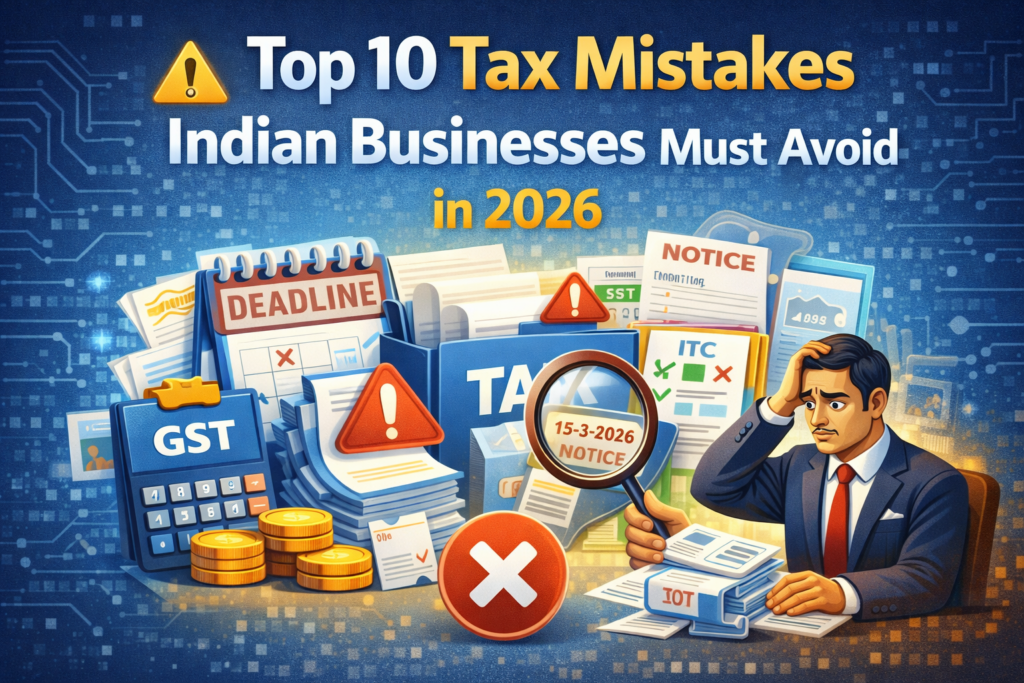
Top 10 Tax Mistakes Indian Businesses Must Avoid in 2026
Running a business in India is already challenging — and tax mistakes can make it even harder.
With stricter compliance, AI-based monitoring, and evolving GST rules in 2026, even small errors can lead to heavy penalties, notices, and financial losses.
The good news?
👉 Most tax mistakes are avoidable — if you know what to look for.
Let’s explore the top 10 tax mistakes Indian businesses must avoid in 2026 👇
1. Missing GST Return Deadlines
Late filing is one of the most common (and costly) mistakes.
Impact:
❌ Late fees
❌ Interest charges
❌ ITC blockage
Solution:
✔ Set monthly reminders
✔ Automate filings
✔ Work with a CA
2. Incorrect Input Tax Credit (ITC) Claims
Claiming wrong ITC or not verifying it properly can trigger notices.
Common Errors:
- Claiming ITC on ineligible expenses
- Mismatch with supplier returns
- Fake invoices
Impact:
🚨 ITC reversal + penalty
Solution:
✔ Reconcile GSTR-2B regularly
✔ Verify vendor compliance
3. Not Reconciling GST Returns
Many businesses don’t match:
- GSTR-1
- GSTR-3B
- GSTR-2B
Impact:
❌ Data mismatch
❌ ITC loss
❌ GST notices
Solution:
✔ Monthly reconciliation
✔ Use accounting software
4. Mixing Personal & Business Expenses
This is a major issue for:
- Freelancers
- Small business owners
Impact:
❌ Incorrect profit calculation
❌ Higher tax liability
❌ Compliance issues
Solution:
✔ Separate bank accounts
✔ Maintain proper records
5. Ignoring Advance Tax Payments
Many businesses forget advance tax.
Impact:
❌ Interest under Sections 234B & 234C
Solution:
✔ Plan quarterly payments
✔ Estimate income correctly
6. Choosing the Wrong Tax Regime
With multiple tax options available, wrong selection can increase tax.
Impact:
❌ Higher tax outgo
Solution:
✔ Compare old vs new regime
✔ Take expert advice
7. Poor Record Keeping
Incomplete or messy records can cause serious issues.
Impact:
❌ Failed audits
❌ Notices from tax authorities
❌ Loss of deductions
Solution:
✔ Maintain digital records
✔ Organize invoices & bills
8. Not Issuing Proper Invoices
Incorrect invoicing is a common GST mistake.
Errors Include:
- Missing GST number
- Wrong tax calculation
- No invoice format compliance
Impact:
❌ Invalid ITC
❌ Penalties
Solution:
✔ Use GST-compliant invoicing tools
9. Ignoring Tax Notices
Many businesses delay or ignore notices.
Impact:
🚨 Penalties increase
🚨 Legal complications
Solution:
✔ Respond immediately
✔ Consult a CA
10. Not Hiring a Professional (Biggest Mistake)
Trying to manage everything alone can backfire.
Impact:
❌ Costly mistakes
❌ Missed tax-saving opportunities
❌ Compliance risks
Solution:
✔ Hire a Chartered Accountant
✔ Use expert guidance
Bonus Mistake: Last-Minute Tax Planning
Waiting till March to save tax is risky.
Impact:
❌ Poor decisions
❌ Missed deductions
Solution:
✔ Plan tax throughout the year
How to Avoid These Mistakes in 2026
Follow this simple strategy:
✅ Automate Your Accounting
Use:
- GST software
- Cloud accounting tools
✅ Stay Updated
Tax laws change frequently — stay informed.
✅ Work with Experts
A CA helps:
✔ Ensure compliance
✔ Save tax legally
✔ Handle notices
✅ Review Monthly
Don’t wait till year-end.
✔ Check returns
✔ Reconcile data
✔ Fix errors early
Who Should Be Most Careful?
- Startups
- MSMEs
- E-commerce sellers
- Freelancers
- Growing businesses
👉 These segments are most vulnerable to tax mistakes.
Final Thoughts
In 2026, tax compliance in India is:
✔ More digital
✔ More strict
✔ More automated
👉 Small mistakes = Big consequences
Conclusion
Avoiding tax mistakes is not just about saving money —
👉 It’s about protecting your business.
The smartest businesses:
✔ Stay compliant
✔ Plan ahead
✔ Take expert help
Need Help Avoiding Tax Mistakes?
Connect with verified Chartered Accountants on Expenect and ensure your business stays compliant, penalty-free, and profitable.
GST 2026 New Rules Explained: What Every Business Must Know
The GST system in India is evolving rapidly. With 2026 bringing stricter compliance, advanced technology integration, and tighter monitoring, businesses must stay updated to avoid penalties and ensure smooth operations.
If you’re a business owner, startup, or SME, understanding the latest GST rules is no longer optional — it’s critical.
Let’s break down everything you need to know in simple terms 👇
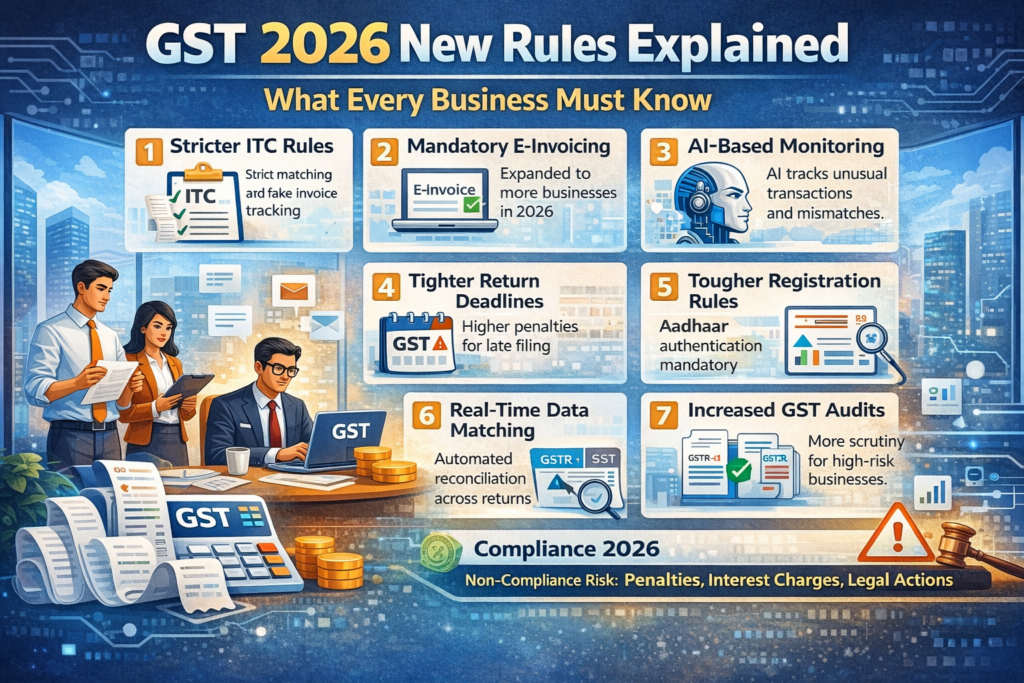
Why GST Changes in 2026 Matter
The government is focusing on:
✔ Reducing tax evasion
✔ Increasing transparency
✔ Automating compliance
✔ Improving data matching
👉 Result:
More accuracy required, less room for errors
1. Stricter Input Tax Credit (ITC) Rules
One of the biggest updates in 2026 is around Input Tax Credit (ITC).
What’s Changed?
- ITC allowed only if supplier files returns correctly
- Real-time invoice matching becoming more strict
- Fake invoicing detection using AI
Impact on Businesses:
❌ Wrong ITC claims = penalties
❌ Mismatch = credit blocked
What You Should Do:
✔ Work with reliable vendors
✔ Reconcile GSTR-2B regularly
✔ Use automated GST tools
2. Mandatory E-Invoicing Expansion
E-invoicing is being expanded to more businesses in 2026.
Key Updates:
- Lower turnover threshold
- Real-time invoice validation
- Integration with GST portal
Impact:
✔ Faster compliance
✔ Reduced fraud
✔ Better reporting
👉 Businesses not using e-invoicing may face penalties and invalid invoices.
3. AI-Based GST Monitoring & Notices
The GST system is now powered by Artificial Intelligence (AI).
What AI Tracks:
- Mismatch in returns
- Unusual transactions
- Fake billing patterns
Impact:
🚨 Faster GST notices
🚨 Increased scrutiny
Tip:
✔ Ensure 100% accurate filing
✔ Avoid aggressive or risky tax practices
4. Tighter Return Filing Deadlines
Late filing is becoming more expensive.
Changes:
- Stricter penalties for delays
- Auto-blocking of returns in some cases
- No ITC if returns are not filed on time
Impact:
❌ Cash flow issues
❌ Compliance risks
Solution:
✔ Maintain a monthly GST calendar
✔ Automate reminders
✔ Hire a CA for timely filing
5. GST Registration Rules Tightened
To prevent fraud, registration rules are stricter.
Updates:
- Aadhaar authentication mandatory
- Physical verification in some cases
- More document checks
Impact:
✔ Genuine businesses get faster approval
❌ Fake registrations get blocked
6. Real-Time Data Matching Across Returns
GST is moving towards real-time reconciliation.
What It Means:
- GSTR-1 vs GSTR-3B matching
- Buyer-seller data matching
- Automated discrepancy detection
Impact:
❌ Errors flagged instantly
❌ ITC blocked quickly
What to Do:
✔ Regular reconciliation
✔ Use cloud accounting software
✔ Avoid manual errors
7. Increased GST Audits & Compliance Checks
With better data tracking, audits are increasing.
Businesses at Risk:
- High ITC claims
- Inconsistent filings
- Large transactions
Impact:
🚨 More scrutiny
🚨 Higher penalty risk
8. Penalties & Consequences in 2026
Non-compliance can lead to:
❌ Heavy penalties
❌ Interest charges
❌ GST registration cancellation
❌ Legal notices
👉 Compliance is now non-negotiable
How Businesses Can Stay Compliant in 2026
Follow these best practices:
✅ 1. Automate Your Accounting
Use tools for:
- GST filing
- Invoice generation
- Reconciliation
✅ 2. Work with a Chartered Accountant
A CA ensures:
✔ Accurate filing
✔ ITC optimization
✔ Notice handling
✔ Compliance management
✅ 3. Maintain Proper Documentation
Keep:
- Invoices
- Bills
- GST returns
- Bank statements
✅ 4. Reconcile Data Monthly
Don’t wait till year-end.
✔ Match GSTR-1, GSTR-3B, GSTR-2B
✔ Fix mismatches early
✅ 5. Stay Updated with GST Changes
GST rules evolve frequently.
👉 Follow updates or consult a CA regularly.
Who Is Most Affected by GST 2026 Changes?
- Small businesses
- E-commerce sellers
- Startups
- MSMEs
- Service providers
👉 Especially those with poor compliance systems.
Final Thoughts
GST in 2026 is becoming:
✔ More digital
✔ More transparent
✔ More strict
Businesses that adapt will:
✅ Avoid penalties
✅ Improve efficiency
✅ Grow faster
Businesses that ignore changes will:
❌ Face notices
❌ Lose money
❌ Risk shutdown
Conclusion
The new GST rules are not just about compliance — they are about building a clean, transparent, and efficient business ecosystem.
👉 The smarter approach is:
Be proactive, not reactive.
Looking for Expert GST Help?
Connect with verified Chartered Accountants on Expenect to manage your GST compliance, avoid penalties, and grow your business stress-free.
AI in Accounting: How Technology Is Changing CA Services in India
The accounting industry in India is going through a massive transformation.
What once required hours of manual work is now being done in minutes — thanks to Artificial Intelligence (AI).
From automated bookkeeping to predictive tax planning, AI is redefining how Chartered Accountants (CAs) work and deliver value to clients.
But the real question is 👇
👉 Will AI replace CAs or make them more powerful?
Let’s explore.
What Is AI in Accounting?
AI in accounting refers to the use of:
- Machine Learning (ML)
- Automation tools
- Data analytics
- Cloud-based software
…to perform tasks like:
✔ Data entry
✔ Invoice processing
✔ Tax calculations
✔ Financial forecasting
In simple terms:
👉 AI handles repetitive tasks, while CAs focus on strategy and decision-making.
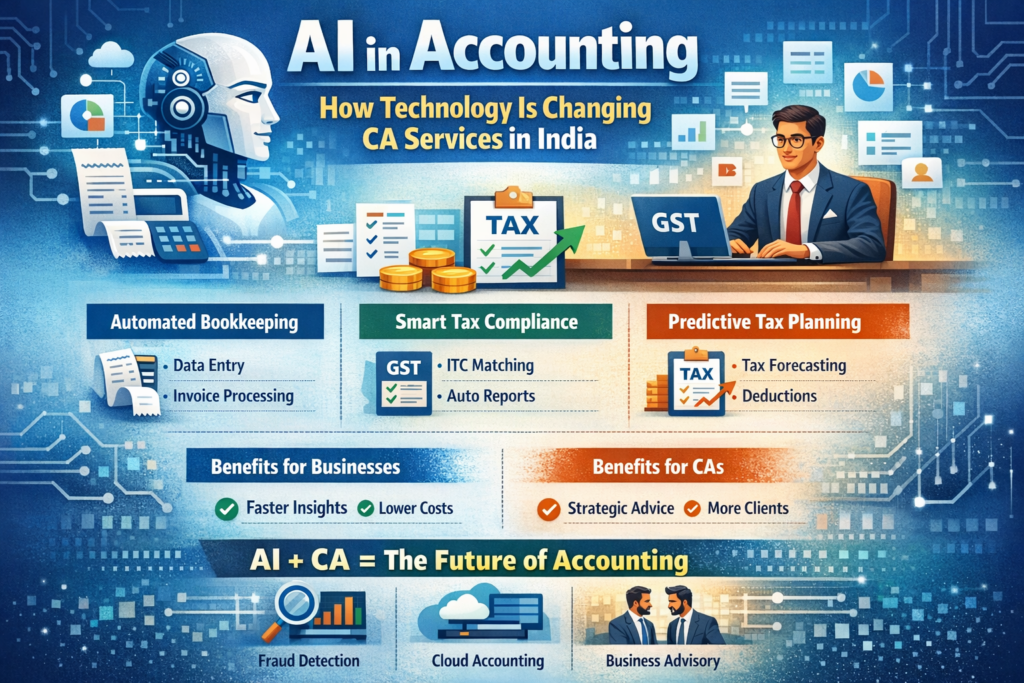
How AI Is Transforming CA Services in India
1. Automated Bookkeeping & Data Entry
Earlier:
- Manual entries in Tally or spreadsheets
- High chances of human error
Now:
- AI tools auto-read invoices
- Bank transactions are synced
- Real-time bookkeeping
✔ Saves time
✔ Improves accuracy
✔ Reduces cost
2. Smart GST & Tax Compliance
AI-powered tools now:
- Detect mismatches in GST returns
- Suggest Input Tax Credit (ITC)
- Track compliance deadlines
- Auto-generate reports
👉 Result:
Fewer errors + fewer notices + better compliance
3. Faster Financial Analysis & Reporting
AI can analyze:
- Profit & loss trends
- Cash flow patterns
- Expense breakdowns
Within seconds.
CAs now provide:
✔ Real-time financial insights
✔ Actionable business advice
✔ Growth strategies
4. Predictive Tax Planning
This is where AI becomes powerful.
AI tools can:
- Predict future tax liability
- Suggest investment strategies
- Optimize deductions
👉 Instead of reacting, businesses can now plan proactively.
5. Fraud Detection & Risk Management
AI systems can:
- Detect unusual transactions
- Identify fraud patterns
- Alert inconsistencies
✔ Improves financial security
✔ Reduces business risk
6. Cloud Accounting & Remote Access
With cloud-based tools:
- Data is accessible anytime, anywhere
- Real-time collaboration with CA
- No dependency on physical files
👉 This has made online CA services more popular in India.
Benefits of AI for Businesses
Using AI-powered CA services gives businesses:
✅ Faster turnaround time
✅ Lower operational costs
✅ Better financial insights
✅ Higher accuracy
✅ Real-time decision-making
Benefits of AI for Chartered Accountants
AI is not replacing CAs — it is upgrading them.
CAs can now:
✔ Focus on advisory services
✔ Handle more clients efficiently
✔ Offer strategic financial planning
✔ Improve client satisfaction
👉 The role of a CA is shifting from “number cruncher” to “business advisor.”
Challenges of AI in Accounting
While AI brings advantages, there are some challenges:
⚠ Data privacy concerns
⚠ Dependence on technology
⚠ Initial setup cost
⚠ Learning curve for professionals
But with proper implementation, these can be managed.
Will AI Replace Chartered Accountants?
Short answer: No.
AI can:
- Process data
- Automate tasks
But it cannot:
❌ Provide human judgment
❌ Understand complex business scenarios
❌ Handle legal representation
❌ Build client trust
👉 The future is not AI vs CA
👉 It is AI + CA
Future of CA Services in India
The future will see:
🚀 AI-powered tax planning
🚀 Fully automated compliance systems
🚀 Real-time financial dashboards
🚀 Digital-first CA firms
🚀 Hybrid (online + local) CA services
Businesses will prefer:
👉 Tech-enabled Chartered Accountants
How to Choose a Tech-Enabled CA
When hiring a CA, check:
✔ Use of modern tools (cloud accounting, AI software)
✔ Digital communication (email, dashboards)
✔ Fast turnaround time
✔ Data security practices
✔ Advisory capabilities
👉 A modern CA = Technology + Expertise
Conclusion
AI is not a threat — it’s a game-changer for the accounting industry.
It is:
✔ Making processes faster
✔ Improving accuracy
✔ Enabling smarter decisions
And most importantly —
👉 It is helping Chartered Accountants deliver more value than ever before.
Looking for a Tech-Enabled Chartered Accountant?
Explore Expenect to connect with modern, AI-powered CAs who can help you grow your business smarter and faster
CA vs Accountant: Who Do You Actually Need for Your Business in India?
When running a business in India, one of the most confusing decisions for founders and business owners is:
👉 Should I hire a Chartered Accountant (CA) or just an Accountant?
Many people use these terms interchangeably — but they are not the same. Choosing the wrong professional can lead to compliance issues, penalties, and missed growth opportunities.
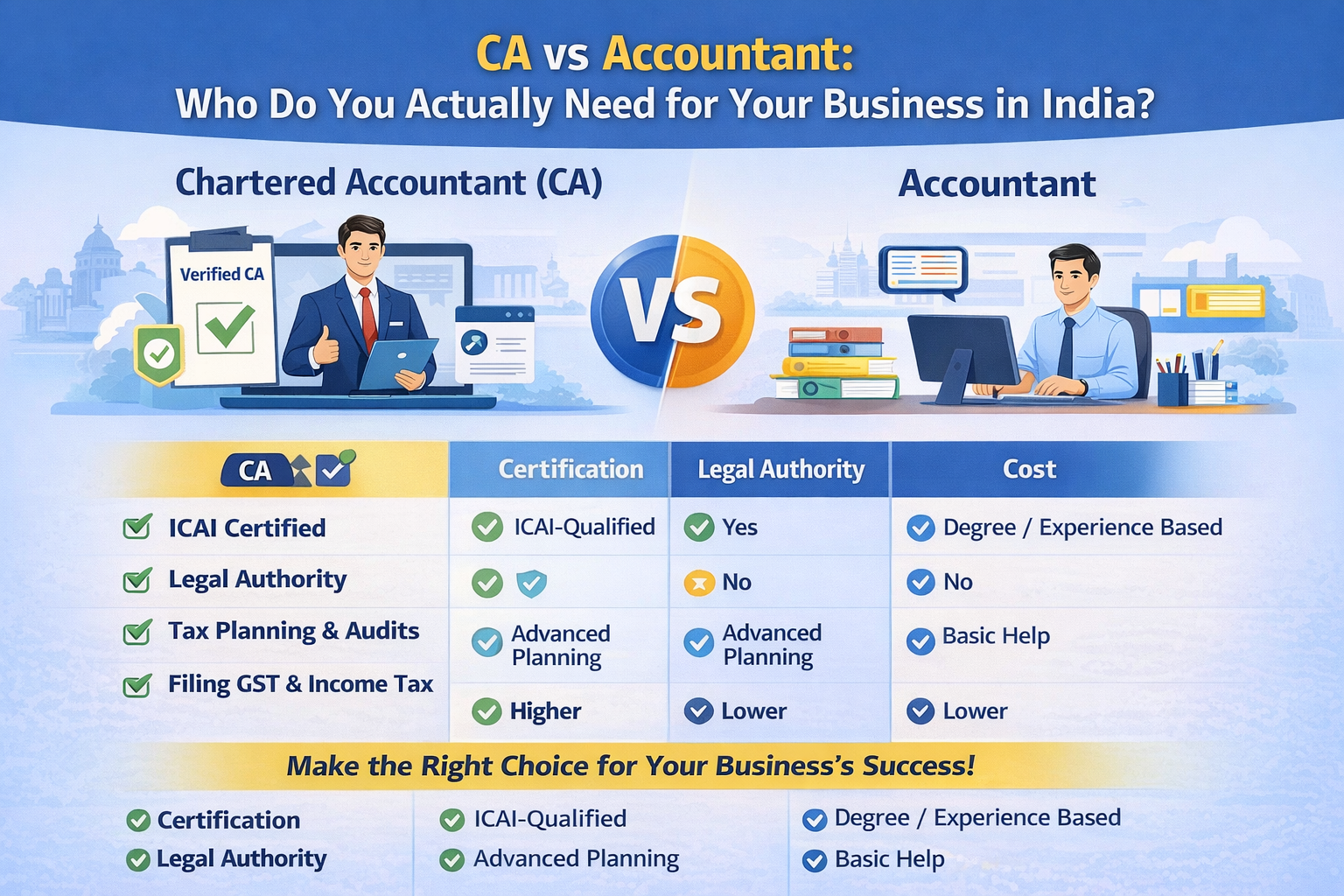
Let’s break it down clearly so you can make the right decision for your business.
Understanding the Difference: CA vs Accountant
Who Is a Chartered Accountant (CA)?
A Chartered Accountant is a highly qualified professional who:
- Is certified by the Institute of Chartered Accountants of India (ICAI)
- Clears rigorous exams (CA Foundation, Intermediate, Final)
- Completes mandatory articleship training
- Holds a Certificate of Practice (COP) to offer services
A CA is legally authorized to:
✔ Audit financial statements
✔ File income tax & GST returns
✔ Represent you before tax authorities
✔ Sign audit & compliance reports
Who Is an Accountant?
An Accountant is someone who:
- Maintains books of accounts
- Records daily transactions
- Prepares basic financial reports
They may have:
- A commerce degree
- Accounting software knowledge (Tally, Zoho, etc.)
- Practical experience
⚠️ Accountants are not regulated by ICAI and have limited legal authority.
Key Differences: CA vs Accountant (Quick Comparison)
| Aspect | Chartered Accountant (CA) | Accountant |
|---|---|---|
| Qualification | ICAI Certified | Degree / Experience Based |
| Legal Authority | Yes | No |
| Can Sign Audit Reports | Yes | No |
| Represent Before Tax Dept | Yes | No |
| Tax Planning | Advanced & Legal | Limited |
| Cost | Higher | Lower |
| Risk Handling | High | Low |
When Do You Need an Accountant?
An Accountant is suitable if your business:
✔ Is small or early-stage
✔ Has simple transactions
✔ Needs daily bookkeeping
✔ Requires invoice management
✔ Wants cost-effective data entry support
Best for:
- Small traders
- Freelancers
- Micro businesses
- Shops & local vendors
👉 Accountants help keep records organized, but cannot replace a CA for compliance.
When Do You Need a Chartered Accountant?
You need a CA if your business:
✔ Needs GST filing or audits
✔ Requires income tax planning
✔ Receives tax notices
✔ Needs company compliance
✔ Is growing or scaling
✔ Wants legal tax savings
Best for:
- Startups
- Private Limited Companies
- LLPs
- MSMEs
- Funded businesses
- High-turnover firms
👉 A CA protects your business legally and financially.
Can You Use Both? (Best Practice)
Yes — and this is what smart businesses do.
Ideal Setup:
- Accountant → Daily bookkeeping & records
- CA → Tax filing, compliance, audits & planning
This combination:
✔ Reduces cost
✔ Improves accuracy
✔ Minimizes risk
✔ Ensures compliance
Common Mistakes Businesses Make
🚨 Depending only on an accountant for tax filings
🚨 Hiring unqualified “tax consultants”
🚨 Ignoring CA advice to save fees
🚨 Late compliance due to poor guidance
These mistakes often lead to:
- Penalties
- Legal notices
- Loss of credibility
- Financial stress
Cost Comparison: CA vs Accountant
- Accountant: ₹5,000 – ₹15,000/month (varies by city & scope)
- CA: Project-based or monthly retainer depending on services
💡 A CA may cost more, but the money they save you legally is often much higher.
How to Choose the Right Professional for Your Business
Before hiring:
✔ Verify ICAI registration (for CA)
✔ Check experience in your industry
✔ Ask about scope of services
✔ Ensure clear pricing
✔ Use verified platforms like Expenect
Final Verdict: CA or Accountant?
| Business Stage | Who You Need |
|---|---|
| Very Small / Early Stage | Accountant |
| Growing Business | Accountant + CA |
| GST Registered Business | CA |
| Company / LLP | CA |
| Tax Notices / Audits | CA |
| Scaling / Fundraising | CA |
👉 Accountants manage numbers.
CAs manage risk, compliance & growth.
Conclusion
If your business is serious about growth, compliance, and long-term stability, you cannot avoid a Chartered Accountant.
An accountant supports operations.
A CA safeguards your business future.
Looking for the Right CA for Your Business?
Explore Expenect and connect with ICAI-verified Chartered Accountants suited to your business needs.
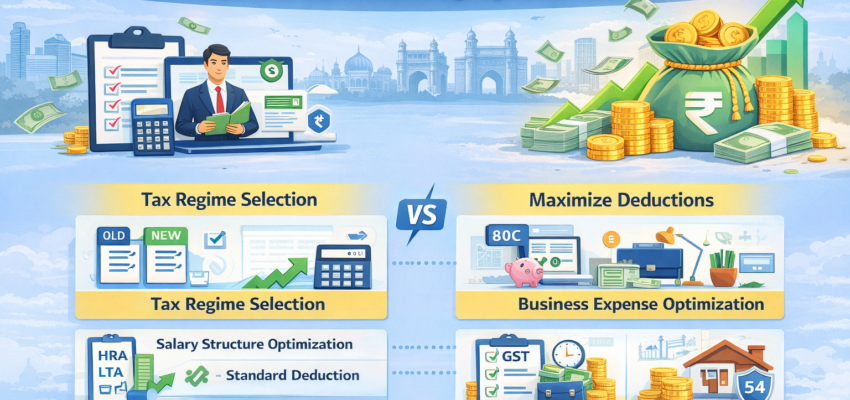
How a Chartered Accountant Helps You Save Tax Legally in India
Paying tax is mandatory.
Paying extra tax due to lack of knowledge is not.
In India, tax laws are complex, frequently changing, and full of legal provisions that most people don’t fully understand. This is where a Chartered Accountant (CA) becomes your biggest financial ally.
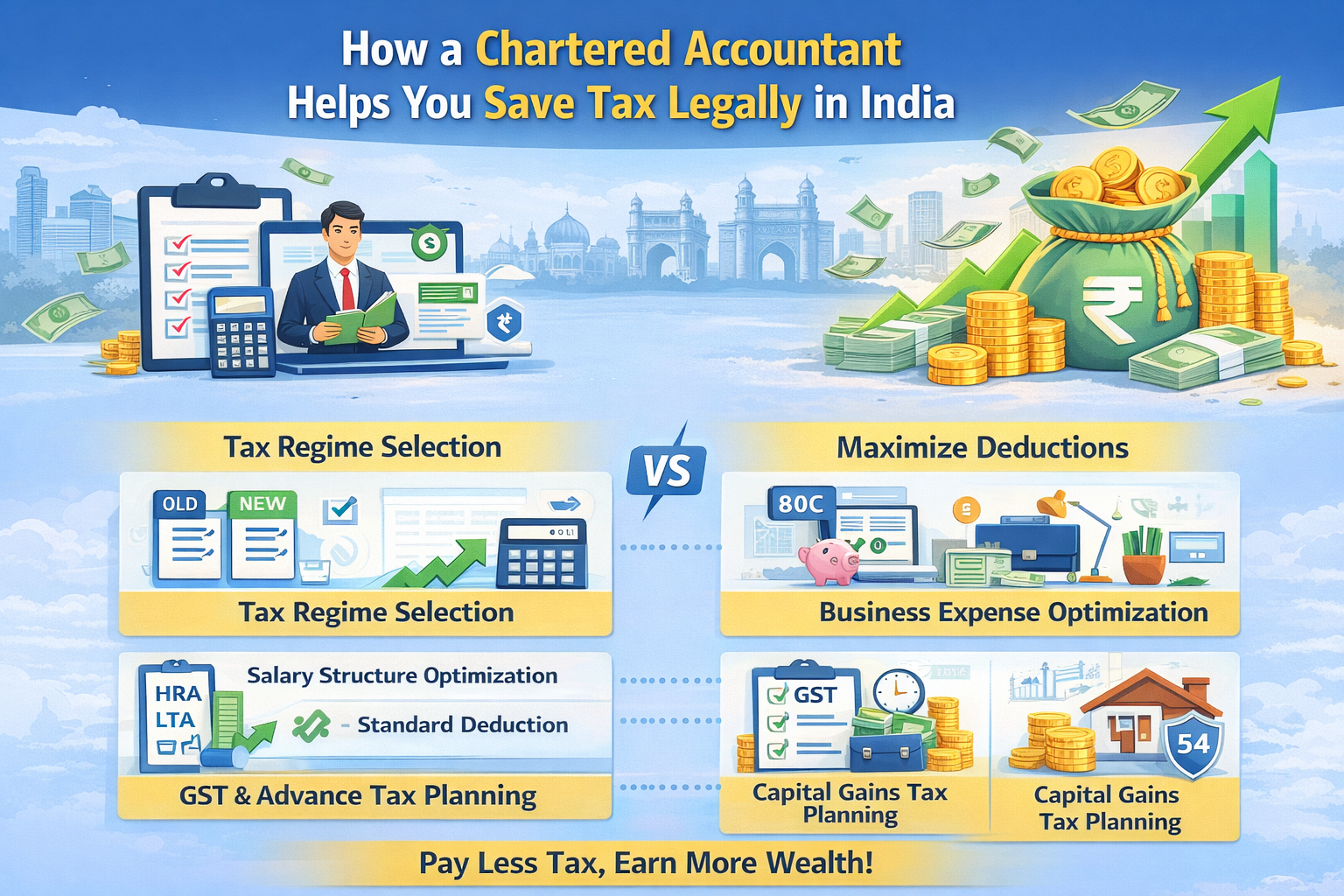
A professional CA doesn’t help you evade tax — they help you save tax legally, ethically, and intelligently.
Let’s understand how.
Why Tax Planning Is Important in India
Many people think tax saving happens only while filing returns.
That’s a mistake.
❌ Last-minute tax filing
❌ Random investments without planning
❌ Ignoring deductions & exemptions
❌ Wrong income classification
All these result in higher tax outgo.
A CA focuses on tax planning throughout the year, not just tax filing season.
1. Choosing the Right Tax Regime (Old vs New)
One of the biggest confusions today is:
👉 Old Tax Regime or New Tax Regime?
A Chartered Accountant:
- Calculates tax liability under both regimes
- Considers:
- Income level
- Deductions
- Investments
- Family structure
- Suggests the most tax-efficient option
✔️ This alone can save thousands (or lakhs) every year.
2. Maximizing Deductions Under Income Tax Act
A CA ensures you don’t miss out on legal deductions, such as:
Common Deductions:
- Section 80C – PPF, ELSS, LIC, EPF
- Section 80D – Health insurance
- Section 80CCD – NPS
- Section 24(b) – Home loan interest
- Section 80E – Education loan interest
Many taxpayers either:
- Don’t claim them
- Claim them incorrectly
A CA ensures maximum benefit with full compliance.
3. Smart Salary Structuring (For Salaried Individuals)
A Chartered Accountant helps restructure salary to reduce tax legally:
- HRA optimization
- Leave Travel Allowance (LTA)
- Standard deduction
- Reimbursements
- Employer NPS contribution
✔️ Same salary, lower tax.
4. Business Expense Optimization (For Business Owners & Freelancers)
Business owners often pay more tax than needed due to poor expense management.
A CA helps you:
- Identify allowable business expenses
- Maintain proper documentation
- Claim depreciation correctly
- Separate personal & business expenses
- Reduce taxable profit legally
Examples:
- Office rent
- Internet & phone bills
- Travel expenses
- Software & tools
- Professional fees
Result? Lower taxable income without any risk.
5. GST Planning to Reduce Tax Burden
For GST-registered businesses, a CA helps with:
- Input Tax Credit (ITC) optimization
- Correct GST classification
- Avoiding blocked credits
- Timely filing to avoid penalties
- Proper reconciliation
Incorrect GST planning can silently increase costs.
A CA ensures:
✔️ Maximum ITC
✔️ Minimum compliance risk
6. Capital Gains Tax Planning
Selling property, shares, or other assets?
A CA helps reduce capital gains tax through:
- Indexation benefits
- Long-term vs short-term planning
- Section 54, 54F, 54EC exemptions
- Proper timing of asset sale
Without planning, you may pay unnecessary capital gains tax.
7. Advance Tax & Interest Avoidance
Many taxpayers end up paying:
- Interest under Section 234A, 234B, 234C
A CA:
- Calculates advance tax liability
- Plans timely payments
- Prevents interest & penalties
✔️ Saves money and stress.
8. Handling Notices & Compliance Safely
Sometimes tax-saving mistakes lead to notices.
A Chartered Accountant:
- Replies to Income Tax notices
- Represents you legally
- Justifies deductions correctly
- Protects you from penalties
This legal backing is priceless.
9. Long-Term Tax & Wealth Planning
Tax saving is not just about this year.
A CA helps with:
- Long-term investment planning
- Retirement planning
- Business restructuring
- Succession planning
- Family tax optimization
This ensures sustainable wealth growth with minimum tax leakage.
10. Ensuring 100% Legal & Ethical Tax Saving
The biggest advantage of a CA is peace of mind.
✔️ No fake deductions
✔️ No risky shortcuts
✔️ No future penalties
✔️ Fully compliant with Indian laws
Legal tax saving is about smart planning, not manipulation.
Who Should Hire a Chartered Accountant for Tax Saving?
You should definitely hire a CA if you are:
- A salaried professional
- A freelancer or consultant
- A business owner
- A startup founder
- An investor
- A high-income individual
If your income is growing, professional tax planning becomes essential.
Conclusion
Paying tax is compulsory.
Overpaying tax is optional.
A Chartered Accountant helps you:
✅ Understand tax laws
✅ Plan income smartly
✅ Claim every legal benefit
✅ Stay compliant
✅ Build long-term financial security
The right CA doesn’t cost you money —
they save you money.
Looking for a Verified Chartered Accountant?
Find ICAI-verified CAs on Expenect and start saving tax legally today.
Online CA Services vs Local CA in Mumbai: Which Is Better for You?
Choosing the right Chartered Accountant (CA) is one of the most important decisions for your business, taxes, compliance, and financial planning. With the rise of digital services, you now have two main options: Online CA Services and Local CA in Mumbai.
Both have their advantages — but which one is best for you?
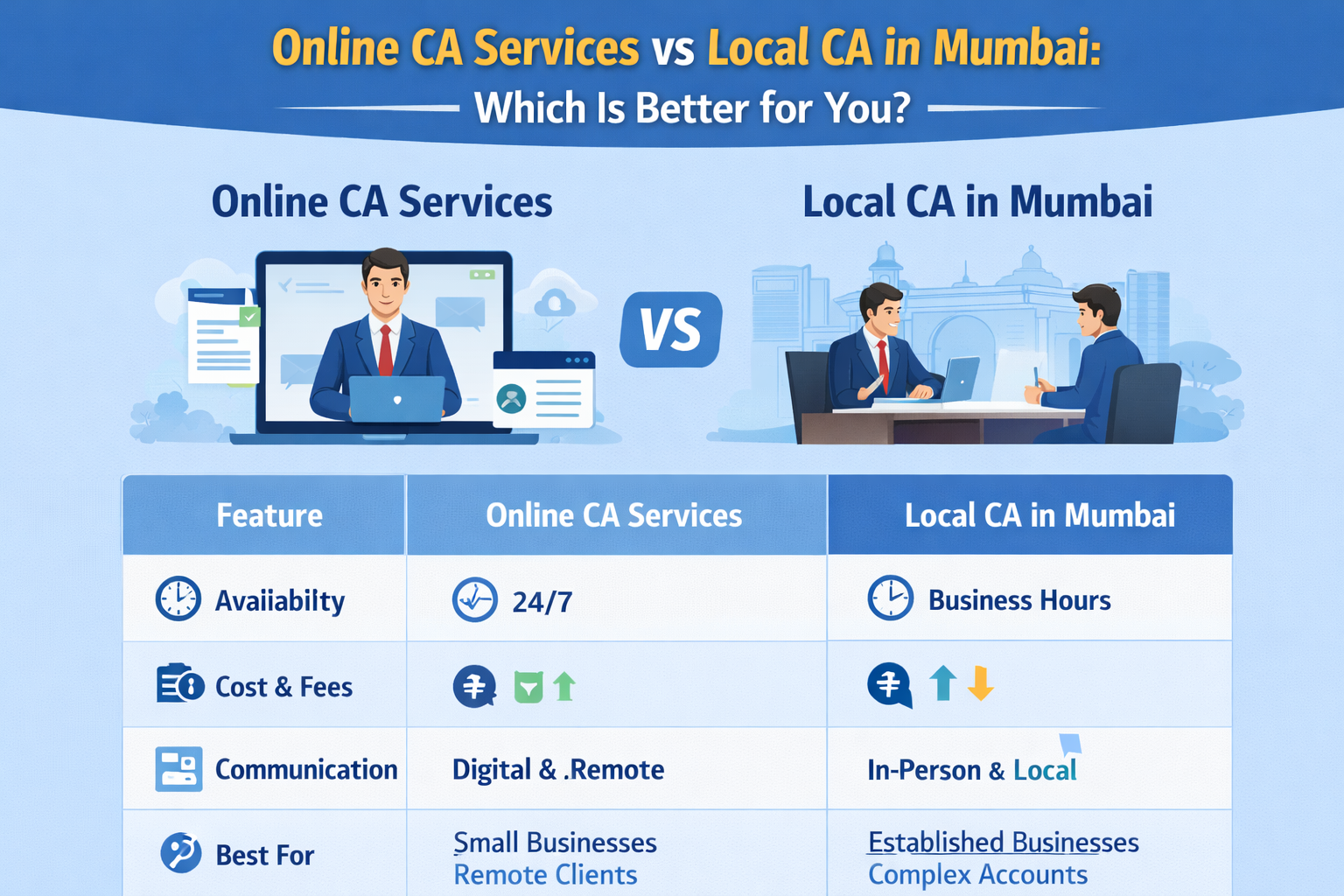
In this guide, we’ll compare both options, help you decide based on your needs, and share tips to choose the right CA so you don’t end up paying extra or risking non-compliance.
Why This Decision Matters
Hiring the wrong CA can lead to:
- Missed tax deadlines
- Compliance penalties from GST/Income Tax departments
- Wrong tax planning
- Poor financial decisions
Whether you choose an online service or a Mumbai local CA, the goal is accuracy, reliability, transparency, and trust.
What Is an Online CA Service?
Online CA Services are digital platforms or professionals who offer accounting, taxation, GST filing, compliance, and advisory services remotely using technology.
📍 Typical features:
- Cloud-based collaboration
- Email / WhatsApp communication
- Digital documents & signatures
- Faster turnaround times
- Lower fees
Examples:
- Tax filing
- GST returns
- Financial statements
- Startup compliance
- Advisory services
What Is a Local CA in Mumbai?
A Local CA is a physically present Chartered Accountant usually based in or around Mumbai, with offices you can visit.
📍 Typical features:
- In-person meetings
- Local market knowledge
- Direct communication
- Personalized services
Often preferred by:
- Established businesses
- Companies with complex books
- Clients needing face-to-face interaction
Head-to-Head Comparison: Online CA vs Local CA
1. Accessibility & Communication
Online CA Services
✅ 24/7 messages & emails
✅ Rapid digital turnaround
❌ No physical meetings
Local CA in Mumbai
✅ In-person consultations
✅ Can visit your office
❌ Limited to business hours
➡️ Best for:
- Online: Remote clients, startups, solopreneurs
- Local: Businesses valuing face-to-face support
2. Cost & Fees
Online CA Services
💲 Typically lower fees
💲 No office overheads
💲 Transparent pricing
Local CA in Mumbai
💰 Higher fees due to office expenses
💰 Personal attention adds cost
➡️ Best for:
- Online: Small businesses & freelancers
- Local: Complex accounts & high-value clients
3. Convenience
Online CA Services
👍 No location limits
👍 Upload documents digitally
👍 Faster communication
Local CA in Mumbai
👍 Easy local coordination
👍 Immediate availability for meetings
👎 Travel required for appointments
➡️ Best for:
- Online: Busy founders & remote businesses
- Local: Traditional clients needing touchpoints
4. Local Knowledge & Personalization
Online CA Services
✔️ Good with standard processes
✔️ Great with tech workflows
✖️ Limited local context
Local CA in Mumbai
✔️ Deep local tax & compliance understanding
✔️ Familiar with Mumbai government rules
✔️ Better for MSME & regional businesses
➡️ Best for:
- Online: Standard compliance work
- Local: Local legal matters & specific municipal rules
5. Trust & Accountability
Online CA Services
🔹 Depends on platform credibility
🔹 Digital ratings & reviews
🔹 Quick support tracking
Local CA in Mumbai
🔹 Office address & physical presence
🔹 Reputation in local business circles
🔹 Word-of-mouth trust
➡️ Best for:
- Online: Verified & reviewed platforms
- Local: Long-term partnership & reliability
Who Should Choose Online CA Services?
Choose Online CA if you:
✔ Are a startup with simple compliance
✔ Want lower pricing
✔ Prefer digital documentation
✔ Work remotely or outside Mumbai
✔ Don’t need physical meetings
Best suited for:
- Freelancers
- E-commerce sellers
- Consultants
- Small startups
- Remote businesses
Who Should Choose a Local CA in Mumbai?
Choose Local CA if you:
✔ Need in-person meetings
✔ Have complex accounts
✔ Plan audits & financial restructuring
✔ Want local compliance insights
✔ Seek personalized face-to-face service
Best suited for:
- Medium / large businesses
- Companies with GST audits
- Businesses with legal notices
- Clients needing deep custom advice
Tips to Choose the Right CA (Online or Local)
1. Verify ICAI Registration
Any CA you hire must be registered with ICAI and have a valid Certificate of Practice (COP).
2. Check Reviews & Testimonials
Look for:
- Verified reviews
- Client feedback
- Google ratings
3. Ask for Sample Workflows
Whether online or local, see how they:
- Collect data
- Communicate
- Deliver reports
- Handle queries
4. Clarify Pricing Upfront
Ask for:
- Transparent fee structure
- No hidden charges
- Billing schedules
5. Confirm Communication Channels
Make sure you are comfortable with:
- Emails
- Phone calls
- Video meetings
- In-person schedules (for local CAs)
Final Verdict: Which Is Better for You?
There’s no one-size-fits-all answer.
| Needs | Better Choice |
|---|---|
| Lower Cost | Online CA Services |
| Fast Digital Filing | Online CA Services |
| Complex Business Needs | Local CA in Mumbai |
| Personalized Support | Local CA in Mumbai |
| Remote Business | Online CA Services |
| Local Insights | Local CA in Mumbai |
👉 If you’re still unsure, Expenect helps you compare verified CAs — local and online — in one place.
Conclusion
Both Online CA Services and Local CAs in Mumbai have unique benefits. The right choice depends on:
💡 Your business size
💡 Complexity of accounts
💡 Need for personal interaction
💡 Budget and timeline
Whether online or local, always choose a verified, qualified, and trustworthy CA.
Need Help Choosing?
Explore Expenect’s verified CA listings and find the best fit for your business today!