

ESOPs & Taxation in India: A Complete Guide for Founders and Employees
ESOPs & Taxation in India: A Complete Guide for Founders and Employees
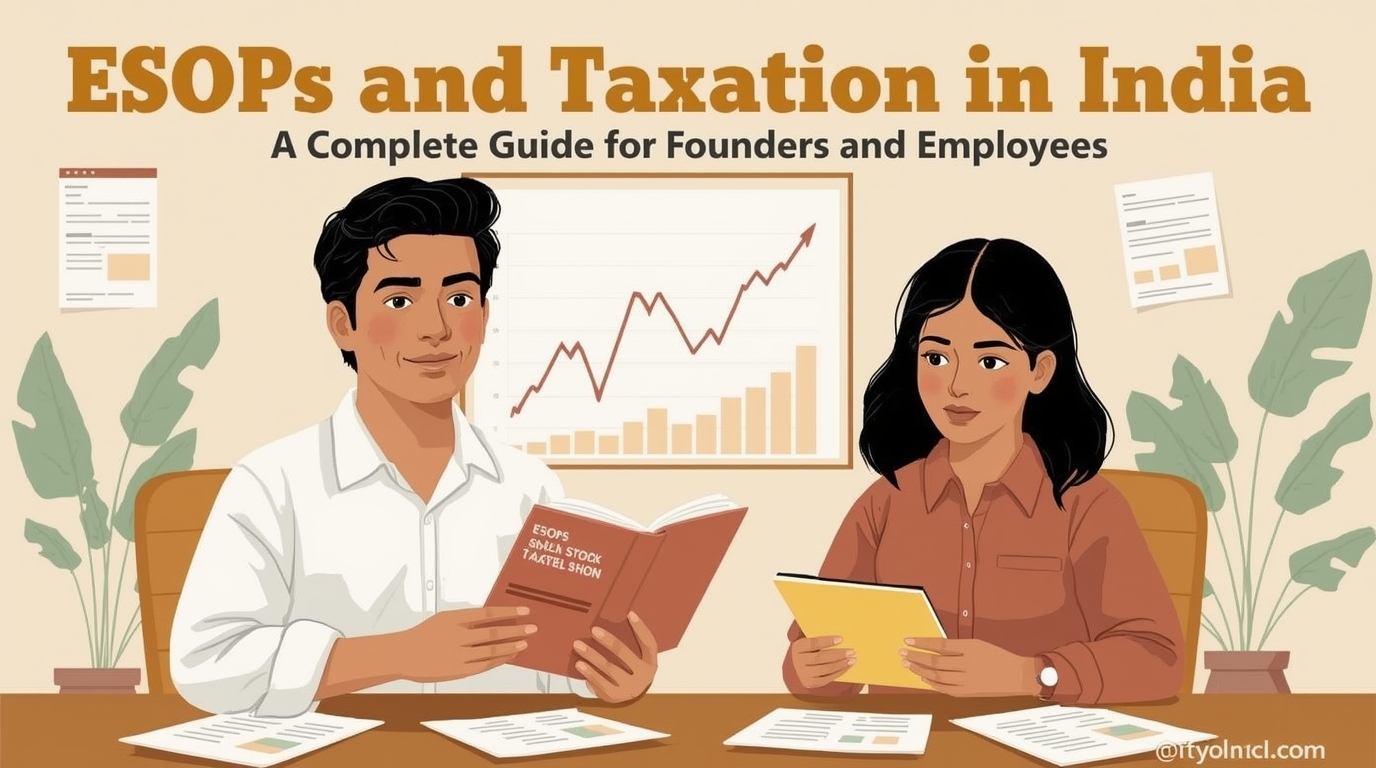
Employee Stock Option Plans (ESOPs) have become a popular tool for Indian startups to reward employees and align their growth with the company’s success. However, when it comes to ESOP taxation in India, both founders and employees often face confusion.
This guide will help you understand what ESOPs are, how they work, and the taxation rules in India that you need to know in 2025.
What are ESOPs?
An ESOP (Employee Stock Option Plan) is a benefit plan that gives employees the right to buy company shares at a pre-decided price (known as the exercise price) after a certain period, called the vesting period.
For startups, ESOPs are a great way to:
- Attract top talent without upfront high salaries.
- Retain employees by offering long-term ownership benefits.
- Align employee goals with company valuation growth.
How Do ESOPs Work in India?
- Grant – Company grants stock options to employees.
- Vesting – Employees earn the right to exercise options after a fixed period.
- Exercise – Employees buy shares at the predetermined price.
- Sale – Employees can later sell the shares and realize gains.
ESOP Taxation in India (2025)
Taxation on ESOPs happens at two different stages:
1. At the Time of Exercise
- Tax Type: Perquisite Tax (as part of salary income).
- Taxable Value: Fair Market Value (FMV) of shares on the exercise date – Exercise Price paid by employee.
- Tax Rate: Taxed as per employee’s income tax slab.
2. At the Time of Sale of Shares
- Tax Type: Capital Gains Tax.
- If Held < 24 Months (Listed shares) → Short Term Capital Gains (STCG), taxed at 15%.
- If Held > 24 Months (Listed shares) → Long Term Capital Gains (LTCG), taxed at 10% beyond ₹1 lakh.
- For unlisted shares, STCG is taxed as per slab, LTCG at 20% with indexation.
Example: ESOP Taxation in India
- Exercise Price: ₹100 per share
- FMV on exercise date: ₹250
- Sale Price after 2 years: ₹400
- At Exercise – Perquisite = ₹250 – ₹100 = ₹150 (taxed as salary).
- At Sale – Capital Gain = ₹400 – ₹250 = ₹150 (taxed as LTCG if listed/unlisted rules apply).
Recent Updates in ESOP Taxation (2025)
- DPIIT-recognized startups can defer payment of ESOP perquisite tax for up to 5 years or until the employee exits/sells shares, whichever is earlier.
- This is a major relief for employees of cash-strapped startups.
Why Founders Should Consider ESOPs
- Helps in employee retention without immediate cash outflow.
- Boosts company valuation by showing employee commitment.
- Attracts global investors who value strong ESOP pools.
Why Employees Should Care
- Chance to become co-owners of the company.
- Long-term wealth creation if the startup scales.
- However, employees should plan taxation smartly to avoid high liabilities.
Key Takeaways
- ESOPs are powerful wealth-creation tools for employees and growth strategies for startups.
- Taxation happens twice – at exercise (salary tax) and at sale (capital gains).
- New rules in India allow tax deferral for startup employees, making ESOPs more attractive.
Final Word
Whether you are a founder designing an ESOP policy or an employee receiving ESOPs, understanding the tax implications in India is crucial. With the right planning, ESOPs can be a win-win for both startups and employees.

AI in Accounting & Compliance: How Automation is Changing the Role of CAs
AI in Accounting & Compliance: How Automation is Changing the Role of CAs
Artificial Intelligence (AI) is no longer just a buzzword—it’s transforming industries, and accounting and compliance are no exception. Chartered Accountants (CAs), traditionally known for number-crunching and compliance tasks, are now leveraging automation and AI tools to work smarter, faster, and more strategically.

But what does this shift mean for businesses and professionals? Let’s dive in.
1. Why AI Matters in Accounting & Compliance
Accounting has always been data-heavy—processing invoices, reconciling accounts, auditing, and ensuring compliance with ever-changing tax laws. AI makes these tasks:
- Faster: Automating routine data entry, reconciliations, and report generation.
- Smarter: Predictive analytics to forecast cash flow, expenses, and financial risks.
- Error-Free: Reducing human mistakes in compliance filings and audits.
Businesses adopting AI see reduced operational costs and increased compliance accuracy.
2. Key Areas Where AI is Transforming CA Work
Here are some practical applications:
a) Bookkeeping & Data Entry Automation
AI-powered tools can read invoices, categorize expenses, and update ledgers—eliminating hours of manual work.
b) GST & Tax Compliance
AI solutions help businesses stay updated with India’s dynamic GST regulations, auto-validate filings, and flag mismatches before penalties occur.
c) Fraud Detection & Risk Management
Machine learning algorithms analyze patterns to detect unusual transactions and prevent fraud.
d) Auditing & Financial Reporting
AI-driven audit tools scan through massive datasets to ensure compliance and accuracy in financial statements.
e) Predictive Insights for Businesses
Instead of just reporting numbers, CAs can now provide real-time insights and growth forecasts using AI-driven dashboards.
3. How AI is Changing the Role of Chartered Accountants
AI is not replacing CAs—it’s reshaping their role:
- From data processors → strategic advisors
- From compliance officers → business growth partners
- From reactive reporting → proactive financial forecasting
This means CAs of 2025 and beyond need to upskill in AI, analytics, and advisory services to remain competitive.
4. Challenges of AI Adoption in Accounting
While promising, AI adoption comes with hurdles:
- Data security & privacy concerns
- High setup cost of advanced AI tools
- Skill gap among professionals
- Over-reliance on automation without human checks
A balanced approach—where AI handles repetitive tasks and CAs focus on strategy—is the key.
5. The Future of AI in Compliance & Accounting
By 2030, we can expect:
- Fully automated tax filings with minimal human intervention
- Virtual CFO services powered by AI for startups and SMEs
- Real-time compliance tracking across GST, Income Tax, and Corporate Laws
- CAs becoming financial strategists supported by AI-powered insights
Conclusion
AI in accounting and compliance is not about replacing Chartered Accountants—it’s about empowering them. Businesses that adopt AI early will not only reduce costs but also gain deeper financial insights.
For CAs, the future lies in combining financial expertise with AI-driven tools to provide unmatched value to businesses.

Virtual CFO Services in 2025: Do Indian Startups Really Need One?
Virtual CFO Services in 2025: Do Indian Startups Really Need One?

In the fast-evolving Indian startup ecosystem, every rupee counts. Founders are juggling product development, marketing, hiring, compliance, and fundraising. But here’s the big question: who’s watching the money?
Traditionally, businesses relied on full-time CFOs (Chief Financial Officers) to manage financial strategy, fundraising, and compliance. But in 2025, many startups are turning to a smarter alternative — the Virtual CFO (vCFO).
💡 What is a Virtual CFO?
A Virtual CFO is a finance expert (or team) who provides CFO-level guidance remotely or on-demand. Instead of hiring an expensive in-house CFO, startups get access to high-end financial expertise at a fraction of the cost.
Think of it as “CFO-as-a-Service.”
🚀 Why Startups in 2025 Are Choosing Virtual CFOs
- Cost-Effective – Hiring a full-time CFO can cost ₹40–60 lakhs per year. A vCFO offers the same expertise starting at a few lakhs annually.
- Scalable Support – Pay only for the hours/services you need. Perfect for early-stage startups with lean budgets.
- Fundraising Made Easy – vCFOs prepare financial models, pitch decks, and help with investor negotiations.
- Compliance Without Stress – GST, tax filings, ESOPs, ROC compliances — all handled professionally.
- Strategic Insights – Beyond accounting, a vCFO advises on growth, cost control, and profitability.
📊 Virtual CFO vs. Traditional CFO
| Feature | Traditional CFO | Virtual CFO |
|---|---|---|
| Cost | High (₹40–60L) | Flexible (₹3–15L) |
| Availability | Full-time | Part-time / On-demand |
| Expertise | Single person | Team of experts |
| Suitability | Large companies | Startups, SMEs |
🔮 2025 Trends in Virtual CFO Services
- AI & Automation: vCFOs now use AI-driven dashboards for real-time cashflow insights.
- Global Expansion: Indian startups raising funds abroad need cross-border compliance — vCFOs handle this.
- Subscription Model: CFO-as-a-service is now available like SaaS — monthly retainers instead of heavy salaries.
- Sector Specialization: Startups in fintech, edtech, and D2C are hiring vCFOs with niche expertise.
🏆 Do You Really Need a Virtual CFO?
Ask yourself:
- Are you planning to raise funds in the next 12 months?
- Do you struggle with cash flow management?
- Are compliance and tax filings eating into your time?
- Do you lack financial projections for investors?
👉 If you said YES to even 2 of these, a Virtual CFO is not a luxury—it’s a necessity.
✅ How Expenect Can Help
At Expenect, we connect startups and SMEs with trusted CAs, finance professionals, and Virtual CFOs who understand your business needs. Whether it’s compliance, fundraising, or financial strategy, we ensure you get the right expertise at the right price.
✨ Final Takeaway: In 2025, startups can’t afford financial blind spots. A Virtual CFO gives you clarity, control, and confidence—without the heavy cost of a full-time hire.

What is GST and Who Should File It? | Cost of Filing GST | All About GST in India
India’s tax system underwent a major transformation with the introduction of Goods and Services Tax (GST) on July 1, 2017. It simplified the indirect tax structure and brought a unified taxation regime across the country.
Whether you’re a freelancer, small business owner, startup founder, or established enterprise — understanding GST is crucial to staying compliant and avoiding penalties.
📌 What is GST?
GST (Goods and Services Tax) is a unified indirect tax levied on the supply of goods and services in India. It replaced multiple cascading taxes like VAT, Service Tax, and Excise Duty.
GST is based on the principle of “One Nation, One Tax” and is levied at every stage of the supply chain, with a full set-off for taxes paid on inputs.
📚 Types of GST
- CGST – Central GST, collected by the Central Government
- SGST – State GST, collected by State Governments
- IGST – Integrated GST, applicable on inter-state supply
- UTGST – Union Territory GST, for union territories
✅ Who Should File GST?
You should file for GST if you fall under any of these categories:
Mandatory GST Registration:
- Businesses with aggregate turnover exceeding ₹40 lakhs (₹20 lakhs for special category states)
- Service providers earning more than ₹20 lakhs annually (₹10 lakhs in special states)
- E-commerce sellers
- Inter-state suppliers
- Businesses registered under reverse charge mechanism
- Input Service Distributors (ISD)
- Online service providers to Indian consumers from abroad
Voluntary Registration:
Even if you’re below the threshold, registering for GST helps:
- Avail input tax credit
- Appear credible to vendors and clients
- Expand into e-commerce platforms (like Amazon, Flipkart, etc.)
📆 GST Filing Frequency
Regular Taxpayers:
- GSTR-1: Details of outward supplies – Monthly/Quarterly
- GSTR-3B: Summary return of outward + input – Monthly
- GSTR-9: Annual return
Composition Scheme Taxpayers:
- GSTR-4: Quarterly returns
- CMP-08: Payment form
💸 Cost of Filing GST in India (2025 Rates)
| Type of Service | Approx. Cost |
|---|---|
| GST Registration (One-time) | ₹500 – ₹1,500 |
| Monthly GST Filing (Basic Plan) | ₹300 – ₹1,000/month |
| Quarterly GST Filing | ₹750 – ₹2,000/quarter |
| Annual GST Return (GSTR-9) | ₹1,000 – ₹3,000 |
| Composition Scheme Filing | ₹300 – ₹750/quarter |
| Penalty for Late Filing | ₹20 – ₹50/day |
Note: Prices may vary based on complexity and city.
⚠️ Penalties for Non-Compliance
- ₹200/day for late filing (₹100 each CGST & SGST)
- Up to ₹25,000 for incorrect filings
- Suspension or cancellation of GST number
- No input credit allowed during non-compliance
💡 Why File with a Professional CA?
A professional CA ensures:
- Accurate filings
- Compliance with deadlines
- Input tax credit optimization
- Avoidance of penalties
- Assistance during audits or GST notices
🧾 How Expenect Can Help
At Expenect, we simplify GST for startups, freelancers, and businesses of all sizes.
Our CA Experts offer:
✅ GST Registration
✅ Monthly & Quarterly Filing
✅ Compliance Audits
✅ GSTR-9 Filing
✅ Advisory for Tax Savings
📲 Contact us today to ensure smooth, timely, and cost-effective GST compliance.

From Zero to Exit: Financial Roadmap for Indian Founders

From Zero to Exit: Financial Roadmap for Indian Founders
Your Strategic Guide from Incorporation to IPO or Acquisition
Starting up in India’s buzzing entrepreneurial ecosystem is exciting, but the real magic happens when you map your finances with clarity from Day One. Whether you’re planning for a lean startup or aiming for unicorn status, the financial decisions you make today will determine the ease of your tomorrow.
Here’s a founder-friendly roadmap – from scratch to a successful exit.
🚀 Stage 1: Startup Formation & Compliance
Objective: Lay a legally sound and financially efficient foundation.
Key Financial Tasks:
- Choose the right business structure (Private Limited, LLP, etc.).
- Register with Startup India for benefits.
- Open a current bank account.
- Appoint a CA for basic compliance.
- Apply for GST, PAN, and other mandatory licenses.
- Set up basic bookkeeping (cloud-based preferred).
Expenect Tip: Don’t delay getting a CA—early guidance prevents costly errors.
📈 Stage 2: Fundraising & Financial Modeling
Objective: Prepare to pitch and raise capital confidently.
Key Financial Tasks:
- Build a realistic financial model (3-5 years).
- Understand valuation basics (pre-money, post-money, dilution).
- Get pitch-ready with CAC, LTV, and unit economics.
- Stay compliant with RBI & FEMA guidelines for FDI.
- Draft clear cap tables and shareholder agreements.
Expenect Tip: Have a CA audit your financials before talking to VCs—it builds credibility.
📊 Stage 3: Scaling & Operational Finance
Objective: Manage growth without bleeding cash.
Key Financial Tasks:
- Automate your invoicing and payment cycles.
- Implement budgeting and expense controls.
- Apply for MSME/Startup India loans or subsidies.
- File timely GST returns, TDS, and ROC filings.
- Optimize tax outflows with smart structuring.
Expenect Tip: Use monthly MIS reports to track burn rate and runway.
💼 Stage 4: Audit, Due Diligence & Governance
Objective: Be investor-ready and legally audit-proof.
Key Financial Tasks:
- Conduct internal audits every 6-12 months.
- Clean up ESOP documents and statutory registers.
- Update shareholder agreements and board resolutions.
- Prepare for statutory audits and investor due diligence.
Expenect Tip: Create a financial data room in advance—this impresses serious investors and buyers.
🏁 Stage 5: Exit – IPO or Acquisition
Objective: Secure a successful and smooth exit.
Key Financial Tasks:
- Perform a full forensic audit before due diligence.
- Structure deal/tax terms to reduce capital gains.
- Comply with SEBI norms (for IPO).
- Finalize all regulatory filings and legal disclosures.
- Reconcile all investor payouts, ESOP exercises, and closure of liabilities.
Expenect Tip: A well-maintained financial trail increases your startup’s valuation and speeds up the deal.
Why Expenect?
At Expenect, we’re not just accountants—we’re financial architects. From setting up your first ledger to navigating complex exit strategies, our expert CAs and advisors walk with you every step of the journey.
✅ Startup Compliance
✅ Fundraising Support
✅ Tax & Financial Optimization
✅ Audit & Valuation
✅ Exit Strategy Planning
📞 Let’s build your financial future together—reach out to Expenect today!

Legal Checklist for Building a SaaS Company in India (2025 Edition)

Legal Checklist for Building a SaaS Company in India (2025 Edition)
India’s SaaS (Software as a Service) sector is booming, with startups like Zoho, Freshworks, and Postman setting global benchmarks. If you’re planning to launch your own SaaS venture in 2025, congratulations — you’re entering one of the most promising and scalable business models in the digital economy.
But before you start building your product or onboarding clients, you need a strong legal foundation. This blog provides a legal checklist to help SaaS founders in India avoid compliance pitfalls and build investor-ready, future-proof companies.
✅ 1. Choose the Right Legal Structure
Start by registering your business as a Private Limited Company (Pvt Ltd). It’s the most preferred structure for SaaS startups due to its:
- Limited liability protection
- Eligibility to raise equity funding
- Global credibility
- Easy ESOP setup
Other options like LLPs or OPCs may restrict growth or investor interest.
✅ 2. Register Your Company with MCA
To make your business legally operational, register with the Ministry of Corporate Affairs (MCA).
- Documents Needed: PAN, Aadhaar, utility bills, rental agreement, etc.
- Digital Signatures (DSC) and Director Identification Number (DIN) are mandatory.
Use the SPICe+ form for a simplified registration process.
✅ 3. Obtain PAN, TAN & GST
Apply for:
- PAN (Permanent Account Number) for tax identity
- TAN (Tax Deduction and Collection Account Number) for TDS compliance
- GST Registration if annual turnover exceeds ₹20 lakhs or if selling across states/digital services.
Pro Tip: SaaS companies dealing in cloud services and software downloads are liable for 18% GST even if turnover is below ₹20 lakhs.
✅ 4. Draft Robust Founders’ Agreement
A Founders’ Agreement avoids future conflicts. It must cover:
- Roles & responsibilities
- Shareholding pattern
- Vesting schedule
- Exit clauses
- IP ownership
Get it drafted by a startup lawyer, not a template website.
✅ 5. Protect Your Intellectual Property (IP)
Your code, brand name, and designs are your business assets. Protect them early.
- Trademark your brand/logo
- Copyright your source code
- Consider patent if your SaaS product is innovative
✅ 6. Draft SaaS Contracts and Legal Policies
For a SaaS business, your contracts are your frontline defense. Ensure you have:
- Terms of Service (ToS): Defines usage rules, service scope
- Privacy Policy: Must comply with India’s Digital Personal Data Protection Act, 2023 (DPDP Act)
- End-User License Agreement (EULA): Software access rights
- Service Level Agreement (SLA): Performance benchmarks, uptime guarantees
✅ 7. Data Protection & Cybersecurity Compliance
India’s data privacy regulations have evolved.
- Comply with DPDP Act 2023 for data collection, storage, and transfer
- If serving foreign users (like EU), comply with GDPR
- Use encryption, firewalls, and regular audits
Remember: Non-compliance can result in heavy penalties or even user bans.
✅ 8. Setup ESOP Plan Legally
If you plan to offer Employee Stock Ownership Plans (ESOPs):
- Ensure board and shareholder approval
- Draft detailed ESOP agreement
- Maintain proper records for ROC compliance
✅ 9. Comply with FEMA & FDI Guidelines (if raising foreign investment)
- File FC-GPR within 30 days of receiving foreign investment
- Adhere to pricing guidelines and reporting norms
- Appoint a CA or legal advisor to assist in compliance
✅ 10. Yearly ROC & Income Tax Filings
Even if you’re not profitable, you must:
- File ROC Annual Returns (AOC-4, MGT-7) annually
- File ITR-6 and pay advance tax (if applicable)
- Maintain books as per Companies Act, 2013
Late filing leads to penalties ranging from ₹100/day to ₹1 lakh+.
Conclusion: Build Smart, Scale Confidently
SaaS success is not just about building a great product — it’s also about building a legally sound company that earns the trust of investors, employees, and customers.
If you want help navigating legal, tax, and compliance matters for your SaaS startup, Expenect is here to help. Our expert CAs, lawyers, and startup consultants simplify complex processes so you can focus on scaling your software.
🔍 Need help with company registration, legal contracts, or compliance?
👉 Book a Free Consultation with Expenect

Legal Checklist for Building a SaaS Company in India (2025 Edition)
The Software-as-a-Service (SaaS) industry in India is booming, with Indian startups attracting global clients and funding. But while tech founders are often focused on product development and scaling, legal compliance is the foundation that keeps everything secure and investment-ready.
If you’re planning to build or scale a SaaS company in India in 2025, this legal checklist will help you avoid roadblocks—from incorporation and IP protection to tax and data compliance.

✅ 1. Choose the Right Business Structure
For a SaaS startup, the most popular legal structures are:
- Private Limited Company (recommended for funding, limited liability, and scale)
- LLP (Limited Liability Partnership) (good for bootstrapped ventures)
- OPC (One Person Company) for solo founders
⚖️ Tip: Private Limited is investor-friendly and enables easy ESOP implementation.
📄 2. Register with MCA & Get CIN
If you opt for Pvt Ltd or LLP:
- Register with Ministry of Corporate Affairs (MCA)
- Get Certificate of Incorporation (COI)
- Obtain CIN (Corporate Identity Number)
Also get:
- PAN & TAN from the Income Tax Department
- GST Registration, especially if you’re selling to businesses
🧠 3. Protect Your Intellectual Property (IP)
For SaaS startups, IP is your core asset.
- Trademark your brand name, logo, tagline
- Copyright your software code and UI
- Patent (if applicable) your tech innovations
🚀 IP protection also strengthens your investor pitch and product defensibility.
📋 4. Draft Essential Legal Agreements
A SaaS startup needs a solid legal stack:
| Agreement | Purpose |
|---|---|
| Founder’s Agreement | Define roles, equity, vesting, and exit clauses |
| Service Agreement | Between company and clients; defines service scope |
| Terms of Service | Protects business from misuse and outlines user rights |
| Privacy Policy | Mandatory under IT Act; especially important for data handling |
| Non-Disclosure Agreement (NDA) | Protects code and business data with vendors or partners |
| Employment Agreements | Mandatory for full-time hires; include IP transfer clauses |
🔐 5. Ensure Data Privacy Compliance
As a SaaS business, you’re likely processing sensitive user data.
In India, the Digital Personal Data Protection (DPDP) Act, 2023 now governs how businesses collect and process data.
You must:
- Take user consent for data collection
- Store data securely (ideally within India or under approved jurisdictions)
- Appoint a Data Protection Officer (DPO) (for mid to large SaaS firms)
- Create clear privacy policies and grievance mechanisms
📣 International SaaS Tip: If serving EU customers, ensure GDPR compliance too.
🧾 6. Understand SaaS Taxation in India
SaaS companies must:
- Register under GST (18% applicable on B2B services)
- File monthly, quarterly, and annual returns
- Deduct and deposit TDS on payments like rent, contracts, and salaries
💡 Foreign income is generally zero-rated (export of services) but documentation is key to avoid tax disputes.
🧑💻 7. Employee & Contractor Compliance
For growing SaaS startups:
- Draft clear employment/contractor agreements
- Provide offer letters, job descriptions, and IP assignment clauses
- Comply with PF, ESI, Gratuity if applicable (once staff count crosses threshold)
Also consider:
- ESOP Plan & Policy if raising funding or rewarding early team members
📊 8. Stay Compliant with ROC & MCA Filings
Registered companies must file:
- MCA annual returns (AOC-4, MGT-7)
- Board meeting minutes
- Shareholder meeting records
⚠️ Non-compliance leads to hefty penalties and investor red flags.
🔎 9. Cybersecurity Compliance
Although not always mandatory, it’s highly recommended to:
- Implement end-to-end encryption
- Adopt SSL certificates and multi-factor authentication
- Comply with CERT-In directives for data breaches
🛡️ Protecting client and user data strengthens brand trust and compliance credibility.
📬 10. Register on Startup India & Get DPIIT Recognition
Registering on Startup India Portal provides:
- Angel tax exemptions
- Easy IPR filing
- Access to government tenders
- Networking with accelerators and incubators
This is especially important if you’re seeking funding or government contracts.
💼 How Expenect Can Help
At Expenect, we offer end-to-end support for SaaS founders including:
✔️ Startup registration and incorporation
✔️ Trademark, copyright, and IP assistance
✔️ Founders & legal agreements
✔️ DPIIT registration & compliance
✔️ Tax filing and financial planning
✔️ Virtual CFO services for growing startups
Whether you’re building your MVP or onboarding your 100th customer, we help you stay legally sound and investor-ready.
👉 Visit www.expenect.com to talk to a startup legal & finance expert today.
✅ Conclusion
Launching a SaaS company in India is exciting—but skipping legal basics can cost you customers, funding, or even your business. Follow this legal checklist to protect your startup, gain credibility, and scale with confidence.
2025 is the year Indian SaaS will thrive. Let’s build it right from the start.

From Zero to Exit: Financial Roadmap for Indian Founders
Every successful startup begins with a vision—but it takes a clear financial roadmap to turn that vision into a profitable, scalable, and eventually sellable business. Whether you dream of ringing the bell at the Bombay Stock Exchange or getting acquired by a unicorn, your startup needs strategic financial planning from Day 1 to Exit.
This blog outlines the complete financial lifecycle of Indian startups, and how Expenect acts as a strategic partner at every growth stage—ensuring you’re investor-ready, compliant, and profitable.

🚀 Stage 1: The Launch (0–12 Months)
Key Focus:
- Legal incorporation
- Business model validation
- Basic compliance & bookkeeping
Financial Actions:
- Choose the right structure: Private Limited, LLP, or OPC
- Register with MCA, get PAN, TAN, and GST
- Set up accounting systems and open a business bank account
- Build a financial forecast & break-even analysis
- Consider Startup India DPIIT Registration for tax benefits and investor confidence
How Expenect Helps:
- Company formation
- CA advisory for structuring & tax planning
- Accounting software integration
- UDYAM/MSME registration
💰 Stage 2: Early Traction & Fundraising (1–2 Years)
Key Focus:
- Product-market fit
- Building the team
- Raising seed or angel funding
Financial Actions:
- Draft a valuation report and pitch deck with clear financial metrics
- Structure equity and ESOP plans
- Maintain monthly cash flow reports and MIS
- File for Angel Tax Exemption (Form 2)
- Prepare for due diligence—clean books, legal contracts, IP protection
How Expenect Helps:
- Valuation reports
- Financial modeling
- Virtual CFO services
- Legal & financial compliance during funding rounds
- Angel Tax exemption filing
📈 Stage 3: Scaling & Series A/B Funding (2–4 Years)
Key Focus:
- Rapid customer acquisition
- Team expansion
- Multi-city or global launch
Financial Actions:
- Implement VCFO support to manage growth
- Introduce unit economics and cohort analysis
- Comply with statutory audits, ROC filings, TDS, and GST
- Set up payroll systems and manage multi-state taxation
- File annual MCA reports and maintain corporate governance standards
How Expenect Helps:
- Ongoing CFO services
- Real-time accounting & audit support
- Payroll management
- Investor & board reporting dashboards
- Financial KPI tracking
📊 Stage 4: Pre-Exit Planning (4–6 Years)
Key Focus:
- Profitability
- M&A readiness or IPO planning
- Financial compliance & optimization
Financial Actions:
- Restructure financials to show long-term sustainability
- Conduct internal audits and prepare for external due diligence
- Explore international compliance if operating globally
- Set up cap table hygiene, legal due diligence reports, and tax structuring
- Work on ESOP buybacks or secondary sales to give early investors exits
How Expenect Helps:
- Exit strategy consulting
- M&A or IPO financial readiness checklist
- Audit preparation
- ESOP management & legal coordination
- Cross-border compliance
🏁 Stage 5: Exit (IPO or Acquisition)
Key Focus:
- Ensuring transparency & accuracy
- Maximizing founder & investor value
- Smooth regulatory compliance
Financial Actions:
- Prepare for IPO listing with SEBI, NSE/BSE
- Coordinate with merchant bankers, auditors, legal teams
- Comply with SEBI (LODR), Companies Act, Income Tax Act
- Close any tax liabilities or dues
- Finalize shareholding exits, founder payouts, and investor settlements
How Expenect Helps:
- IPO documentation support
- Tax optimization for exit
- Founders’ personal finance & tax management
- Due diligence and audit team coordination
- End-to-end financial reporting
🧩 Why Founders Need a Strategic Finance Partner
Most startups fail not due to lack of product-market fit—but due to poor financial planning, regulatory non-compliance, or investor mistrust.
With Expenect, you get more than a CA—you get a strategic finance partner with expertise in startups, funding, and exits.
Our expert network includes:
- Chartered Accountants
- Virtual CFOs
- Company Secretaries
- Tax Consultants
- Legal Advisors
🔄 Expenect’s Startup-to-Exit Service Model
| Stage | Expenect Services Offered |
|---|---|
| Formation | Company registration, tax setup, legal structuring |
| Growth | Accounting, compliance, valuation, fundraising help |
| Scaling | VCFO, tax optimization, employee management |
| Pre-Exit | Audit prep, M&A advisory, ESOP consulting |
| Exit | IPO support, acquisition due diligence, founder payout |
✅ Conclusion
Scaling from zero to exit is not just about building a great product—it’s about building a financially sound, compliant, and investor-ready business. Every decision you make—from choosing your CA to structuring your cap table—affects your ability to raise funds, scale, and eventually exit profitably.
Expenect walks with you through every step of the journey—from your first invoice to your first investor to your final exit.
👉 Ready to start your zero-to-exit journey? Let Expenect be your financial partner. Visit www.expenect.com or talk to a startup expert today.

Business Loan Under Pradhan Mantri Mudra Yojana (PMMY): A Complete Guide for MSMEs
Access to timely credit is a game-changer for any micro or small business. To bridge this gap and empower MSMEs, the Government of India launched the Pradhan Mantri Mudra Yojana (PMMY)—a flagship scheme that provides collateral-free business loans to micro enterprises, startups, and self-employed individuals.
If you’re an MSME owner looking for hassle-free funding to grow your business, this blog will guide you through the Mudra Loan Scheme, its benefits, loan types, and how to apply step-by-step.
✅ What Is Pradhan Mantri Mudra Yojana (PMMY)?
Launched in April 2015, PMMY is an initiative of the Micro Units Development and Refinance Agency (MUDRA) under the Ministry of Finance.
It offers loans up to ₹10 lakhs to:
- Micro and small enterprises (including MSMEs)
- Non-corporate small businesses
- Startups, shopkeepers, artisans, manufacturers, traders, etc.
Best of all — no collateral or guarantor required.
💼 Categories of Mudra Loans
Mudra loans are categorized into three types based on the growth stage of the business:
| Loan Type | Amount | Best For |
|---|---|---|
| Shishu | Up to ₹50,000 | New and early-stage startups |
| Kishore | ₹50,001 to ₹5 lakhs | Growing businesses needing working capital |
| Tarun | ₹5 lakhs to ₹10 lakhs | Established businesses looking to scale |
🎯 Who Can Apply?
Eligible borrowers include:
- Proprietors of small manufacturing units
- Service sector businesses
- Traders and retailers
- Food vendors, repair shops, beauty parlors, etc.
- Individuals wanting to start a small business
Note: You must not have a default history with any bank or NBFC.
🌟 Benefits of PMMY for MSMEs
✅ No collateral required
✅ Low interest rates (based on bank’s base rate + spread)
✅ Minimal paperwork
✅ Loans tailored to your business stage
✅ Boosts credit score if paid on time
✅ Available through multiple banks and NBFCs
🧾 Documents Required for Mudra Loan
Here’s what you’ll typically need:
- Application Form (can be downloaded or filled at the bank)
- ID Proof – Aadhaar Card, PAN Card, Passport, Voter ID
- Address Proof – Utility Bill, Rent Agreement, Aadhaar, etc.
- Business Proof – Registration certificate, license, etc.
- Quotations/Estimates for machinery or working capital use
- Bank Statement (last 6 months)
- Passport Size Photos
📝 How to Apply for a Mudra Loan (Step-by-Step)
You can apply both online and offline.
Offline (at Bank Branch)
- Visit a nearby bank branch or MUDRA loan provider (SBI, HDFC, PNB, ICICI, etc.)
- Fill in the Mudra Loan Application Form
- Submit required documents
- Loan officer reviews your proposal
- Upon approval, loan is disbursed to your account
Online Application
Some banks also allow online applications through their portals.
Alternatively, visit:
🔗 https://www.udyamimitra.in
Steps:
- Register your profile
- Fill the loan application
- Choose preferred bank
- Submit documents
- Track loan status online
🔍 Where to Get a Mudra Loan?
More than 70 institutions offer Mudra Loans, including:
- Public sector banks (SBI, PNB, Bank of Baroda)
- Private banks (HDFC, ICICI, Axis)
- Regional rural banks
- Microfinance institutions (MFIs)
- NBFCs
📈 Use of Funds
Mudra loan can be used for:
- Working capital
- Purchasing machinery/equipment
- Business expansion
- Inventory stocking
- Setting up service units (repair shops, coaching centers, etc.)
- Transportation (e-rickshaws, autos, etc.)
Important: The funds must be used strictly for business purposes.
💡 Tips to Get Your Loan Approved Faster
- Maintain a clean credit history
- Register your business with UDYAM/MSME portal
- Clearly present your business plan or use-case
- Submit accurate documents
- Avoid over-borrowing — ask for the amount you need
🏁 Conclusion
For MSMEs and aspiring entrepreneurs in India, the Pradhan Mantri Mudra Yojana is one of the easiest, most accessible funding options available in 2025.
Whether you’re setting up a kirana shop or scaling a small manufacturing unit, a Mudra loan can provide the push your business needs—without the stress of collateral or heavy EMIs.
🚀 Need Help Applying for a Mudra Loan?
At Expenect, we help MSMEs and startups with:
- Business registration
- Loan application assistance
- Financial documentation
- CA & compliance support
👉 Visit www.expenect.com to get started with a Mudra loan today!

Startup India 2025: Updated Benefits You Might Be Missing Out On
Launched in 2016, the Startup India initiative by the Government of India has transformed the entrepreneurial landscape. As we enter 2025, the scheme has evolved to offer new benefits, enhanced incentives, and simplified processes that Indian startups simply cannot afford to overlook.
If you’re a budding entrepreneur or already running a startup, this blog will walk you through the updated benefits of Startup India in 2025—and how you can leverage them to scale your business faster and smarter.
✅ What Is Startup India?
Startup India is a flagship initiative by the Department for Promotion of Industry and Internal Trade (DPIIT) that aims to:
- Encourage entrepreneurship
- Reduce regulatory burdens
- Provide funding, mentorship, and tax benefits
- Build a strong ecosystem for innovation
Startups registered under this initiative enjoy a wide range of legal, financial, and operational benefits.
📌 Startup India Benefits in 2025: What’s New & What’s Improved
1. Income Tax Exemption for 3 Years (Still Active in 2025)
Eligible startups can claim a 100% tax exemption on profits for 3 consecutive years out of their first 10 years since incorporation.
💡 New Update: In 2025, the exemption now allows flexible year selection based on the startup’s revenue cycles.
2. Increased Funding Support Through Fund of Funds
The SIDBI Fund of Funds, initially ₹10,000 crore, has been extended and scaled up in 2025 to ₹20,000 crore. This funding is now spread across more SEBI-registered VC firms supporting:
- Deep tech startups
- Green energy startups
- Rural and AgriTech ventures
💡 Pro Tip: Check if the VC you’re pitching to is part of the SIDBI Fund of Funds.
3. Simplified DPIIT Recognition Process
The DPIIT has streamlined the startup recognition portal, enabling approval in less than 48 hours if documentation is complete. Recognized startups receive:
- Recognition certificate
- Access to government schemes
- Tax and IP benefits
4. Angel Tax Exemption (Section 56(2)(viib))
Startups recognized by DPIIT continue to enjoy exemption from Angel Tax, making it easier to raise funds from Indian investors.
💡 New for 2025: Exemption extended to NRIs investing in startups via Indian AIFs or directly.
5. Patent Filing & IPR Benefits
Recognized startups get:
- 80% rebate on patent filing fees
- Fast-track examination of patents
- Panel of facilitators for IPR protection at subsidized rates
💡 In 2025, IPR services are now integrated with the Startup India portal for faster coordination.
6. Credit Guarantee Scheme for Startups
New in 2025: Startups can now avail collateral-free loans up to ₹10 crore through this DPIIT-backed scheme from selected banks and NBFCs.
This makes debt financing easier, especially for growth-stage startups without hard assets.
7. Startup India Hub 2.0
The upgraded Startup India Hub now offers:
- AI-powered advisor tools
- Personalized compliance checklists
- Real-time mentorship matching
- Centralized access to 100+ state and central government schemes
8. Women Entrepreneurship Focus
In 2025, Startup India has partnered with SIDBI and Niti Aayog to launch special schemes:
- Funding access with lower interest rates
- Dedicated mentorship
- Tax incentives for women-led startups
If you’re a woman founder, 2025 is the year to launch!
9. State-Level Incentives Are Now Integrated
Earlier, state-specific benefits required separate applications. In 2025, the Startup India portal now auto-maps you to relevant state schemes based on your incorporation location.
10. Green Startup Incentives
Startups focusing on:
- Sustainable packaging
- Renewable energy
- EV manufacturing
- Carbon capture
Can now apply for green tax exemptions, R&D grants, and pilot project funding under the Startup India Sustainability Program.
🧾 Eligibility Criteria to Register Under Startup India (2025)
- Company must be a Private Limited Company, LLP or Partnership
- Not older than 10 years
- Turnover must not exceed ₹100 crores in any year
- Should be working toward innovation or improvement of existing products/services
- Must not be formed by splitting or reconstruction of an existing business
🛠️ How to Register Your Startup Under Startup India (2025)
- Incorporate your business (Pvt Ltd, LLP, or Partnership)
- Register on startupindia.gov.in
- Fill the Startup Recognition Form
- Upload documents: Incorporation certificate, pitch, etc.
- Wait for DPIIT recognition (usually within 48 hours)
Once recognized, your startup can start applying for all available schemes and benefits.
💼 How Expenect Can Help
Registering and maintaining compliance as a startup can feel overwhelming. That’s where Expenect steps in.
✅ Get connected to verified Chartered Accountants
✅ Simplify DPIIT recognition
✅ Manage tax filings, patents, and funding paperwork
✅ Focus on growth while we handle the financial & legal backend
✅ Conclusion
Startup India in 2025 is smarter, faster, and more inclusive than ever. Whether you’re building a tech platform, a manufacturing company, or a consulting brand—don’t miss out on these government benefits that can help you save money, raise funds, and scale faster.
Ready to register your startup or get expert guidance?
👉 Visit Expenect.com today and consult a startup finance expert in minutes.