
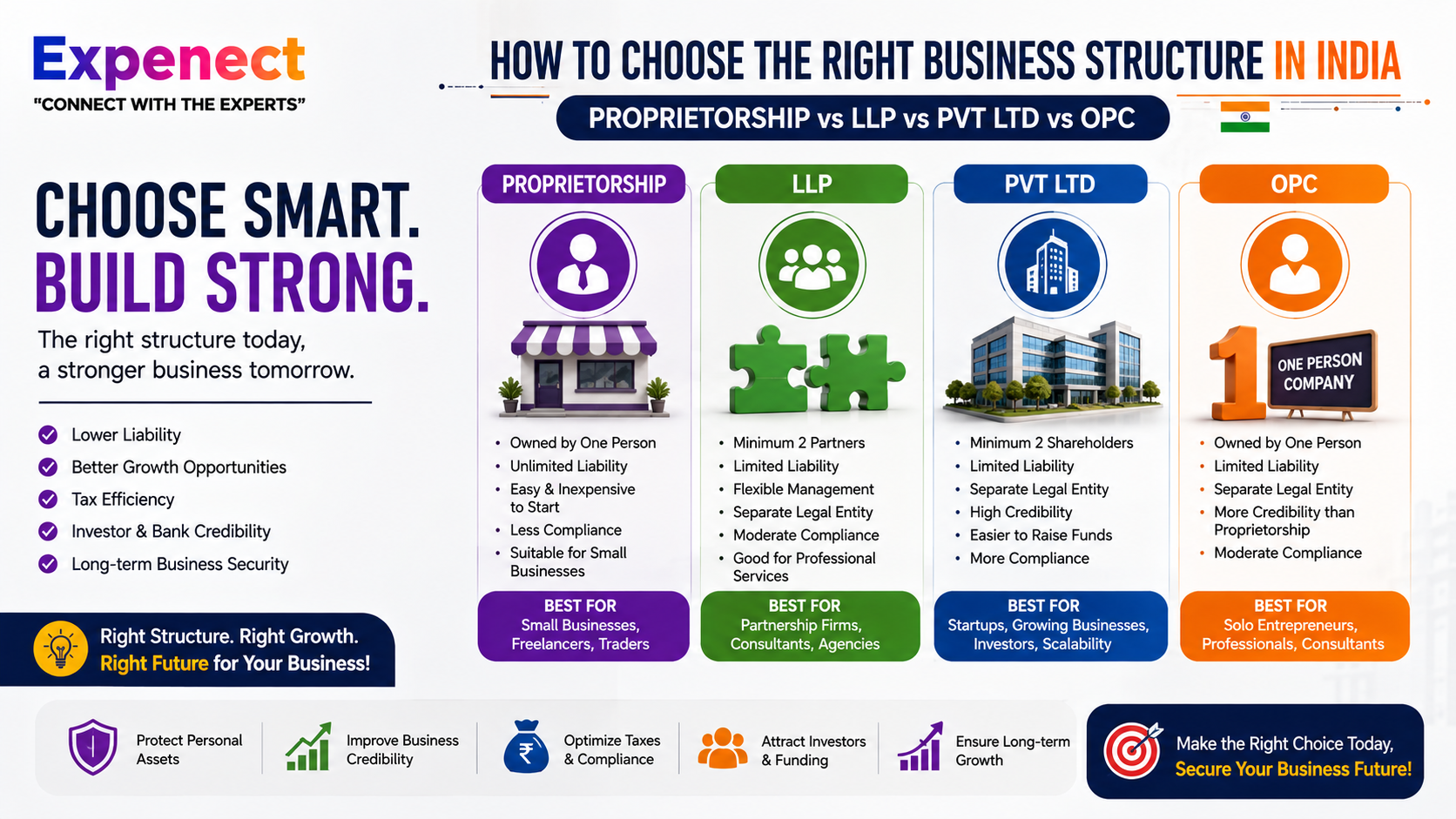
How to Choose the Right Business Structure in India: Proprietorship vs LLP vs Pvt Ltd vs OPC
Starting a business is an exciting journey. You have an idea, a product or service, and a plan to generate revenue. But before you start accepting customers or investing heavily in your business, there is one important decision you need to make:
What legal structure should your business have?
In India, entrepreneurs commonly consider structures such as:
- Sole Proprietorship
- Limited Liability Partnership (LLP)
- Private Limited Company (Pvt Ltd)
- One Person Company (OPC)
Choosing the right structure affects your personal liability, taxation, compliance requirements, ability to raise funding, ownership, credibility, and long-term growth.
There is no single structure that is best for every business.
A freelancer starting a consulting business may have very different requirements from a technology startup planning to raise ₹5 crore from investors.
This guide explains the major differences between Proprietorship vs LLP vs Pvt Ltd vs OPC and helps you understand which structure may be suitable for different business situations.
Important: Business structure, tax treatment and compliance requirements can depend on your specific circumstances and may change with amendments to Indian law. This article is for general educational purposes and should not replace advice from a qualified CA, CS or legal professional.
What Is a Business Structure?
A business structure defines how your business is legally organized.
It determines important factors such as:
- Who owns the business?
- Who is responsible for its debts?
- How are profits taxed?
- How can new owners/investors come in?
- What compliance is required?
- How easily can the business raise capital?
- What happens if the owner leaves or dies?
Choosing the right structure at the beginning can make future growth significantly easier.
The 4 Popular Business Structures in India
Let’s first understand the four structures.
1. Sole Proprietorship
A proprietorship is a business owned and operated by one individual.
The business and owner are generally not separate legal persons in the way a company is.
It is commonly used by:
- Freelancers
- Consultants
- Small retailers
- Local service providers
- Individual professionals
- Small traders
2. Limited Liability Partnership (LLP)
An LLP combines elements of a traditional partnership with limited liability and a separate legal identity.
The Ministry of Corporate Affairs describes an LLP as a separate legal entity from its partners, with the partners’ liability generally limited to their agreed contribution, subject to the law. An LLP requires at least two partners.
LLPs are particularly useful for businesses where two or more founders want flexibility in managing the business while maintaining limited liability.
3. Private Limited Company
A Private Limited Company is a separate incorporated entity owned by its shareholders.
Under the Companies Act, 2013, a private company can be formed by two or more persons, while an OPC can be formed by one person.
Pvt Ltd companies are commonly preferred by:
- Startups
- Technology companies
- E-commerce businesses
- High-growth businesses
- Businesses planning to raise external investment
4. One Person Company (OPC)
An OPC is a type of private company with a single member.
It allows an individual entrepreneur to operate through a corporate structure rather than a traditional proprietorship.
The Companies Act defines an OPC as a company having only one person as a member.
Proprietorship vs LLP vs Pvt Ltd vs OPC: Quick Comparison
| Feature | Proprietorship | LLP | Pvt Ltd | OPC |
|---|---|---|---|---|
| Owners | 1 | 2 or more | 2 or more members | 1 |
| Separate legal entity | No | Yes | Yes | Yes |
| Limited liability | Generally no | Yes, subject to law | Yes, subject to law | Yes, subject to law |
| Compliance | Low | Moderate | High | Moderate/High |
| Suitable for | Small businesses | Professional/partner businesses | Growth startups | Solo entrepreneurs |
| External equity funding | Difficult | Limited suitability | Strong option | More limited |
| Ownership flexibility | Low | High flexibility | High | Limited |
| Corporate structure | No | Yes | Yes | Yes |
| Scalability | Moderate | High | Very high | Moderate |
| Investor friendliness | Low | Moderate | High | Limited |
| Best for | Small/simple businesses | Partnerships | High-growth businesses | Solo founders wanting corporate status |
This table is a general comparison; the actual legal, tax and compliance position depends on the business and applicable rules.
1. Sole Proprietorship: Is It Right for You?
A proprietorship is often the simplest structure for starting a small business.
You operate the business in your own name or under a trade name, subject to applicable registrations and licenses.
Advantages of Proprietorship
Simple to Start
Compared with incorporated structures, a proprietorship generally has fewer formalities.
This can make it attractive for entrepreneurs testing a business idea.
Lower Compliance Burden
There are generally fewer corporate compliance requirements compared with an incorporated company.
Complete Control
The owner controls:
- Business decisions
- Revenue
- Expenses
- Operations
- Business strategy
There are no shareholders or partners to consult.
Suitable for Small Businesses
A proprietorship may work well when:
- Business risk is relatively low
- Revenue is modest
- You are the only owner
- You don’t need external equity funding
- You want to keep administration simple
Disadvantages of Proprietorship
The biggest concern is personal liability.
Because the proprietor and business are not separate legal persons in the same way as an incorporated entity, business liabilities can potentially expose the proprietor personally.
Other limitations include:
- Difficult to bring in equity investors
- Business continuity depends heavily on the owner
- Lower suitability for venture-funded businesses
- Limited ownership flexibility
Example
Suppose you run a small freelance graphic design business.
You have:
- ₹10 lakh annual revenue
- Low operating risk
- No employees
- No plans to raise investment
A proprietorship may be sufficient, subject to your specific tax, licensing and liability requirements.
2. LLP: Is an LLP Right for Your Business?
An LLP is often attractive to two or more founders who want limited liability with a flexible partnership-style operating arrangement.
The MCA describes LLPs as separate legal entities with perpetual succession, while the internal rights and duties of partners can be governed substantially by the LLP agreement.
Advantages of LLP
Limited Liability
Partners generally have limited liability for LLP obligations, subject to statutory exceptions.
Flexible Management
Partners can structure responsibilities and profit-sharing through an LLP agreement.
Separate Legal Identity
The LLP is legally separate from its partners.
Good for Professional Businesses
LLPs can be attractive for:
- Consulting firms
- CA/CS/legal practices where permitted
- Marketing agencies
- Architecture firms
- Professional service businesses
- Family-owned businesses
- Small and medium enterprises
Disadvantages of LLP
An LLP may not be ideal if you plan to build a venture-backed startup.
Why?
Because traditional venture capital investment is generally structured around equity ownership in a company.
An LLP can make some investment structures less straightforward than a Private Limited Company.
There are also ongoing statutory filing and accounting requirements.
3. Private Limited Company: Is It the Best Structure for Startups?
For many ambitious startups, a Private Limited Company is the preferred structure.
It provides a corporate framework that can accommodate multiple shareholders, equity ownership and future investment.
Advantages of Private Limited Company
Easy to Structure Equity
Ownership can be represented through shares.
This makes it easier to allocate ownership among:
- Founders
- Co-founders
- Employees through eligible arrangements
- Angel investors
- Venture capital investors
Better Fundraising Potential
If you plan to raise money from angel investors or venture capital funds, a Private Limited Company is often the more practical structure.
Limited Liability
Shareholders’ liability is generally limited to their shareholding, subject to applicable law and exceptions.
Better Investor Familiarity
Investors are generally familiar with the corporate structure, shareholder agreements, capitalization tables and board governance associated with companies.
Scalability
A Pvt Ltd company can be suitable for businesses planning:
- Rapid expansion
- Multiple founders
- Institutional investment
- Employee equity programs
- Acquisitions
- International expansion
Disadvantages of Private Limited Company
The major disadvantage is compliance.
A company generally requires more formal processes than a proprietorship.
Depending on the circumstances, this may include:
- Annual filings
- Financial statements
- Corporate records
- Board processes
- Statutory audit requirements
- Income-tax compliance
- ROC-related compliance
Therefore, administrative and professional costs can be higher.
4. OPC: Is One Person Company Right for You?
An OPC is designed for an individual who wants to operate through a company structure.
It can provide a middle ground between a proprietorship and a traditional private company.
Advantages of OPC
Single Owner
You can operate as the sole member of the company.
Limited Liability Structure
The company structure can provide separation between the owner and business, subject to applicable law and exceptions.
Corporate Identity
An OPC can provide a formal corporate identity that may be useful for certain businesses.
Suitable for Solo Entrepreneurs
It may be considered by:
- Consultants
- Online business owners
- Technology entrepreneurs
- Professional service providers
- Small agencies
- Independent founders
Disadvantages of OPC
The main limitation is that it is designed around a single-member structure.
If your objective is to quickly bring in multiple equity investors or co-founders, you may need to restructure or convert the business as appropriate.
There are also corporate compliance obligations.
Therefore, an OPC isn’t automatically better than a proprietorship simply because it is a company.
Proprietorship vs LLP vs Pvt Ltd vs OPC: Detailed Comparison
Ownership
Proprietorship
One owner.
LLP
Two or more partners.
Pvt Ltd
Two or more members/shareholders.
OPC
One member.
Liability
This is one of the most important differences.
Proprietorship
The owner generally has unlimited personal liability for business obligations.
LLP
Partners generally receive limited liability protection, subject to statutory exceptions.
Pvt Ltd
Shareholders generally have limited liability, subject to applicable law.
OPC
The corporate structure generally provides limited liability, subject to applicable law.
Taxation Considerations
Taxation is another major factor—but tax rate alone should not determine your structure.
For AY 2026–27, the Income Tax Department states that partnership firms, including LLPs, are generally taxed at 30%, with applicable surcharge and cess.
For individuals carrying on business, taxation follows the applicable individual tax regime and circumstances. The Income Tax Department’s AY 2026–27 guidance lists the relevant individual tax slabs and rules.
Domestic companies may have different tax regimes and rates depending on eligibility and the provisions they use.
Therefore, before choosing a structure based on taxation, consider:
- Expected profit
- Business expenses
- Owner remuneration
- Dividend/distribution strategy
- Applicable deductions
- Compliance costs
- Future funding
- Business reinvestment requirements
A lower headline tax rate does not necessarily mean a lower overall cost.
Compliance Comparison
Generally:
Proprietorship
Lowest compliance burden
Suitable when simplicity is a priority.
LLP
Moderate compliance
Requires statutory filings and maintenance of records.
OPC
Higher than proprietorship
Because it is a company, corporate compliance applies.
Pvt Ltd
Highest among these four in many cases
Requires ongoing corporate governance and statutory compliance.
The exact compliance burden depends on turnover, business activity, audit applicability and other factors.
Which Structure Is Best for a Freelancer?
If you’re a freelancer working independently, a proprietorship may be the simplest option.
Examples:
- Graphic designer
- Copywriter
- Digital marketer
- Consultant
- Developer
- Photographer
However, if your business has significant contractual or operational risk, you should consider whether a limited-liability structure is more appropriate.
Which Structure Is Best for a Small Business?
For a small business with one owner and relatively straightforward operations, a proprietorship may be appropriate.
For example:
Local retailer → Proprietorship
Independent consultant → Proprietorship
Small trading business → Proprietorship
But if the business is growing rapidly, hiring employees, entering larger contracts or taking on significant liabilities, it may be worth evaluating an LLP or company structure.
Which Structure Is Best for Two or More Founders?
An LLP or Private Limited Company can be considered.
Choose based on your long-term objectives.
Consider LLP if:
- You want partnership-style flexibility.
- You don’t expect institutional equity investment.
- You’re building a professional/service business.
- You want limited liability.
Consider Pvt Ltd if:
- You want to raise venture capital.
- You plan to issue equity.
- You expect rapid growth.
- You want multiple investors.
- You plan to create an employee equity structure.
Which Structure Is Best for a Startup Raising Funding?
For a startup planning to raise angel or venture capital funding, a Private Limited Company is often the most practical structure.
Why?
Because startups typically need:
- Shareholding structures
- Equity issuance
- Investor participation
- Cap tables
- Founder agreements
- Board governance
- Employee equity arrangements
These are naturally compatible with a corporate structure.
However, the correct choice depends on the funding strategy and investor requirements.
Which Structure Is Best for a Solo Founder?
There are two common options to evaluate:
Proprietorship
Best when:
- You want simplicity.
- Business risk is relatively low.
- You’re testing an idea.
- You don’t need external equity investment.
OPC
Worth considering when:
- You want a corporate structure.
- You want a separate legal entity.
- You expect the business to grow.
- Limited-liability protection is important.
A Simple Decision Framework
Ask yourself these seven questions:
Question 1: How many owners will the business have?
One → Proprietorship or OPC
Two or more → LLP or Pvt Ltd
Question 2: Do you plan to raise equity funding?
Yes → Pvt Ltd is often the strongest option to evaluate.
No → Proprietorship or LLP may be sufficient depending on the business.
Question 3: How much liability does the business have?
Low-risk business:
→ Proprietorship may be suitable.
Higher-risk business:
→ Consider LLP/Pvt Ltd/OPC after professional advice.
Question 4: How fast do you expect to grow?
Small/local:
→ Proprietorship
Moderate/professional:
→ LLP
High-growth/startup:
→ Pvt Ltd
Question 5: Do you need multiple owners?
Yes → LLP or Pvt Ltd
No → Proprietorship or OPC
Question 6: Do you want a corporate structure?
No → Proprietorship
Yes → OPC or Pvt Ltd
Question 7: How much compliance can you manage?
If keeping administration simple is a priority:
→ Proprietorship
If you can handle more compliance for greater structural flexibility:
→ LLP/Pvt Ltd/OPC
Example: Choosing the Right Structure
Let’s consider four hypothetical entrepreneurs.
Example 1: Freelance Designer
Revenue: ₹8 lakh/year
Employees: None
Funding: No
Risk: Low
Possible choice: Proprietorship
Example 2: Two Partners Starting a Consulting Firm
Founders: 2
Funding: No external investors
Business model: Professional services
Growth: Moderate
Possible choice: LLP
Example 3: SaaS Startup
Founders: 3
Funding: Planning to raise ₹2 crore
Growth: High
Employees: 10+
Possible choice: Private Limited Company
Example 4: Solo Technology Founder
Founder: 1
Funding: Not immediately required
Goal: Build a formal corporate business
Possible options: OPC or Proprietorship, depending on the founder’s priorities and professional advice.
Common Mistakes When Choosing a Business Structure
1. Choosing Only Based on Tax
Tax is important, but it shouldn’t be the only consideration.
Think about:
Tax + Liability + Funding + Compliance + Growth
2. Choosing Pvt Ltd Just Because It Looks Professional
A company isn’t automatically better.
If your business is tiny and has no growth or funding requirements, the additional compliance may not provide enough value.
3. Ignoring Personal Liability
Entrepreneurs often focus on registration costs while ignoring the potential financial consequences of business liabilities.
4. Not Planning for Future Investors
If you expect to raise significant equity funding later, your initial structure can affect the process.
Plan ahead.
5. Not Reviewing the Structure as the Business Grows
Your business structure doesn’t necessarily have to remain the same forever.
A business can evolve.
For example:
Freelancer → Proprietorship → Pvt Ltd
or
Professional Partnership → LLP
The appropriate transition depends on the business and legal/tax requirements.
What Should You Consider Before Registering?
Before making the decision, prepare a basic financial and business plan covering:
- Expected annual revenue
- Expected profit
- Number of founders
- Business risk
- Funding requirements
- Employee requirements
- Expansion plans
- Ownership requirements
- Tax implications
- Compliance costs
- Exit strategy
Then discuss these factors with a qualified professional.
Proprietorship vs LLP vs Pvt Ltd vs OPC: Which One Should You Choose?
There is no universal answer.
A simple way to think about it is:
Choose Proprietorship when:
You want simplicity and you’re operating a relatively small, low-risk business as an individual.
Consider LLP when:
Two or more founders want limited liability and flexible partnership-style management.
Consider Pvt Ltd when:
You’re building a scalable company, need equity investors, or expect significant growth.
Consider OPC when:
You’re a solo entrepreneur who wants to operate through a corporate structure.
Final Thoughts
Choosing the right business structure is one of the earliest—and most important—decisions an entrepreneur makes.
The right structure can help you:
- Protect your interests
- Manage taxes efficiently
- Reduce unnecessary compliance costs
- Bring in investors
- Build credibility
- Plan for growth
- Create a sustainable business
Don’t choose a structure simply because another entrepreneur is using it.
Your ideal structure depends on your business size, ownership, risk profile, funding plans, profitability, growth strategy and long-term goals.
If you’re unsure, speak with a qualified Chartered Accountant, Company Secretary or legal professional before registering your business.
Frequently Asked Questions
Is a proprietorship better than a Private Limited Company?
Not necessarily. A proprietorship is simpler and generally involves less compliance, while a Private Limited Company offers a corporate structure that may be better suited to businesses seeking investors and rapid growth.
Is LLP better than Pvt Ltd?
It depends on the business. LLP can be attractive for professional businesses and partners seeking flexibility. Pvt Ltd is generally more suitable when equity fundraising and scalable ownership are important.
Can a single person start a Private Limited Company?
A traditional private company requires at least two persons. A single-person founder can consider an OPC, subject to applicable eligibility and legal requirements.
Can an LLP raise funding?
An LLP can receive capital contributions and can have various financing arrangements, but its structure is different from a company issuing shares. Startups seeking conventional venture-capital equity investment often evaluate a Private Limited Company.
Is OPC better than proprietorship?
An OPC provides a corporate structure, while proprietorship is simpler. Whether the additional corporate compliance is worthwhile depends on the entrepreneur’s business size, risk and growth plans.
Which structure is best for a startup in India?
For a startup planning to raise equity funding and build a scalable business, a Private Limited Company is often the structure worth evaluating first. However, founders should consider their specific circumstances and obtain professional advice.
Build Your Business With the Right Financial Experts
Choosing a business structure is only the beginning. As your business grows, you’ll also need support with company registration, taxation, GST, accounting, compliance, financial planning, audits and fundraising preparation.
Expenect can help businesses connect with qualified finance professionals and Chartered Accountants who can provide guidance based on their specific business requirements.
The right structure today can make your business easier to manage, fund and scale tomorrow.