
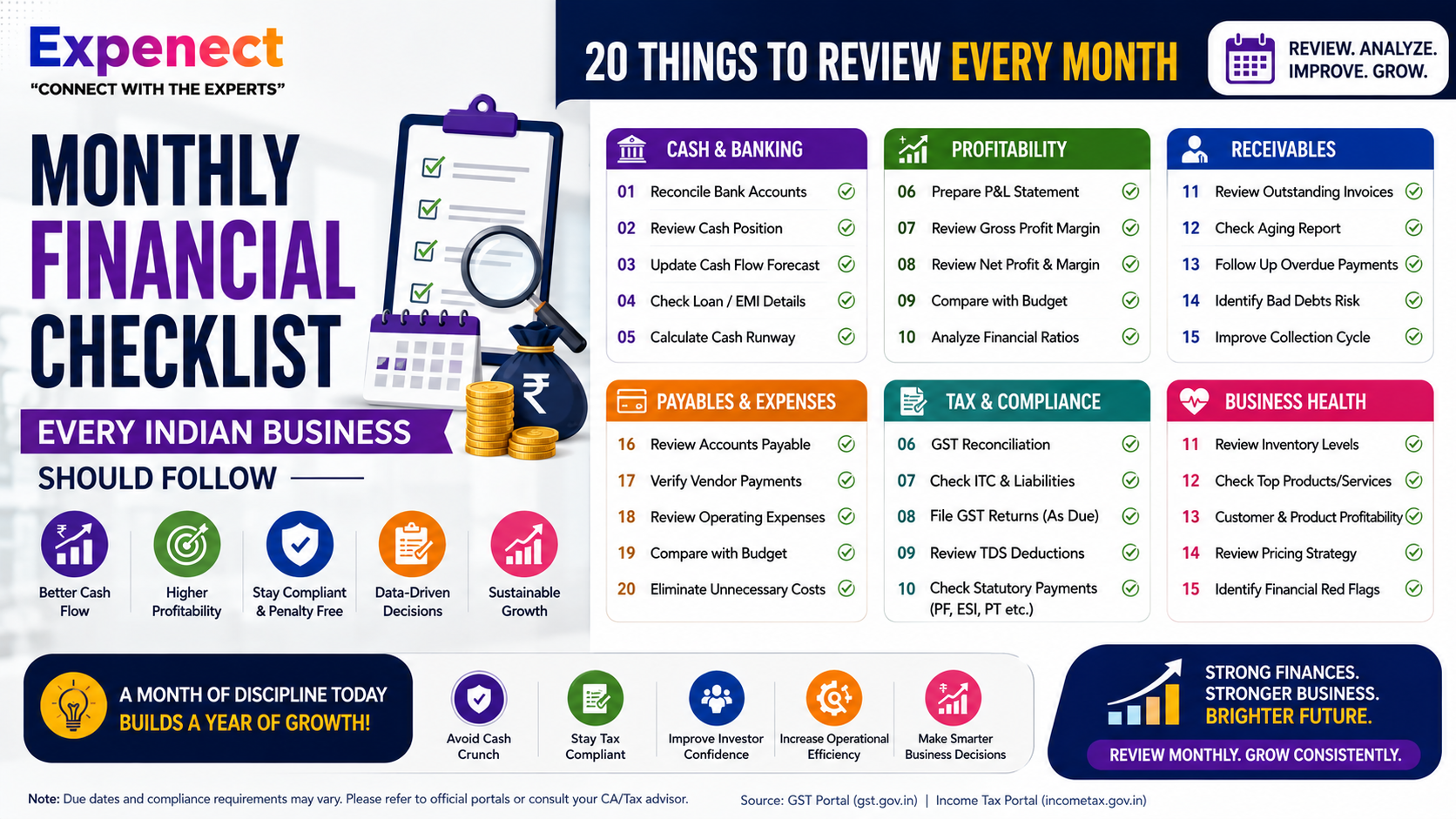
Monthly Financial Checklist Every Indian Business Should Follow
Running a business is not just about generating sales. A financially healthy business needs consistent monitoring of cash flow, expenses, taxes, receivables, payables, payroll, profitability and compliance.
Many entrepreneurs review their finances only at the end of the financial year or when their CA asks for documents. By then, financial problems may already have become difficult or expensive to fix.
A better approach is to perform a monthly financial health check.
Whether you run a startup, MSME, agency, consultancy, manufacturing company, retail business, e-commerce brand or professional service firm, a monthly financial checklist can help you identify problems early and make better decisions.
This guide provides a practical monthly financial checklist for Indian businesses.
Important: Tax and compliance requirements depend on your business structure, turnover, registrations, industry and applicable law. Due dates can also change through notifications. Use this checklist as a management framework and confirm applicable deadlines with your CA/CS or the relevant government portal.
Why Should Businesses Review Their Finances Every Month?
Imagine discovering in March that your business has been losing money since July.
By then, you have already lost eight months.
Monthly financial reviews help you identify:
- Declining profit margins
- Cash-flow problems
- Unpaid customer invoices
- Excessive expenses
- Tax liabilities
- Inventory problems
- Increasing debt
- Payroll issues
- Compliance gaps
- Unprofitable products or customers
The objective isn’t simply to prepare accounts.
The objective is to understand what is happening inside your business before it becomes a serious problem.
The Complete Monthly Financial Checklist
Here are the key areas every Indian business should review each month.
1. Reconcile All Bank Accounts
Start the month-end review by comparing your accounting records with your actual bank transactions.
Check:
- Business bank accounts
- Current accounts
- Savings accounts used for business
- Credit cards
- Payment gateway settlements
- UPI collections
- Loans and overdraft accounts
Look for:
- Missing transactions
- Duplicate entries
- Unidentified payments
- Bank charges
- Failed transactions
- Unrecorded receipts
Why it matters
A bank reconciliation helps ensure that your accounting records accurately reflect the money actually moving through your business.
2. Review Your Cash Position
Ask a simple question:
How much cash does my business actually have today?
Prepare a summary of:
- Bank balance
- Cash in hand
- Expected customer collections
- Upcoming supplier payments
- Salaries
- Taxes
- EMIs
- Other major obligations
Don’t confuse profit with cash.
A profitable business can still face a cash shortage if customers haven’t paid their invoices.
3. Prepare a Monthly Profit & Loss Statement
Your monthly P&L should show:
Revenue – Direct Costs – Operating Expenses = Profit
Track at least:
- Revenue
- Cost of goods/services
- Gross profit
- Employee costs
- Rent
- Marketing
- Technology
- Professional fees
- Interest
- Depreciation
- Net profit
Then compare the current month with:
- Previous month
- Same month last year
- Budget
- Forecast
This allows you to identify trends instead of looking at one month’s numbers in isolation.
4. Calculate Your Gross Profit Margin
Revenue alone doesn’t tell you whether your business is healthy.
For example:
Business A
Revenue: ₹50 lakh
Gross Profit: ₹10 lakh
Gross Margin = 20%
Business B
Revenue: ₹30 lakh
Gross Profit: ₹12 lakh
Gross Margin = 40%
Business B generates less revenue but may have a stronger underlying economics.
Track your gross margin every month and investigate significant changes.
5. Review Net Profit
Next, calculate your net profitability.
Monitor:
- Net profit
- Net profit margin
- EBITDA, where relevant
- Profit before tax
- Profit after tax
If revenue is increasing but profit is declining, investigate why.
Possible reasons include:
- Rising salaries
- Higher advertising costs
- Discounting
- Increasing vendor costs
- Higher rent
- Poor pricing
- Operational inefficiencies
6. Review Accounts Receivable
Accounts receivable represents money customers owe your business.
Prepare an ageing report showing invoices such as:
| Age | Action |
|---|---|
| 0–30 days | Normal follow-up |
| 31–60 days | Follow-up required |
| 61–90 days | Strong collection action |
| 90+ days | Immediate attention |
Don’t just track total receivables.
Track how long customers are taking to pay.
A ₹20 lakh receivable balance isn’t necessarily healthy if most of it is overdue.
7. Follow Up on Outstanding Payments
Create a monthly collection process.
For overdue customers:
- Send an automated reminder.
- Contact the accounts department.
- Confirm the invoice was received.
- Resolve disputes quickly.
- Request a specific payment date.
- Escalate significantly overdue accounts.
Improving collections can sometimes improve cash flow faster than increasing sales.
8. Review Accounts Payable
Now review the money your business owes to suppliers and service providers.
Check:
- Vendor invoices
- Payment due dates
- Outstanding balances
- Credit terms
- Disputed invoices
- Upcoming large payments
Good payable management helps you maintain healthy supplier relationships without unnecessarily paying early when cash is needed elsewhere.
9. Review GST Compliance
If your business is registered under GST, include GST reconciliation in your monthly financial process.
Depending on your filing frequency and registration, review:
- Sales invoices
- Purchase invoices
- Output GST
- Input Tax Credit
- Credit/debit notes
- GSTR-1
- GSTR-3B
- GSTR-2B
- E-invoices, where applicable
- E-way bills, where applicable
For monthly GSTR-1 filers, the standard due date is generally the 11th of the following month, while GSTR-1A can be used, where applicable, to amend/add records before GSTR-3B is filed.
Businesses using the QRMP scheme have different filing/payment schedules. GST guidance states that eligible taxpayers with aggregate turnover up to ₹5 crore can use QRMP, subject to the scheme’s conditions.
Important
Don’t wait until the GST filing deadline to discover that your sales register doesn’t match your books.
Perform the reconciliation during your monthly close.
10. Check Input Tax Credit
If you’re eligible for Input Tax Credit, reconcile your purchase records with the relevant GST data.
Check for:
- Missing invoices
- Incorrect GSTIN
- Wrong tax amounts
- Duplicate invoices
- Vendor filing issues
- Credit notes
Your accounting records and GST data should be consistent.
11. Review TDS
If your business deducts TDS, check all applicable transactions.
Common areas include:
- Salaries
- Professional fees
- Contractor payments
- Rent
- Commission
- Interest
- Other applicable payments
For many regular TDS obligations, tax deducted during a month is generally deposited by the 7th of the following month, with specific exceptions.
Since India’s tax framework transitioned to the Income Tax Act, 2025 from 1 April 2026, businesses should ensure their accounting and TDS systems use the applicable provisions and updated section references for transactions occurring from that date.
12. Review Payroll
Payroll should be reviewed every month.
Check:
- Employee salaries
- Attendance
- Bonuses
- Incentives
- Overtime
- Salary deductions
- TDS
- PF
- ESI, where applicable
- Professional tax, where applicable
- Salary advances
Make sure payroll records agree with the accounting system.
13. Check EPF and ESI Compliance
If your business is covered by applicable social-security requirements, review statutory contributions every month.
EPFO guidance states that employer PF contributions are generally required to be remitted on or before the 15th of the following month.
Don’t simply check whether the payment was made.
Also verify:
- Employee details
- Wage data
- Contribution calculations
- New employees
- Employees who left
- ECR/payment records
14. Review Business Expenses
Go through every major expense category.
Check:
- Office rent
- Salaries
- Marketing
- Software
- Travel
- Utilities
- Professional fees
- Logistics
- Insurance
- Repairs
- Subscriptions
Ask:
“Is this expense generating enough business value?”
Cancel unused subscriptions and identify unnecessary recurring expenses.
15. Compare Actual Expenses With Your Budget
A budget is useful only if you compare it against actual performance.
For example:
| Expense | Budget | Actual | Difference |
|---|---|---|---|
| Marketing | ₹2,00,000 | ₹2,40,000 | +₹40,000 |
| Salaries | ₹5,00,000 | ₹5,10,000 | +₹10,000 |
| Software | ₹50,000 | ₹35,000 | -₹15,000 |
| Travel | ₹75,000 | ₹1,20,000 | +₹45,000 |
Large differences should be investigated.
16. Review Inventory
For businesses that sell physical products, inventory can consume a significant amount of working capital.
Review:
- Opening inventory
- Purchases
- Sales
- Closing inventory
- Slow-moving products
- Damaged goods
- Expired products
- Dead stock
Ask:
“How much cash is currently sitting in inventory?”
Reducing unnecessary inventory can release cash for business operations.
17. Calculate Your Working Capital
Working capital gives you an idea of your short-term financial position.
A simple formula is:
Working Capital = Current Assets – Current Liabilities
Monitor:
- Receivables
- Inventory
- Bank balances
- Payables
- Short-term loans
- Other current liabilities
A business growing rapidly can actually experience greater working-capital pressure because it needs more cash to support that growth.
18. Review Business Loans and EMIs
If your business has loans, review:
- Outstanding principal
- Interest rate
- EMI
- Remaining tenure
- Prepayment options
- Upcoming payments
Don’t take additional debt simply because your business qualifies for it.
Ask:
“Will this borrowing generate enough return to justify its cost?”
19. Calculate Your Cash Runway
This is particularly important for startups.
A simple calculation is:
Cash Runway = Available Cash ÷ Average Monthly Cash Burn
For example:
Available cash = ₹60 lakh
Average monthly burn = ₹10 lakh
Estimated runway = 6 months
This tells you how long your business can continue operating at the current burn rate if additional cash doesn’t come in.
20. Review Customer and Product Profitability
Revenue isn’t everything.
A customer generating ₹10 lakh in sales may be less profitable than one generating ₹5 lakh.
Analyze:
- Revenue per customer
- Gross margin
- Customer acquisition cost
- Support costs
- Discounts
- Payment collection time
For product businesses, review profitability by SKU or product category where practical.
This can reveal which customers and products actually contribute to your bottom line.
21. Review Pricing
Your costs may change every year.
Suppliers increase prices.
Salaries increase.
Advertising becomes more expensive.
Software subscriptions increase.
If your pricing stays unchanged, your margins may gradually disappear.
Review:
- Product pricing
- Service pricing
- Discounts
- Vendor costs
- Gross margins
At least once a month, identify products or services where margins have deteriorated significantly.
22. Check Recurring Subscriptions
Businesses often accumulate dozens of subscriptions.
Review:
- SaaS tools
- CRM
- Accounting software
- Cloud storage
- Design tools
- Marketing platforms
- Communication tools
- Website services
Ask:
“Did we actually use this during the last 30 days?”
Cancel what you don’t need.
23. Review Financial Ratios
You don’t need dozens of complicated financial ratios.
Start with a few important ones:
Gross Profit Margin
Gross Profit ÷ Revenue × 100
Net Profit Margin
Net Profit ÷ Revenue × 100
Current Ratio
Current Assets ÷ Current Liabilities
Receivable Days
Measures how quickly customers pay.
Inventory Turnover
Measures how efficiently inventory is being sold.
Debt-to-Equity
Helps understand financial leverage.
The right benchmark varies by industry, so don’t compare your business blindly with another sector.
24. Update Your Cash Flow Forecast
At the end of every month, create or update a 90-day cash flow forecast.
Include:
Expected Cash Inflows
- Customer collections
- New sales
- Loans
- Investments
- Other income
Expected Cash Outflows
- Salaries
- Rent
- Suppliers
- Taxes
- Marketing
- EMIs
- Capital expenditure
This gives you visibility into potential cash shortages before they happen.
25. Check for Financial Red Flags
At the end of every month, ask:
- Are sales falling?
- Is profit margin declining?
- Are customers paying late?
- Is debt increasing?
- Is inventory increasing faster than sales?
- Are expenses growing faster than revenue?
- Is cash balance declining?
- Are taxes unpaid?
- Are suppliers demanding faster payments?
- Are we repeatedly using short-term borrowing?
If several answers are “Yes,” investigate immediately.
A Simple Monthly Financial Closing Process
You can organize your monthly review into four stages.
Days 1–5: Collect Data
Gather:
- Sales invoices
- Purchase invoices
- Bank statements
- Expense bills
- Payroll information
- Inventory data
- Payment gateway reports
Days 6–10: Reconcile
Complete:
- Bank reconciliation
- GST reconciliation
- Payment gateway reconciliation
- Customer receivables
- Vendor payables
Days 11–15: Analyze
Prepare:
- P&L
- Balance Sheet
- Cash Flow
- Budget vs actual
- Receivables ageing
- Payables ageing
- Key financial ratios
Days 16–20: Take Action
Decide:
- Which expenses to reduce?
- Which customers require collection follow-up?
- Whether pricing needs adjustment?
- Whether inventory needs reduction?
- Whether additional funding is required?
- Whether hiring should be delayed or accelerated?
The important point is:
Don’t just prepare reports. Take action based on them.
Monthly Financial Dashboard Every Business Owner Should Have
A simple dashboard can include:
| Metric | Current Month | Previous Month | Target |
|---|---|---|---|
| Revenue | ₹ | ₹ | ₹ |
| Gross Profit | ₹ | ₹ | ₹ |
| Gross Margin | % | % | % |
| Net Profit | ₹ | ₹ | ₹ |
| Net Margin | % | % | % |
| Cash Balance | ₹ | ₹ | ₹ |
| Receivables | ₹ | ₹ | ₹ |
| Payables | ₹ | ₹ | ₹ |
| Inventory | ₹ | ₹ | ₹ |
| Monthly Burn | ₹ | ₹ | ₹ |
| Cash Runway | Months | Months | Months |
This dashboard can often give the business owner a much clearer picture than looking at a bank balance alone.
The 10 Numbers Every Business Owner Should Know
If you don’t have time to review everything every day, know these ten numbers every month:
- Total Revenue
- Gross Profit
- Net Profit
- Cash in Bank
- Accounts Receivable
- Accounts Payable
- Monthly Expenses
- Tax Liability
- Debt Outstanding
- Cash Runway
If you understand these numbers, you are already much closer to understanding the financial health of your business.
Monthly Financial Checklist: One-Page Version
Accounting
☐ Bank reconciliation completed
☐ Credit cards reconciled
☐ Sales recorded
☐ Purchases recorded
☐ Expenses recorded
☐ P&L prepared
☐ Balance Sheet reviewed
☐ Cash Flow reviewed
Cash Flow
☐ Cash balance checked
☐ Receivables reviewed
☐ Overdue invoices followed up
☐ Payables reviewed
☐ 90-day cash forecast updated
☐ Emergency reserve reviewed
Tax & Compliance
☐ GST records reconciled
☐ GST returns/payment checked where applicable
☐ Input Tax Credit reviewed
☐ TDS deducted correctly
☐ TDS payment checked
☐ Payroll statutory obligations checked
☐ PF/ESI reviewed where applicable
Business Performance
☐ Revenue compared with previous month
☐ Gross margin reviewed
☐ Net margin reviewed
☐ Expenses compared with budget
☐ Product/service profitability reviewed
☐ Customer profitability reviewed
☐ Pricing reviewed
Management
☐ Financial dashboard updated
☐ Major financial risks identified
☐ Corrective actions assigned
☐ Next month’s budget reviewed
☐ 90-day forecast updated
What Happens If You Don’t Review Your Finances Monthly?
Ignoring financial monitoring can lead to:
Cash Flow Crisis
You may discover too late that customers aren’t paying fast enough.
Tax Problems
Missing or incorrect compliance can create interest, penalties and additional administrative work.
Falling Profitability
Small margin declines can go unnoticed for months.
Excessive Debt
Businesses may borrow money to solve problems that could have been identified earlier.
Poor Business Decisions
Without reliable financial information, decisions become based on assumptions rather than data.
Should You Manage Your Finances Yourself or Hire a Professional?
Small businesses can often handle basic financial monitoring using accounting software and structured processes.
However, professional support becomes increasingly valuable when you have:
- Multiple employees
- Significant GST activity
- Multiple branches
- Complex transactions
- High revenue
- External investors
- Business loans
- International transactions
- Rapid growth
- Multiple business entities
A Chartered Accountant, accountant or Virtual CFO can help transform financial data into actionable business decisions.
Final Thoughts
A monthly financial review doesn’t need to take weeks.
With the right system, business owners can establish a simple monthly routine:
Record → Reconcile → Analyze → Act
The goal isn’t merely to stay compliant.
It’s to understand:
Where is my money coming from?
Where is it going?
Am I actually making money?
Do I have enough cash to operate?
Which areas of my business are growing?
Which areas are losing money?
Businesses that consistently answer these questions are better positioned to control costs, manage cash flow, identify risks and make informed growth decisions.
Your financial year may be annual, but your financial management should be monthly.
Frequently Asked Questions
How often should a small business review its finances?
A detailed financial review should ideally be performed every month. Cash position, bank balances and major receivables/payables can be monitored even more frequently.
What financial statements should a business review monthly?
At minimum, review the Profit & Loss Statement, Balance Sheet and Cash Flow Statement. Businesses should also review receivables, payables and relevant compliance reports.
Should GST be included in a monthly financial checklist?
Yes. GST-registered businesses should reconcile sales, purchases, Input Tax Credit and applicable GST returns as part of their regular financial process.
What is the most important financial metric for a small business?
There isn’t one universal metric. Revenue, gross margin, net profit, cash flow, receivables and working capital should be considered together.
Can a CA manage monthly financial reporting?
Yes. A Chartered Accountant or accounting professional can help with bookkeeping oversight, reconciliations, financial statements, taxation and compliance. A Virtual CFO can additionally provide strategic financial planning and management insights.
Need Help Managing Your Business Finances?
Managing accounting, taxation, GST, compliance and financial planning can become increasingly complicated as your business grows.
Expenect connects businesses with verified Chartered Accountants, accountants, Virtual CFOs and finance professionals across India who can help businesses manage their finances and make better financial decisions.
A monthly financial review isn’t just an accounting exercise—it’s a business-growth tool.